NZD: NZD/USD - Holds Steady Below 0.5500 In A Quiet Session
Nov-26 22:08
The NZD/USD had a range overnight of 0.5469 - 0.5486, Asia is currently trading around 0.5471. The p...
Want to read more?
Find more articles and bullets on these widgets:
Historical bullets
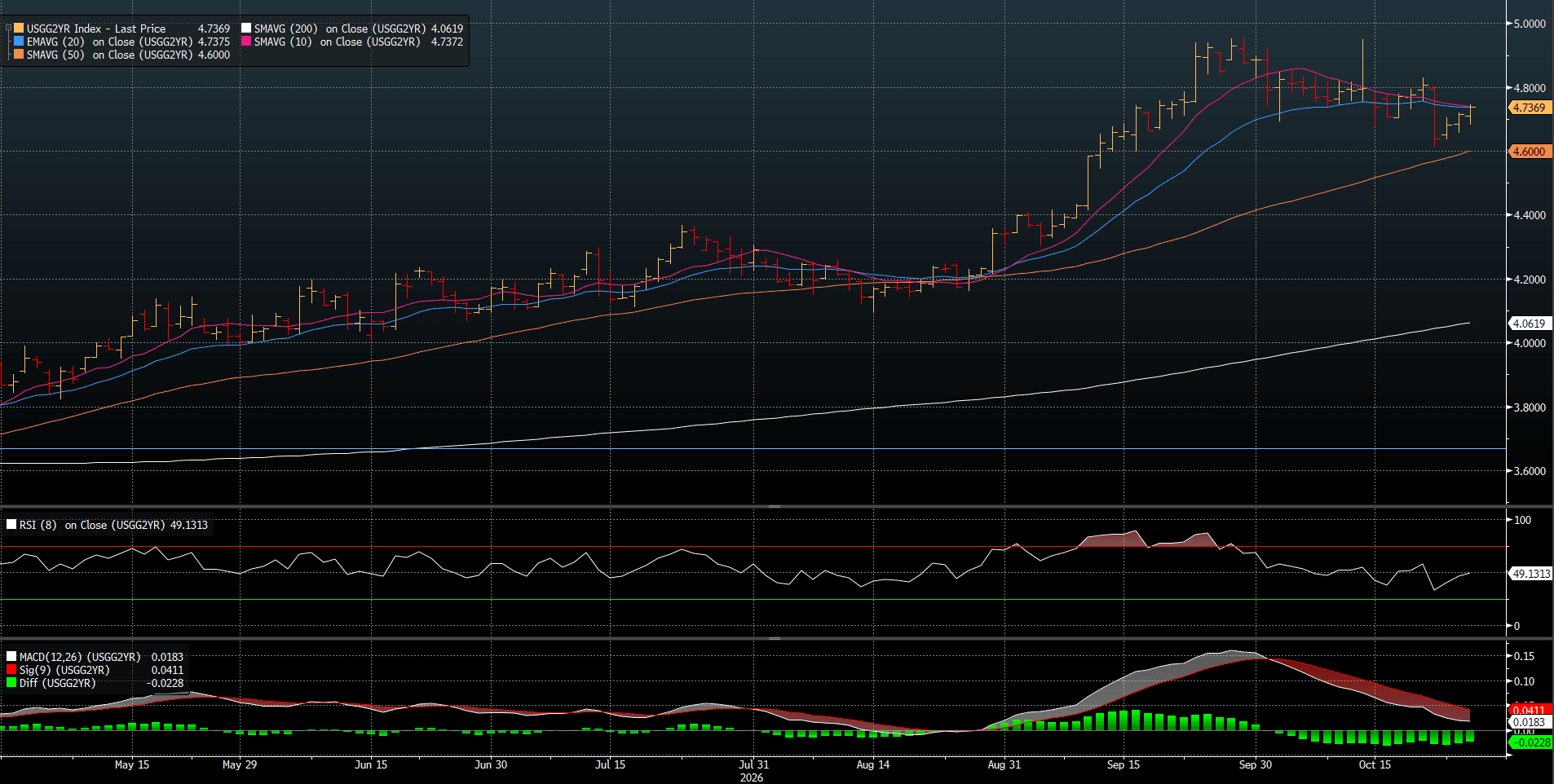
US TSYS: Modest Bear-Flattener Ahead Of FOMC
Oct-27 22:08
TYZ6 is dealing at 106-02, +0-00+ from closing levels in today's Asia-Pac session.
- Cash bonds finished showing a modest bear-flattening, with benchmark yields 1-2bps higher, in the lead-up to Wednesday's busy central bank release schedule with RBNZ, BOC and FOMC announcing (ECB on Thursday and BOJ on Friday).
- Current Fed rate hike projections vs. Monday levels (*) look flat through year end, Q1 '27 firmer: Oct'26 at +1.9bp (+2.8bp), Dec'26 +22.4bp (+22.8bp), Jan'27 +32.5bp (+31.9bp), Mar'27 50.3bp (+48.2bp).
- Rates generally reacted positively to weaker crude prices amid modest optimism around US-Iran negotiations, even as Iran's hardline demands appear to remain intact. Houthi attacks on Saudi Arabia continue, with the group claiming a hit on Ras Tanura infrastructure today.
- ADP employment increased an average 16.75k per week across the four weeks to Oct 10, easing slightly further from the downward revised 17.5k (initial 18.5k) the week prior having hit 26k the week before that for its fastest since early June.
- Headline Confidence index jumped to 91.7 (81.0 expected) from 84.2, with Present Situation up to 120.4 (107.9 expected) from 111.8 and Expectations at 72.6 (62.0 expected) from 65.7, with all three also seeing upward revisions to September's readings.
Bloomberg Finance LP
OIL: Crude Continues Downtrend On Diplomacy Hopes, Nothing Concrete Yet Though
Oct-27 21:58
Oil continued to trend lower on hopes that increased diplomatic interactions in the Middle East will allow for free shipping of energy exports. However, there has only been talk without any concrete developments or even statements, which are needed before there is a decisive move below $100.
- Brent fell 1.5% to $114.07/bbl off the intraday low at $113.35. It rose to $116.95 early in European trading, still below Friday’s high at $117.45. A bullish trend remains intact with initial resistance at $117.69. The 20-day EMA at $107.01 is support.
- WTI is down 1.5% to $100.20 after falling below $100 a number of times but the break couldn’t be sustained. Initial support is at $95.31, 20-day EMA. Initial resistance is at $103.92, 23 October high.
- The risk of a resumption of hostilities after the US mid-term elections remains high but is likely to depend on the outcome of Tuesday’s Israeli elections, which exit polls currently have opposition leader Eisenkot in the lead but without a majority.
- Defence leaders from Saudi Arabia, Turkey and Pakistan met with Pezeshkian and Iran’s Security boss in Tehran yesterday. The group agreed to further talks. Iran also said that it is open to the US’ proposal to open the Strait of Hormuz in exchange for ending the blockade of Iran within 7 days - if its conditions are met.
- Pezeshkian and Russian President Putin met on Tuesday at an energy summit in Moscow, according to Bloomberg, and Iran’s semi-official Tasnim news reported increased “cooperation among sanctioned nations”.
- Bloomberg reported a US oil inventory draw down of 2.03mn barrels when a small build had been expected, according to those familiar with the API data. The decline in crude along with the rise in product stocks suggest a pickup in refining. Gasoline rose 2.39mn and distillate 420k. The official EIA data is out Wednesday.
NEW ZEALAND: {NZ} "*NZ SEPT. FILLED JOBS RISE 0.3% M/M
Oct-27 21:47
{NZ} "*NZ SEPT. FILLED JOBS RISE 0.3% M/M
*NZ SEPT. FILLED JOBS 2.363M" - BBG
(prior 0.2%m/m)


