IRAN: NYTimes: Trump Meets With Top Advisers as He Weighs a Major Escalation
NYTimes: "President Trump was meeting on Friday with top advisers and senior members of his cabinet ...
Want to read more?
Find more articles and bullets on these widgets:
Historical bullets
BOC: Governing Council's Policy Dilemma Lessened By Pullback In Oil Prices
The Summary of Deliberations for the June BOC meeting (link) released Wednesday contains, as usual, few major revelations about Governing Council's thinking at the time of the decision. The latest edition does read especially stale, however, with the meeting being held before the US-Iran ceasefire memorandum agreement. Indeed, with Gov Macklem's comments the day prior to the deliberations' release, it's clear the BOC currently sees the de-escalation in the Middle East as mitigating upside risks to inflation.
- Compare that with the opening of the deliberations: "The conflict in the Middle East was in its fourth month, and its impact on the global economy had increased. Higher energy prices had pushed up inflation worldwide and global growth looked to have slowed".
- Since then, front crude oil prices have come down 22% to nearly pre-war levels. Indeed, one of the scenarios they depicted was if "the ceasefire continued and some arrangement was worked out to allow the Strait of Hormuz to reopen but, in the absence of a peace agreement, uncertainty remained elevated. If that happened, members agreed there could be some easing in oil prices from current highs, but oil would likely continue to trade above pre-war levels." That remains to be seen but as it stands, prices are only slightly higher (WTI $70/bbl vs $65/bbl in late February).
- On incoming economic data to that point, despite volatility in GDP and labour market readings in particular, "members agreed that, taken together, the economic data suggested that not a great deal had changed since the Council’s last decision in April."
- And we had confirmation from Macklem's subsequent comments that the upside surprise in May's headline CPI to 3.2% is being looked through, with the BOC already having expected it to rise to around 3%.
- The deliberations noted the dilemma mentioned in the post-meeting communications: "In responding to the rise in inflation, Governing Council did not want to overreact, but nor did it want to be too slow to respond. If the Bank were to raise rates to combat higher inflation and oil prices came back down quickly, by the time higher interest rates were affecting the economy, they would not be needed. But if higher oil prices persisted and spread, and the Bank held the policy rate for too long, the eventual monetary policy response would have to be more aggressive than if it had acted earlier."
- In conclusion, with uncertainty "unusually elevated" , Governing Council "agreed it was important to reiterate the different possible paths for monetary policy. If the United States imposes new trade restrictions, the policy interest rate may need to be cut to support growth. Alternatively, if the conflict in the Middle East continues and higher energy prices lead to ongoing generalized inflation, consecutive increases in the policy rate may be warranted. It is also possible that both risks could materialize at the same time. Monetary policy will need to remain nimble." Again, this was a repeat of the meeting communications.
- Market rate expectations were little changed from pre-deliberations release, pointing to 13bp of cumulative tightening by year-end, vs about 27bp after the BOC's June meeting.
ECB: Croatia's Zigman: Oil Price Drop A Positive Development For Inflation Fight
In his first public commentary since being confirmed on June 19 as Croatia's new central bank governor (and thus ECB Governing Council member), Ante Zigman said on Croatian TV Wednesday that the recent fall in oil prices will help keep inflation contained.
- As quoted by Bloomberg: "We have to pay attention to the stability of prices...geopolitical developments that are tied to the opening of the Strait of Hormuz resulted in the fall of oil prices. That will surely have a positive effect on inflation.”
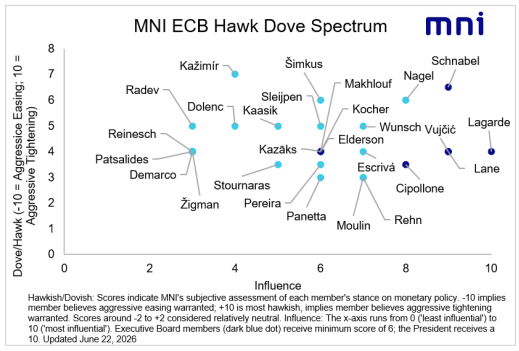
- In our latest comprehensive overview of ECB speak (since the June 11 decision), we characterized Zigman as relatively neutral on the Hawk/Dove spectrum, with his monetary policy leanings still relatively unknown.
- However some of his initial comments suggest that perhaps he leans a little on the cautious side when it comes to tamping down price pressures: “As an economist who grew up in times of hyperinflation in Croatia, that definitely left an impression on me that one must be cautious with inflation, that one must act on time to prevent it from affecting the most vulnerable."
- Zigman replaced Boris Vujcic, who became ECB Vice President this month (replacing de Guindos); Vujcic was close to the neural zone of the ECB Hawk-Dove spectrum as well of late, though historically adopted a slightly more hawkish stance. As such perhaps this will end up being a like-for-like swap.
EURGBP TECHS: Pierces Key Support
- RES 4: 0.8747 76.4% retracement of the Feb 27 - Mar 16 bear leg
- RES 3: 0.8742 High Mar 31 and Apr 1 and a bull trigger
- RES 2: 0.8731 High May 18
- RES 1: 0.8656/94 50-day EMA / High Jun 22
- PRICE: 0.8624 @ 17:10 BST Jun 24
- SUP 1: 0.8610/03 Low Mar 16 and the bear trigger / Low Jun 24
- SUP 2: 0.8597 Low Aug 14 ‘25
- SUP 3: 0.8577 Low Jul 2 ‘25
- SUP 4: 0.8544 50.0% retrace of the Dec 19 ‘24 - Nov 14 ‘25 bull leg
A sharp sell-off this week in EURGBP highlights a bearish threat and the cross maintains a softer tone . Note that moving average studies are in a bear-mode position and this also continues to highlight dominant downtrend. Sights are on the key support and bear trigger at 0.8610 (pierced), the Mar 16 low. A clear break of this level would highlight an important medium-term bearish development. Key short-term resistance is 0.8694, the Jun 22 high.


