FED: Monetary Policy Still Well Positioned - Williams
Apr-16 13:30
NY Fed’s Williams (voter, leaning dove) has continued to describe monetary policy as well positioned in a speech (link). The ongoing uncertainty stemming from the Middle East conflict sees a reluctance to provide further guidance from a permanent voting member who pre-war saw further rate cuts as warranted.
- "This is an unusual set of circumstances, but the current stance of monetary policy is well positioned to balance the risks to our maximum employment and price stability goals,"
- Higher tariffs have contributed between 0.5-0.75pps to PCE inflation, at 2.8% in February ahead of the war, and should begin to wane over the next few quarters.
- If the conflict ceases and energy supply disruptions ease "reasonably soon," energy prices should come down, and the higher energy prices seen in March and April should partially reverse later this year.
- If not, the war could result in a large supply shock with pronounced effects that simultaneously raises inflation through a surge in intermediate costs and commodity prices and dampens economic activity, Williams said, noting increasing supply disruptions related to energy and related goods.
- "This has begun to play out already. While the data have not pointed to significant broad-based supply-chain bottlenecks yet, we are seeing increasing disruptions related to the supply of energy and related goods. Not only are elevated energy prices showing up in the rising cost of fuel, but there are also pass-through costs in the form of higher airfares, groceries, fertilizer, and other consumer products.”
- However: “There are still no signs of significant second-round effects from tariffs spilling over to the rest of the economy. Underlying inflation excluding imported goods has been moving in the right direction.”
- Mixed labor market: "It’s a reasonably good labor market if you have steady employment. But in a low-hire, low-fire labor market, it’s not so good if you are looking for a job or worried you may need one soon." Following in Q&A, he adds that he doesn’t think AI is the cause of a weaker US labor market last year.
Want to read more?
Find more articles and bullets on these widgets:
Historical bullets
EQUITIES: US Cash Opening Calls
Mar-17 13:25
SPX: 6,745.4 (+0.7%); DJIA: 47,284 (+0.7%/+338pts); NDX: 24,826.4 (+0.7%).
PIPELINE: Corporate Bond Roundup: Augusta SpinCo - Becton-Dickinson Spin-Off
Mar-17 13:20
- Date $MM Issuer (Priced *, Launch #)
- 03/17 $1.25B #NWB 5Y SOFR+37
- 03/17 $500M Infinity Natural Resources 5NC2
- 03/17 $Benchmark Sydney Airport 10Y +130a
- 03/17 $Benchmark Bunge 7Y +115a, 10Y +125a
- 03/17 $Benchmark HSBC Perp NC5.5 7.125%a, NC 10 7.375%a
- 03/17 $Benchmark Anglo-American Capital 5Y +120a, 7Y +135a, 10Y +145a
- 03/17 $Benchmark Emera US Finance 30.5NC5.25 7%a, 30.5NC10.25 7.25%a
- 03/17 $Benchmark Augusta SpinCo* 1.5Y SOFR, 2Y +85a, 3Y +100a, 5Y +115a, 7Y +125a, 10Y +135a (*created in June 2025 - wholly owned subsidiary of Becton, Dickinson and Company (BD) to facilitate the spin-off and merger of BD’s Biosciences and Diagnostic Solutions businesses with Waters Corporation)
- 03/17 $4B Electronic Arts 7Y term-loan B (TLB) SOFR+350a investor calls, issuance includes 1.531B Euro debt
EURIBOR OPTIONS: Decrease In Put OI Since Feb 26th Centred In U6 and Z6 (2/2)
Mar-17 13:15
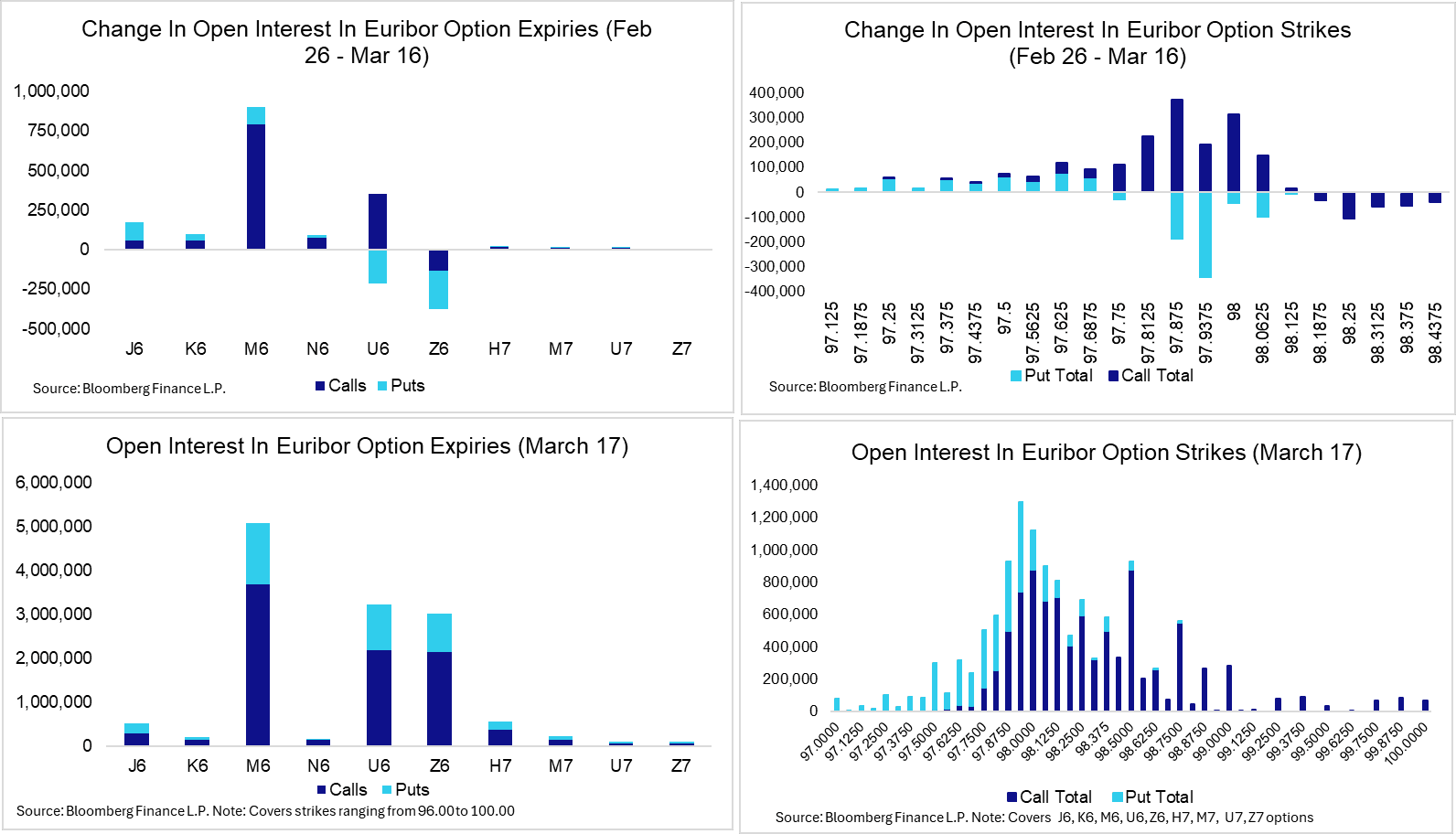
Since February, we estimate a 1.25mln rise in call OI across major expiries and a 150k decrease in put OI.
- The decline in put OI was centred in U6 (-211k) and Z6 (-240k) expiries, specifically the 97.875 and 97.9375 strikes. Puts in these strikes had previously been popular funders for dovish call structures U6 and Z6, so we suspect the decline in OI reflects forced unwinds after outright futures sold off sharply through March. ERU6 is currently at 97.600, down from 97.990 on Feb 26.
- Put OI has increased in J6 (+112k) and M6 (+112K) expiries. Yesterday we saw the ERJ6 97.62/97.50 put spread trade for 3.25 in 21k. This morning has also seen buying interest in the ERK6 97.62/97.50 put spread. If the war persists and energy prices remain elevated, the ECB may choose to deliver a string of rate hikes to contain inflation expectations and affirm credibility around the inflation target. Some analysts suggest this could come as early as April or June.
- On the call side, there’s been a near-800k rise in M6 OI, centred between the 97.8125 – 98.125 strikes. Despite the above, an ECB rate hike is by no means a guarantee, because (i) the war could end soon and (ii) rate hikes and the energy shock are growth-negative. We suspect some participants looked to take advantage of the large decline in outright futures to position for a continued hold: For example on March 10: ERM6 97.87/97.93/98.00 call fly, bought for 2.5 in 20k.
- Z6 call OI has declined by 134k, centred in the 98.25 strike. Rate cuts now appear unlikely (barring an energy-shock driven recession which the ECB is forced to react to). Earlier this month we saw the ERZ6 98.25/98.37 call spread being sold for 1.25 in 90k total – closing a dovish position.