MNI US Macro Weekly: Fed Still Poised For A “Good Debate”

Jul-10 20:43By: Tim Cooper and 1 more...
USFederal Reserve
Hidden PDF
Executive Summary:
- Data received since late June have remained broadly consistent with a resilient economy, with volatile energy prices and their associated inflation implications driving shifts in Fed tightening expectations.
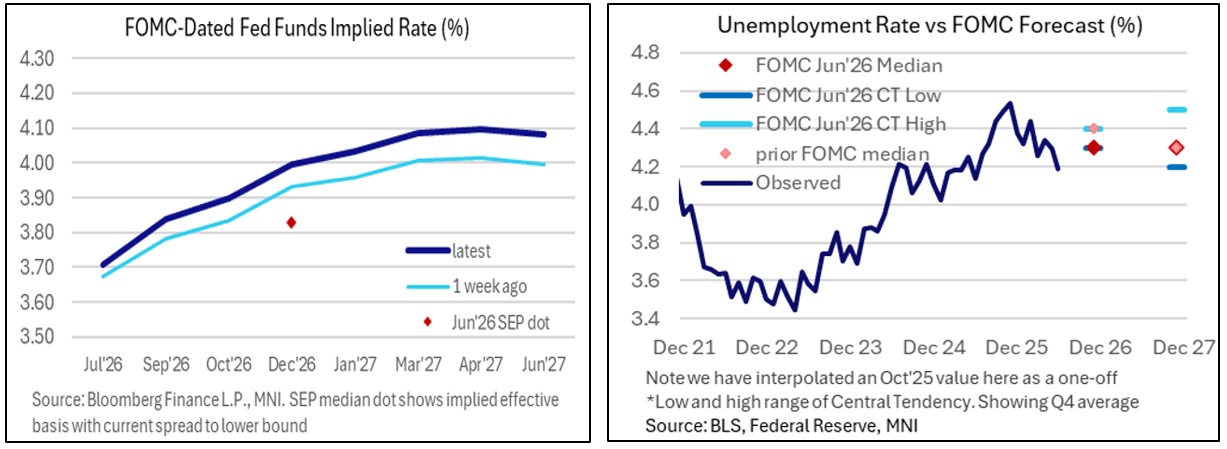
- In the biggest single recent release, June payroll gains disappointed at 57k with a -74k two-month revision. But the labor market still looked solid overall in the first half of the year, and the unemployment rate fell to the lowest since June 2025, even if the dip was in large part a participation story. Meanwhile, other labor indicators remained relatively healthy including weekly claims, and ADP private payrolls.
- Activity indicators were generally expansionary. ISM Manufacturing PMI dipped more than expected but with healthy details, while ISM Services PMI came in exactly in line with expectations.
- Consumption signals remained firm through Q2, with Chicago Fed CARTS and Redbook pointing to strong core June retail sales. Housing remains a soft spot as ever, however, with existing home sales unexpectedly falling and mortgage applications stagnating as rates stayed elevated.
- Overall, Atlanta Fed GDPNow now stands at 1.36% annualized for Q2 but with underlying domestic demand still looking solid at circa 2.9%, with business investment and consumption leading the way.
- That gets us to next week’s key inflation updates. The June CPI report is expected to see the headline index fall on the month as energy prices drop circa 5% in seasonally adjusted terms, while core CPI is expected to maintain a very similar monthly pace to May (MNI analyst median currently 0.21% M/M in June after the same 0.21% M/M in May). June’s PPI and IPPI releases (and PCE implications) are also key.
- While it’s become somewhat more scarce in the Warsh era, Fedspeak has continued to confirm the shift to a more hawkish overall tone, with inflation risks clearly the dominant concern even as oil prices appear past the peak. The June FOMC minutes showed a few members saw a case for a hike at that time, though the Committee remained open-minded on whether the next move should be a hike or a cut.
- In a July 1 appearance, Chair Warsh again avoided forward guidance, saying the July meeting would feature a “good debate”; NY’s Williams saw inflation as far too high but expected it to recede; Gov Waller defended forward guidance as useful with caveats and stressed communicating the reaction function; SF’s Daly continued to see policy as slightly restrictive with two-sided risks; and Cleveland’s Hammack kept an open mind on July while warning hikes may be needed.
- Market-implied pricing saw a large hawkish shift this week after US-Iran re-escalation, with cumulative hike pricing of 37bp through year-end (up from 30bp), and a hike is currently priced by the October meeting.
- As noted, next week’s focus is CPI and PPI, though Warsh’s first semi-annual monetary policy testimony as Chair will be closely watched. The calendar also includes retail sales and a heavy slate of Fed speakers including Bowman, Waller, Barr, Goolsbee, Cook, Williams, Musalem, Logan, Schmid and Jefferson.