MNI US Employment Insight: Weak Jobs Growth vs Low U/E Rate

Aug-07 18:50By: Chris Harrison
EmploymentPayrollsUSFederal Reserve+ 1
Hidden PDF
Executive Summary
The July payrolls report started H2 on the backfoot after a June report that was characterized as ending a mostly solid H1 on a soft note. That’s at least the case with particularly soft payrolls and wage growth although the unemployment rate pressed lower once again to what is now the weakest since Jan 2025. It points to an uneasy balance in the labor market and, ex post, suggests potentially very low breakeven jobs growth. September hike pricing has faded to a little under 50/50 probability although July inflation updates loom large next week, and of course with another August round of both NFP and CPI/PPI reports due before the FOMC decision on Sep 16.
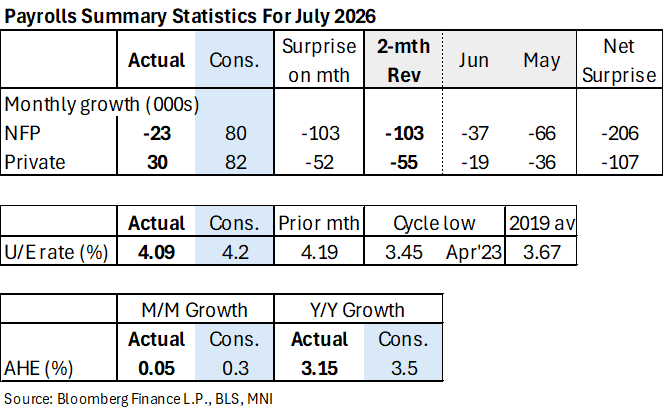
- Nonfarm payroll growth was clearly far weaker than expected in July at -23k (cons 80K) along with a two-month downward revision of -103k (of which -37k in Jun and -66k in May).
- The government played an oversized role (-53k in July and a two-month downward revision of -48k alone), with July weakness dominated by local education roles which could be a seasonal adjustment issue.
- However, private sector hiring was still soft at 30k (cons 82k) with a two-month revision of -55k and non-education & healthcare jobs growth was barely positive over the latest three months.
- Average hourly earnings rounded out a weak establishment survey as they converged closer to trends in the more comprehensive ECI data.
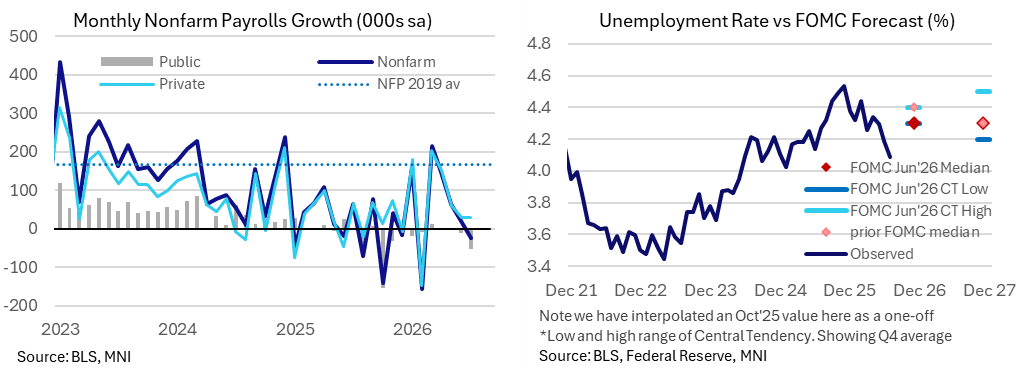
- The household survey was stronger meanwhile with the unemployment rate surprising lower again and now at just 4.09% for its lowest since Jan 2025. It’s further below the 4.3% median FOMC forecast for 4Q26 from back in June.
- There's another supply side caveat to the low unemployment rate, with the participation rate falling to 61.43% (lowest since Feb 2021) from 61.55% in Jun and 61.83% in May, although the pace of the deterioration in labor supply was slower than in June and this time also away from the prime age cohort.
- The low unemployment rate only partly offset weak jobs and wage growth, with September hike pricing fading from 14bp to 11bp. Similarly, cumulative hikes by year-end eased to 29bp from 32.5bp pre-release to extend the decline from 44bp seen before the last July FOMC decision.
- As for other recent labor indicators, a subdued ADP increase of 44k was closer to the 30k for BLS private payrolls than the Revelio entry of 70k (the latter part of the 79k estimate for nonfarm), whilst initial claims continued to show very low firing with a third week below 200k. For slower moving more comprehensive data, JOLTS job openings fell in June but both quit and hire rates nudged higher again from low levels whilst the employment cost index was surprisingly strong but with productivity helping offset this.