MNI US CPI Preview: Payback

Jan-12 20:12By: Tim Cooper and 1 more...
Inflation
Hidden PDF
EXECUTIVE SUMMARY
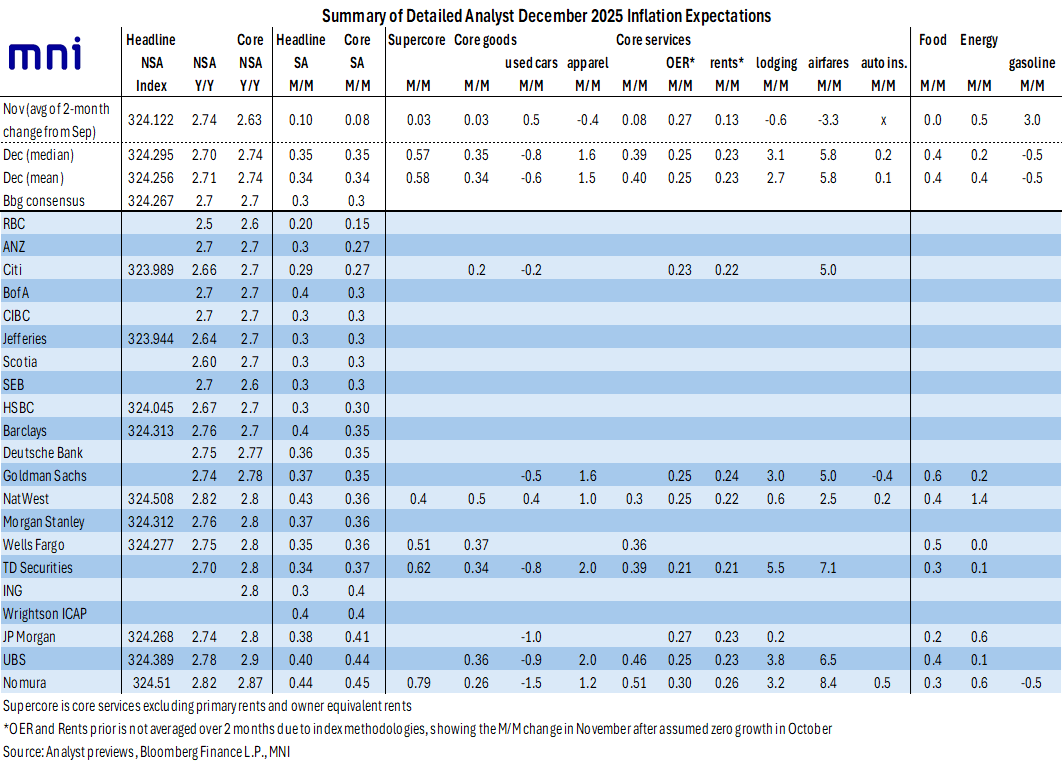
- Consumer price inflation is set to pick up on a sequential basis in December from the suspiciously weak prior price prints, with MNI’s collection of analyst previews suggesting a rise to 0.35% M/M core / 0.37% headline after average monthly increases of 0.08% and 0.10% respectively over November and October.
- However, distortions mean that an inflation acceleration in December shouldn't be taken at face value.
- Few analysts took the shutdown-delayed October/November report either literally or seriously, given the unusual data collection period (incorporating late November holiday discounting in key goods categories) and "carry-forward imputation" due to the cancellation of the October survey.
- One implication is that inflation in several categories is seen accelerating in December in a reflection of a more typical survey period: this includes multiple goods categories (e.g. apparel, recreational goods), as well as travel-related services (e.g. lodging away from home, airfares).
- One category that isn’t expected to see such dramatic “payback” is housing, however a reversion to previous rates of inflation is broadly expected after the BLS assumed inflation in October to be zero.
- All of the above means that reading the details of the report will be even more critical than usual in making any interpretation of the aggregate indices, and any extreme results are likely to be downplayed.
- This will be the last major data report ahead of the Fed’s end-January meeting, but is very unlikely to sway the FOMC from holding rates as is heavily priced (only about 1bp of cuts implied by futures).
- Even if the data are more robust this time, the continued distortions in the December report will probably keep the Committee waiting for the next two CPI reports available by the following meeting on March 17-18 to get a better sense of underlying pressures.
- Indeed some FOMC members have identified the turn-of-the-year price-setting by firms as a key determinant of whether tariff-related inflation is set to be meaningfully passed through.