MNI EUROPEAN MARKETS ANALYSIS: US/Iran Trade Further Strikes
- US and Iran continued to trade strikes, which aided oil, but crude benchmarks remain off Wednesday highs.
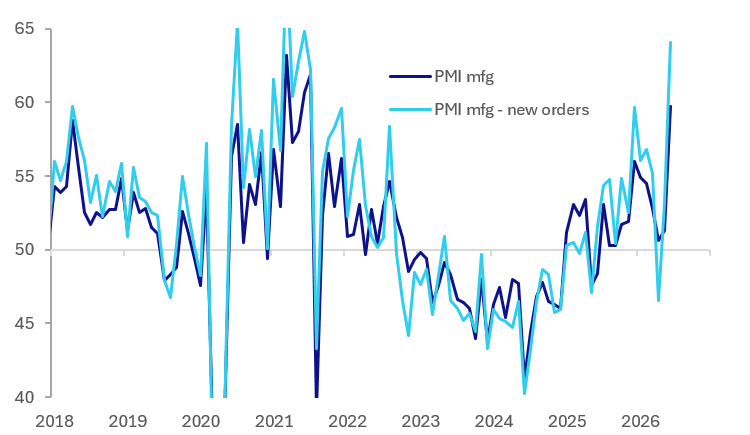
- In NZ, the BNZ manufacturing PMI jumped to 59.7 in June from an upwardly revised 51.3 (from 49.9) in May, the highest since the pandemic-impacted July 2021 and well above its historical average. NZGBs closed sharply cheaper, with benchmark yields 7-14bps higher and the 2/10 curve flatter, while NZD is outperforming in the G10 space.
- Looking ahead, ECB minutes and US jobless claims headline a light calendar on Thursday.
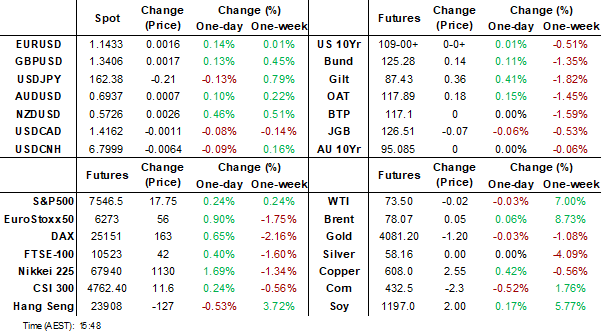
MARKETS
US TSYS: Nudges Lower As Middle East Strikes Continue
TYU6 is dealing at 108-30, -0-02 from closing levels in today's Asia-Pac session.
- Cash bonds are flat to modestly richer, with a steepening bias, in today's Asia-Pac session after finishing yesterday's session 2-4bps cheaper as the markets mulled comments from Pres. Trump that the US/Iran ceasefire was over.
- President Trump spoke with to reporters on board Air Force One earlier today covering a variety of topics. Trump stated he is unsure if Iran will honor a deal (reiterating they want to make a deal badly). Trump also stated that a lot of issues with NATO have been resolved after the meeting today, while Trump stated that Spain had been very generous with honored payments.
- The 2-year yield is back at its recent peak as the rise in the price of oil rekindles inflation fears.
- (Bloomberg) “Solid flows into low-duration bond funds this year aren’t “materially” sapping growth in money-market instruments, says JPMorgan Chase & Co. Assets under management for bond funds that minimize interest-rate risk, deemed “low duration” in the industry, have climbed $55bn or 6% through May, “and that has lifted total balances to $986bn,” JPM strategists Teresa Ho, Pankaj Vohra, and Molly Herkis wrote in a note.”
- ECB minutes and US jobless claims headline an otherwise light calendar today.
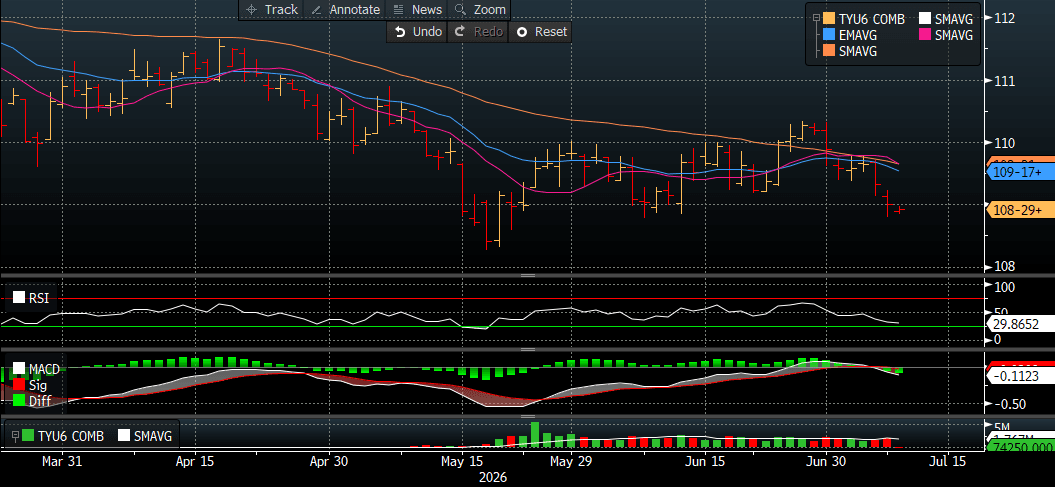
Bloomberg Finance LP
JGBS: Higher Yields Despite Solid 5Y Auction
JGB futures are weaker, -17 compared to settlement levels, hovering just above session cheaps.
- JGBs are holding losses as oil prices rise after the US said it struck Iran for a second day.
- Yields are, however, mostly off session highs after today’s auction of 5-year bonds drew solid demand. The low price met expectations at 99.88, the bid-to-cover ratio edged higher to 3.4327x from 3.2161x and the tail shortened to 0.03 from 0.06.
- The BoJ's Sakura Report left regional assessments unchanged. Export risks have eased, AI-driven capex remains strong, firms continue raising wages and prices, while Middle East-related cost pressures are accelerating price pass-through. Smaller firms continue to face margin pressure. - RTRS
- Cash US tsys are flat to modestly richer, with a steepening bias, in today's Asia-Pac session. The 2-year yield is back at its recent peak as the rise in the price of oil rekindles inflation fears.
- (Bloomberg) “Fixed-income traders are pricing for more central banks to join this week’s interest-rate hike by the RBNZ. Currently rate increases are seen as likely by year-end for the Fed, ECB, BOE, BOJ and two more in New Zealand.”
- Cash JGBs are 1-2bps cheaper across benchmarks.
- Swap rates are 1-6bps higher.
- Tomorrow, the local calendar will see PPI data.
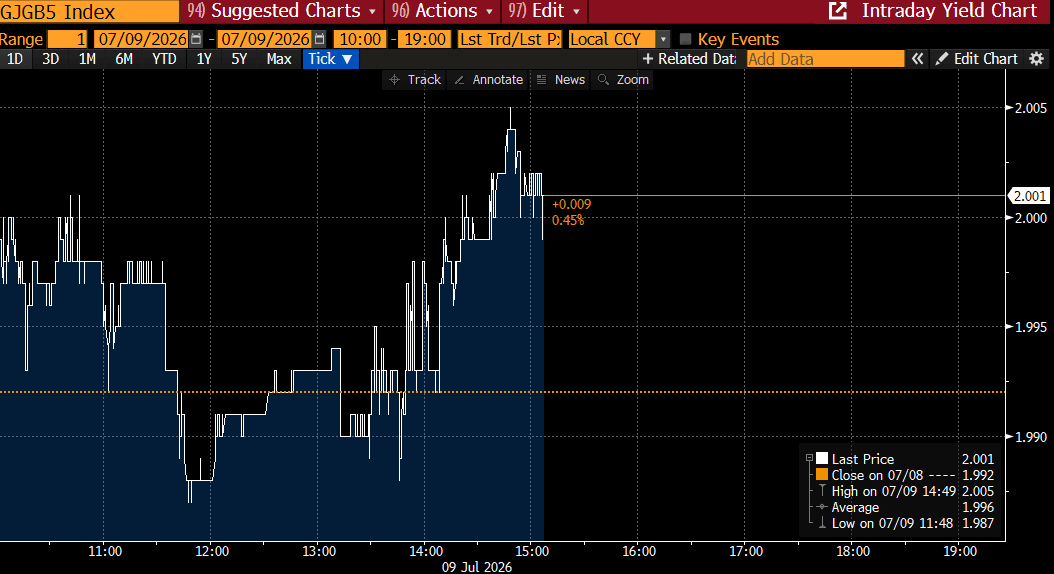
Bloomberg Finance LP
JAPAN DATA: Offshore Flows Muted last Week As Mth/Qtr End Impacted
We did see offshore investors continue with recent trends in the week ending July 3, selling both Japan stocks and bonds. The aggregate outflows were very modest though, with the period covering both month and quarter end, which may have impacted offshore interest/momentum. This week's update may provide a better indication of early Q3 trends, but offshore investors have sold Japan stocks in five out of the last six weeks, while local bonds have been sold for five straight weeks. JGB yields are mostly tracking higher, as resumed oil gains, coupled with uncertainty on whether the BOJ will aim to get ahead of the curve (amidst a weaker yen, more hawkish Fed outlook etc), impacts longer dated tenors.
- In terms of Japan outbound flows, local investors sold offshore bonds for the second straight week. This is not a clear net selling trend though, rather trimming accumulated inflows since the start of Apr/May, which are still positive.
- Local investors did buy offshore stocks for the third straight week. Still, from a cumulative standpoint, net buying for this segment still remains negative in recent months.
Table 1: Japan Weekly Offshore Investment Flows
| Billion Yen | Week ending July 3 | Prior Week |
| Foreign Buying Japan Stocks | -22.2 | -1817.5 |
| Foreign Buying Japan Bonds | -5.9 | -502.3 |
| Japan Buying Foreign Bonds | -218.1 | -277.5 |
| Japan Buying Foreign Stocks | 824.5 | 147.8 |
Source: Bloomberg Finance L.P./MNI
AUSSIE BONDS: Cheaper But Off Worst Levels, ME Headlines In Focus
ACGBs (YM -3.5 & XM -2.0) are weaker but well off the session’s worst levels on a data-light day. The local calendar will be empty again tomorrow.
- (AFR) “The International Monetary Fund has downgraded its forecast growth for Australia to 1.9 per cent in 2026, down from its previous forecast of 2 per cent. The RBA and economists say a slowdown in economic growth would be welcomed in the fight against inflation, with high and persistent inflation indicating the economy is out of balance.” – via BBG
- Cash US tsys are flat to modestly richer, showing a steepening bias, in today's Asia-Pac session.
- President Trump spoke with to reporters on board Air Force One earlier today covering a variety of topics. Trump stated he is unsure if Iran will honor a deal (reiterating they want to make a deal badly). Cash ACGBs are 2-3bps cheaper with the AU-US 10-year yield differential at +32bps.
- The bills strip bear-steepened, with pricing -2 to -5 across contracts.
- RBA-dated OIS pricing shows modest tightening across all meetings, with the probability of a 25bp hike rising from 25% for August to 64% by December 2026.
- The AOFM plans to sell A$900mn of the 1.75% 21 November 2032 bond tomorrow.
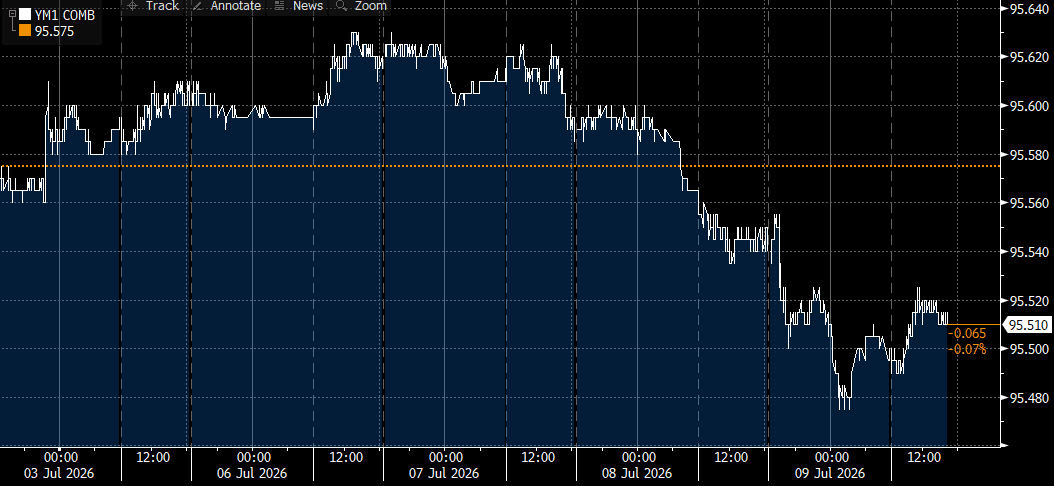
Bloomberg Finance LP
NEW ZEALAND: Manufacturing Activity & Outlook Strong And Its Hiring
The BNZ manufacturing PMI jumped to 59.7 in June from an upwardly revised 51.3 (from 49.9) in May, the highest since the pandemic-impacted July 2021 and well above its historical average. The strong rise was across components with new orders and employment also close to mid-2021 levels. This data release is consistent with the RBNZ’s view that the recovery has been stronger than expected. The timing of future rate hikes, following yesterday's 25bp, will be highly data dependent. The June PMI is a start for building a case for consecutive tightening in September.
NZ BNZ manufacturing PMIs
Source: MNI - Market News/LSEG
- BNZ reports that the number of positive comments exceeded negative with a net 52% outcome. The uncertainty from the Middle East and elevated fuel prices remain problems though. However, it said that there was “a renewed sense of confidence”.
- New orders rose 11 points to 64.1 signalling that global demand has improved and is solid as manufactured goods are tradeable. The RBNZ noted in its press conference that NZ’s recovery has been uneven with exporters doing well while domestic sectors continue to find conditions difficult.
- Manufacturing employment rose to 55.8 from 51.4. The Q2 average at 53.5 was 2.3 points above Q1 despite increased global uncertainty. This is good news for NZ’s lacklustre labour market.
- Output rose to 59.4 from 50.6 in May.
- The June performance of services prints on 13 July and has been underperforming manufacturing in line with domestic sectors struggling compared with exporters.
RBNZ: MNI RBNZ Review-July 2026: More Hikes To Reduce Stimulus
- Download full review Hidden PDF.
- In a unanimous decision, the MPC decided to hike rates 25bp to 2.5%, as expected. It decided that it was “appropriate” to remove some accommodation to return inflation to the 2% band mid-point and prevent further easing in financial conditions.
- Further removal of monetary stimulus is likely but the RBNZ kept its options open regarding timing stating that it would be “highly uncertain” and very data dependent. However, Governor Breman two more hikes before year end were “not not realistic”. This opens the two remaining 2026 Monetary Policy Statement meetings, which include updated staff forecasts, on 2 September and 9 December to further tightening with a possible pause on 28 October.
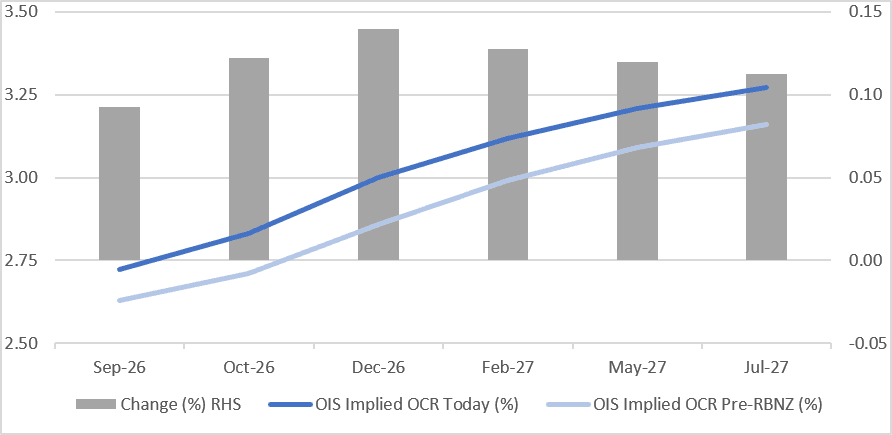
- 62bps of tightening is currently priced for February 2027. Interestingly, pricing remains 7-10bps softer across 2027 meetings versus levels prevailing before the May 27 policy meeting.
MNI Markets Analysis: AUD/NZD Eyeing 1.1900-1.2000 Support
- The AUD/NZD has topped out toward the top-end of its 1.20-1.23 range thanks to the RBNZ delivering yesterday. Strong data this morning is only adding tailwinds to a short NZD market. A retest of the pivotal 1.1900-1.2000 support may materialize at some point. We were last 1.2115/20 for the pair.
- The BNZ manufacturing PMI jumped to 59.7 in June from an upwardly revised 51.3 (from 49.9) in May, the highest since the pandemic-impacted July 2021 and well above its historical average. The strong rise was across components with new orders and employment also close to mid-2021 levels. This reinforces recent trends of NZ data outperforming Australian prints. Such a backdrop could weigh on AU-NZ 2yr swap rate differentials, a potential AUD/NZD headwind.
- Further removal of monetary stimulus is likely but the RBNZ kept its options open regarding timing stating that it would be "highly uncertain" and very data dependent. However, Governor Breman said two more hikes before year end were "not not realistic".
- RBNZ-dated OIS pricing is 9-14bps firmer across meetings following yesterday's 25bp rate hike and today's comments from RBNZ Governor Breman.
See the full piece here at this Hidden PDF.
BONDS: NZGBS: Very Heavy Session After Strong PMI & Gov. Breman Comments
NZGBs closed sharply cheaper, with benchmark yields 7-14bps higher and the 2/10 curve flatter.
- The NZ-US and NZ-AU 10-year yields differentials finished 4bps and 6bps higher, respectively.
- The supply auctions of NZ$275mn of the 1.50% May-31 bond and NZ$175mn of the 4.50% May-35 bond, drew solid to very strong demand. Cover ranged from 3.64x (May-31) to 5.23x (May-35).
- The BNZ manufacturing PMI jumped to 59.7 in June from an upwardly revised 51.3 (from 49.9) in May, the highest since the pandemic-impacted July 2021 and well above its historical average. This data release is consistent with the RBNZ’s view that the recovery has been stronger than expected.
- MNI RBNZ Review-July 2026: More Hikes To Reduce Stimulus (see here): Further removal of monetary stimulus is likely but the RBNZ kept its options open regarding timing stating that it would be "highly uncertain" and very data dependent. However, Governor Breman two more hikes before year end were "not not realistic".
- RBNZ-dated OIS pricing is 9-14bps firmer across meetings following yesterday’s 25bp rate hike and today’s comments from RBNZ Governor Breman.
- 21bps of tightening had been priced going into yesterday’s decision, while February 2027 had been assigned 74bps (49bps excluding yesterday’s hike). 62bps of tightening is currently priced for February 2027.
- Tomorrow, the local calendar will be empty.
Bloomberg Finance LP
FOREX: USD - BBDXY Struggling To Build Momentum Above 1216-1218 For Now
The BBDXY has had a range today of 1219.84 - 1221.24 in the Asia-Pac session; it is currently trading around 1220. The USD tried to bounce off the 1216-1218 support but demand fizzled out and price retraced pretty quickly as risk rebounded overnight. The mess in the Middle-East continues to unfold as the US attacks continued this morning as do the Iranian’s reciprocal strikes. How this ends while the US expects free passage through the Straits and Israel remains in Lebanon is anyone’s guess. I continue to think the market is underpricing the tail risk of a return to an all-out war and even potential boots on the ground. The first support which continues to hold remains 1216-1218 and through here the 1208-1212 area. Having touched the initial target toward the 1225-1230 area, I thought we could see some sort of a pullback but I remain skewed toward fading a dip, looking for a retest of the highs at some point.
- EUR/USD - Asian range 1.1416-1.1430, Asia is currently trading 1.1425. The pair could not break below 1.1400 as risk rebounded overnight. Asian Equities continue to trade heavy in our session though as the Middle-East debacle is the gift that keeps on giving. On the day, I am watching to see if this wobble in risk can help the bid in the USD in tonight's session. I remain skewed in favour of fading rallies with initial resistance toward 1.1430-1.1455 and then the more pivotal 1.1485-1.1525 area, looking for the pair to turn lower again at some point. Can the pair break back below 1.1385-1.1405 again and reassert its trend lower ?
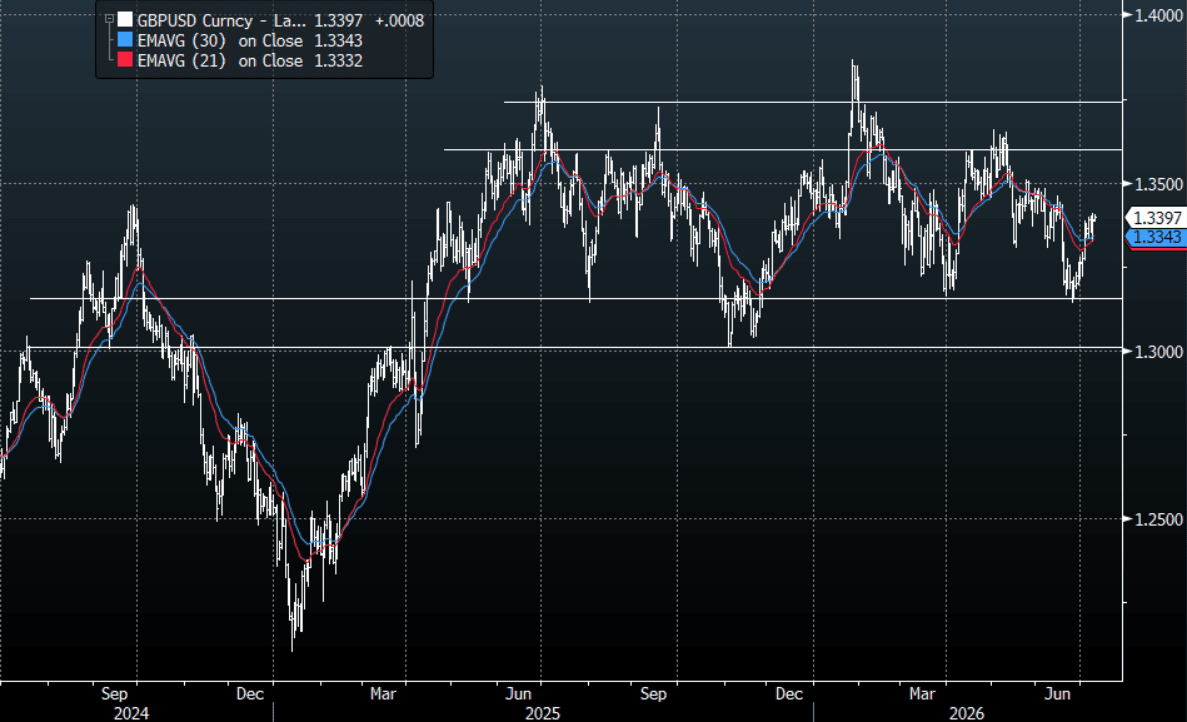
- GBP/USD - Asian range 1.3386-1.3404, Asia is currently dealing around 1.3395. The pair bounced pretty hard yesterday back toward 1.3400. I continue to err on the short-side but I suspect this move lower will need to top out pretty soon to keep the bears in control. On the day, price is challenging some important resistance in the 1.3380-1.3420 area, through here and 1.3500 comes back into play. I am looking for the move to top out somewhere up here and retest the 1.3000-1.3150 area at some point.
- Data: US Weekly Initial Jobless Claims, US June Existing Home Sales
Fig 1: GBP/USD Spot Daily Chart
Source: MNI - Market News/Bloomberg Finance L.P
JPY: USD/JPY-Sits Comfortably Around 162.50, Looking To Challenge The Years High
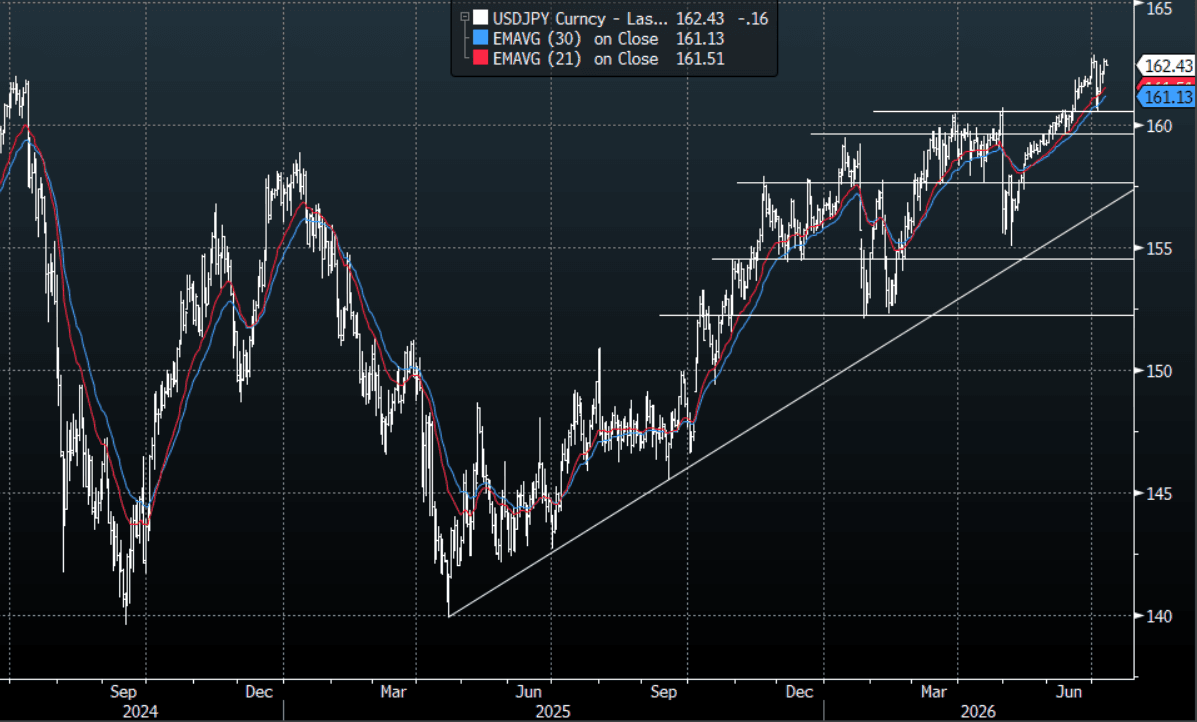
The USD/JPY range today has been 162.36-162.62 in the Asia-Pac session, it is currently trading around 162.45, -0.10%. The pair continues to find demand on dips and has pushed back above 162.00 looking to rechallenge the year's highs toward the 163.00 area. The new strategy of ‘surprise intervention’ has not been enough to slow the consistent addition to short Yen positions. On the day, the first support is toward 161.50 and then the 160.00-160.50 area. The market continues to add to its positions and is again sitting very short Yen as they press the Japanese officials resolve. The underlying story regarding Yen weakness remains the same and core positions are reflecting that, I suspect only a faster rate hiking cycle will probably suffice to break this perpetual loop. Yet comments yesterday from BOJ board member Asada who was the Takaichi administration's first appointment shows they might not have the stomach for that. The market will be watching closely when two hawks, Takata and Tamura finish their terms this month. If their replacements are reflationists similar to Asada the board flipping Dovish would not bode well for the Yen.
- “The BOJ may raise its key rate beyond 2% this cycle, higher than the 1.75% terminal rate most economists expect, according to former BOJ official Tsutomu Watanabe.” - BBG
- Options : Close significant option expiries for NY cut, based on DTCC data: 158.00($1.18b), 160.00($1.5b), 163.00($1.94b). Upcoming Close Strikes : 160.50($3.42b July 13), 163.00($1.61b July 13) - BBG.
- The USD/JPY Average True Range(ATR) for the last 10 Trading days: 68 Points
Fig 1 : USD/JPY Spot Daily Chart
Source: MNI - Market News/Bloomberg Finance L.P
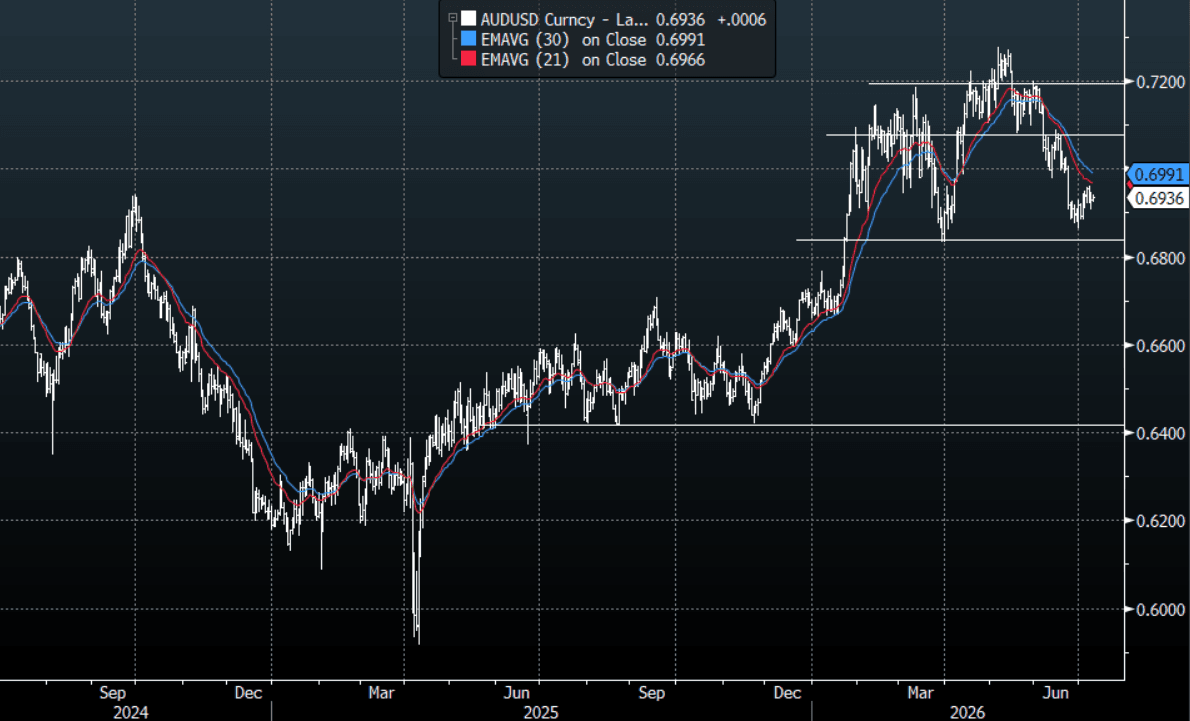
AUD/USD - Treads Water Within A 0.6900-0.6960 Range For Now
The AUD/USD has had a range today of 0.6925-0.6940 in the Asia- Pac session, it is currently trading around 0.6935, +0.05%. The AUD/USD has chopped around without really going anywhere, holding above 0.6900. A solid pullback from US Tech overnight turning back what looked like worrying price action helped risk. The US attacks continue this morning as do the Iranian’s so-called reciprocal strikes. How this ends while the US expects free passage through the Straits and Israel remains in Lebanon is anyone’s guess. I continue to think the market is underpricing the tail risk of a return to an all-out war and even potential boots on the ground. On the day, it looks like we could continue to tread water short-term within 0.6900-0.6960. Watch the support back toward 0.6890-0.6910, this should provide support initially as it did overnight but through here and the market will again turn its focus toward the important 0.6850 area.
- Disclose.tv on X: “White House prepares for extended military exchange with Iran, for control over the Strait of Hormuz, that could stretch for days or several weeks — Axios.”
- MNI - Could China CPI Miss Suggest 'Involution' Is Still a Factor : The decline in CPI could suggest that the excessive, unsustainable competition (known as involution) where aggressive price cuts and thin profit margins occur across various sectors like electric vehicles, technology, and food delivery is not dead yet; a worrying sign for policy makers.
- Options : Closest significant option expiries for NY cut, based on DTCC data: 0.6875(AUD540m), 0.7125(AUD366m). Upcoming Close Strikes : 0.6875(AUD625m July 13), 0.6900(AUD572m July 10), 0.6992(AUD360m July 13) - BBG
- The AUD/USD Average True Range for the last 10 Trading days: 37 Points
Fig 1: AUD/USD spot Daily Chart
Source: MNI - Market News/Bloomberg Finance L.P
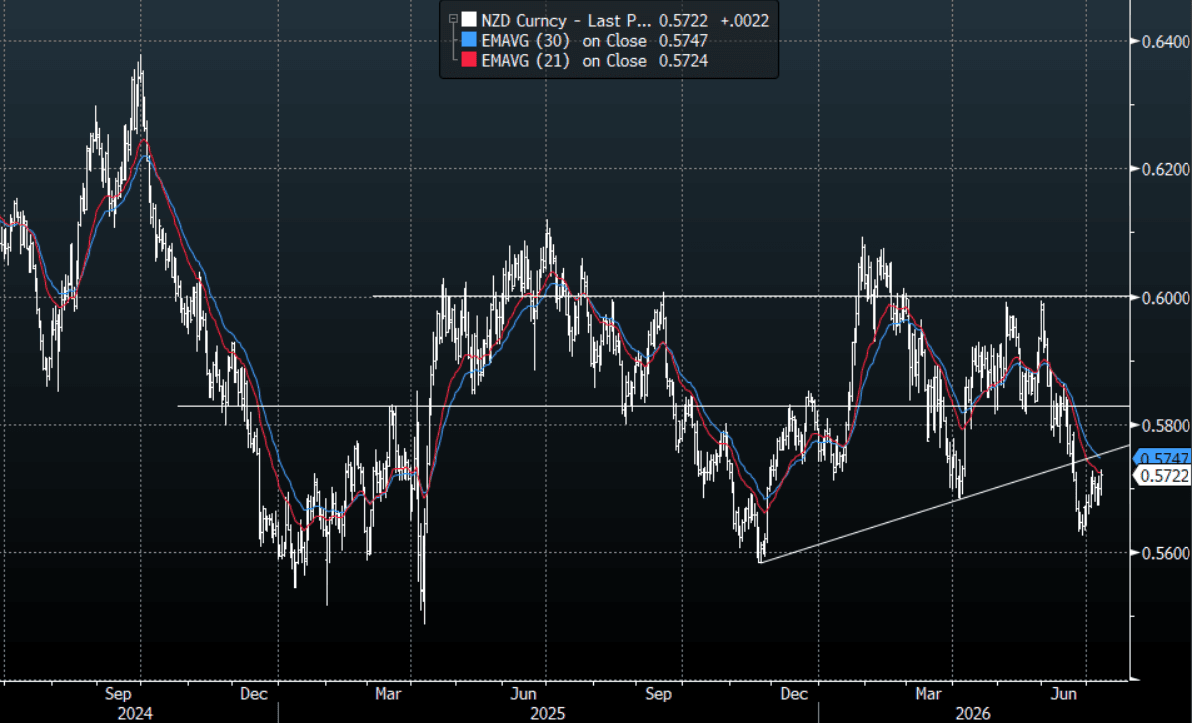
NZD/USD - Challenges 0.5730 Again On Better Data & Breman
The NZD/USD had a range today of 0.5694-0.5729 in the Asia-Pac session; it is currently trading around 0.5720, +0.35%. The NZD has extended above 0.5700 today as better data and Breman add to NZD tailwinds. It has again looked to challenge the 0.5730 area, I suspect the market will also need the US Dollar to turn lower from here for the move to break convincingly back above there. Can the NZD pullback further to test the conviction of a market that is positioned quite short, maybe. I still suspect any decent pullbacks could be faded eventually looking for the move lower to reassert itself at some point. On the day, the first resistance remains toward 0.5730 which continues to hold for now, through here the next level is the 0.5765-0.5815 area which should prove to be a tough ask and I would be skewed toward fading that move on its initial attempt.
- MNI RBNZ Review-July 2026: More Hikes To Reduce Stimulus. Download full review here: https://www.mnimarkets.com/articles/mni-rbnz-review-july-2026-more-hikes-to-reduce-stimulus-1783565297499
- In a unanimous decision, the MPC decided to hike rates 25bp to 2.5%, as expected. It decided that it was "appropriate" to remove some accommodation to return inflation to the 2% band mid-point and prevent further easing in financial conditions.
- Further removal of monetary stimulus is likely but the RBNZ kept its options open regarding timing stating that it would be "highly uncertain" and very data dependent. However, Governor Breman two more hikes before year end were "not not realistic".
- (Bloomberg) - “NZ Two-Year Yield Rises to Near One-Month High on Breman, Oil. New Zealand’s policy-sensitive yields rise to highest in almost a month as a surge in oil prices and RBNZ Governor Anna Breman’s comments reinforce expectations for two more rate hikes this year.”
- Options : Closest significant option expiries for NY cut, based on DTCC data: 0.5650(NZD421m). Upcoming Close Strikes : none - BBG
- The NZD/USD Average True Range for the last 10 Trading days: 40 Points
Fig 1: NZD/USD Spot Daily Chart
Source: MNI - Market News/Bloomberg Finance L.P
FOREX: USD - BBDXY Struggling To Build Momentum Above 1216-1218 For Now
The BBDXY has had a range today of 1219.84 - 1221.24 in the Asia-Pac session; it is currently trading around 1220. The USD tried to bounce off the 1216-1218 support but demand fizzled out and price retraced pretty quickly as risk rebounded overnight. The mess in the Middle-East continues to unfold as the US attacks continued this morning as do the Iranian’s reciprocal strikes. How this ends while the US expects free passage through the Straits and Israel remains in Lebanon is anyone’s guess. I continue to think the market is underpricing the tail risk of a return to an all-out war and even potential boots on the ground. The first support which continues to hold remains 1216-1218 and through here the 1208-1212 area. Having touched the initial target toward the 1225-1230 area, I thought we could see some sort of a pullback but I remain skewed toward fading a dip, looking for a retest of the highs at some point.
- EUR/USD - Asian range 1.1416-1.1430, Asia is currently trading 1.1425. The pair could not break below 1.1400 as risk rebounded overnight. Asian Equities continue to trade heavy in our session though as the Middle-East debacle is the gift that keeps on giving. On the day, I am watching to see if this wobble in risk can help the bid in the USD in tonight's session. I remain skewed in favour of fading rallies with initial resistance toward 1.1430-1.1455 and then the more pivotal 1.1485-1.1525 area, looking for the pair to turn lower again at some point. Can the pair break back below 1.1385-1.1405 again and reassert its trend lower ?
- GBP/USD - Asian range 1.3386-1.3404, Asia is currently dealing around 1.3395. The pair bounced pretty hard yesterday back toward 1.3400. I continue to err on the short-side but I suspect this move lower will need to top out pretty soon to keep the bears in control. On the day, price is challenging some important resistance in the 1.3380-1.3420 area, through here and 1.3500 comes back into play. I am looking for the move to top out somewhere up here and retest the 1.3000-1.3150 area at some point.
- Data: US Weekly Initial Jobless Claims, US June Existing Home Sales
Fig 1: GBP/USD Spot Daily Chart
Source: MNI - Market News/Bloomberg Finance L.P
JPY: USD/JPY-Sits Comfortably Around 162.50, Looking To Challenge The Years High
The USD/JPY range today has been 162.36-162.62 in the Asia-Pac session, it is currently trading around 162.45, -0.10%. The pair continues to find demand on dips and has pushed back above 162.00 looking to rechallenge the year's highs toward the 163.00 area. The new strategy of ‘surprise intervention’ has not been enough to slow the consistent addition to short Yen positions. On the day, the first support is toward 161.50 and then the 160.00-160.50 area. The market continues to add to its positions and is again sitting very short Yen as they press the Japanese officials resolve. The underlying story regarding Yen weakness remains the same and core positions are reflecting that, I suspect only a faster rate hiking cycle will probably suffice to break this perpetual loop. Yet comments yesterday from BOJ board member Asada who was the Takaichi administration's first appointment shows they might not have the stomach for that. The market will be watching closely when two hawks, Takata and Tamura finish their terms this month. If their replacements are reflationists similar to Asada the board flipping Dovish would not bode well for the Yen.
- “The BOJ may raise its key rate beyond 2% this cycle, higher than the 1.75% terminal rate most economists expect, according to former BOJ official Tsutomu Watanabe.” - BBG
- Options : Close significant option expiries for NY cut, based on DTCC data: 158.00($1.18b), 160.00($1.5b), 163.00($1.94b). Upcoming Close Strikes : 160.50($3.42b July 13), 163.00($1.61b July 13) - BBG.
- The USD/JPY Average True Range(ATR) for the last 10 Trading days: 68 Points
Fig 1 : USD/JPY Spot Daily Chart
Source: MNI - Market News/Bloomberg Finance L.P
AUD/USD - Treads Water Within A 0.6900-0.6960 Range For Now
The AUD/USD has had a range today of 0.6925-0.6940 in the Asia- Pac session, it is currently trading around 0.6935, +0.05%. The AUD/USD has chopped around without really going anywhere, holding above 0.6900. A solid pullback from US Tech overnight turning back what looked like worrying price action helped risk. The US attacks continue this morning as do the Iranian’s so-called reciprocal strikes. How this ends while the US expects free passage through the Straits and Israel remains in Lebanon is anyone’s guess. I continue to think the market is underpricing the tail risk of a return to an all-out war and even potential boots on the ground. On the day, it looks like we could continue to tread water short-term within 0.6900-0.6960. Watch the support back toward 0.6890-0.6910, this should provide support initially as it did overnight but through here and the market will again turn its focus toward the important 0.6850 area.
- Disclose.tv on X: “White House prepares for extended military exchange with Iran, for control over the Strait of Hormuz, that could stretch for days or several weeks — Axios.”
- MNI - Could China CPI Miss Suggest 'Involution' Is Still a Factor : The decline in CPI could suggest that the excessive, unsustainable competition (known as involution) where aggressive price cuts and thin profit margins occur across various sectors like electric vehicles, technology, and food delivery is not dead yet; a worrying sign for policy makers.
- Options : Closest significant option expiries for NY cut, based on DTCC data: 0.6875(AUD540m), 0.7125(AUD366m). Upcoming Close Strikes : 0.6875(AUD625m July 13), 0.6900(AUD572m July 10), 0.6992(AUD360m July 13) - BBG
- The AUD/USD Average True Range for the last 10 Trading days: 37 Points
Fig 1: AUD/USD spot Daily Chart
Source: MNI - Market News/Bloomberg Finance L.P
NZD/USD - Challenges 0.5730 Again On Better Data & Breman
The NZD/USD had a range today of 0.5694-0.5729 in the Asia-Pac session; it is currently trading around 0.5720, +0.35%. The NZD has extended above 0.5700 today as better data and Breman add to NZD tailwinds. It has again looked to challenge the 0.5730 area, I suspect the market will also need the US Dollar to turn lower from here for the move to break convincingly back above there. Can the NZD pullback further to test the conviction of a market that is positioned quite short, maybe. I still suspect any decent pullbacks could be faded eventually looking for the move lower to reassert itself at some point. On the day, the first resistance remains toward 0.5730 which continues to hold for now, through here the next level is the 0.5765-0.5815 area which should prove to be a tough ask and I would be skewed toward fading that move on its initial attempt.
- MNI RBNZ Review-July 2026: More Hikes To Reduce Stimulus. Download full review here: https://www.mnimarkets.com/articles/mni-rbnz-review-july-2026-more-hikes-to-reduce-stimulus-1783565297499
- In a unanimous decision, the MPC decided to hike rates 25bp to 2.5%, as expected. It decided that it was "appropriate" to remove some accommodation to return inflation to the 2% band mid-point and prevent further easing in financial conditions.
- Further removal of monetary stimulus is likely but the RBNZ kept its options open regarding timing stating that it would be "highly uncertain" and very data dependent. However, Governor Breman two more hikes before year end were "not not realistic".
- (Bloomberg) - “NZ Two-Year Yield Rises to Near One-Month High on Breman, Oil. New Zealand’s policy-sensitive yields rise to highest in almost a month as a surge in oil prices and RBNZ Governor Anna Breman’s comments reinforce expectations for two more rate hikes this year.”
- Options : Closest significant option expiries for NY cut, based on DTCC data: 0.5650(NZD421m). Upcoming Close Strikes : none - BBG
- The NZD/USD Average True Range for the last 10 Trading days: 40 Points
Fig 1: NZD/USD Spot Daily Chart
Source: MNI - Market News/Bloomberg Finance L.P
ASIA STOCKS: KOSPI Down as ETFs Reviewed; NIFTY Under the Radar Gains
Declines in semiconductor sector sees the KOSPI in a bear market with a decline of more than 20% since the June peak. Falls continued today with the KOSPI down only -0.25% at 7,230 having reached 7,063 earlier. SK Hynix +5.6% and Samsung +2.4% had better days as bargain hunters snapped up stock that had fallen significantly yesterday. A major structural culprit behind the KOSPI's erratic 3% to 5% daily swings is the massive domestic concentration in highly volatile single-stock leveraged ETFs. Regulatory data shows that days with extreme index fluctuations have exploded by over 1,150% this year since the launch of these product. Korean regulators are considering a ban on new single-stock leveraged ETFs and are facing intense political pressure to delist existing ones.Having only been permitted since April, these high-risk products have exacerbated volatility, with authorities now describing them as a 'mistake'.
One of the worst performers of the major bourses - the NIFTY 50 in India - has slowly ground out some modest gains in the last week and is up +0.75% today. As the US and India grind towards a trade deal, equities are delivering modest, under the radar gains, up now +3.5% over the last month. Relative to the Hang Seng down -2.2% the turnaround in India has largely gone unnoticed given it remains down around 8% YTD. However with the IMF ratifying India's strong growth outlook for the remainder of the year, the second half of 2026 has potential to see better performance from the NIFTY
OIL: Iran & Ukraine Conflicts Keep Energy At Forefront Of Central Bank Concerns
Oil is off the highs seen at the start of Thursday’s trading but is still up on the day driven by the resumption of hostilities between the US and Iran but Ukraine strikes are pushing fuel prices higher. Earlier there were reports of explosions in Iran and sirens triggered in Bahrain and Kuwait. The ongoing Middle East and Ukrainian conflicts are pressuring global energy prices and despite the recent US-Iran MoU, inflation is likely to remain a central bank concern, as the RBNZ voiced this week.
- The US confirmed that it had struck around 90 military targets in Iran. Iran said that it attacked US bases in Kuwait and Bahrain.
- President Trump said that he viewed the MoU with Iran as “over” and the hardline IRGC said it was “dead”.
- WTI is up 1.0% to $74.26/bbl after starting at $75.13. The intraday low was at $73.88. Brent is 1.2% higher at $78.94/bbl after falling to $78.37 and then rising to $79.21. The benchmark is now up over 9% this week.
- The other conflict currently impacting fuel prices is Ukraine-Russia. Ukrainian attacks on Russian refining have resulted in the fuel-crude spreads at new highs.
- Continued passage through the Strait of Hormuz remains key to oil price developments. A reclosure of the waterway would likely cause crude to rise materially higher from here. Bloomberg reports that there have been few vessels passing through today and that ships are sticking to the Iranian side.
- Bloomberg reports that according to Goldman Sachs’ estimates, Persian Gulf crude output in June was still around 10.5mbd below pre-war levels.
- Later the Fed’s Williams & Logan appear and BoE’s Breeden speaks. The ECB’s June meeting accounts are published and the Eurogroup meeting takes place. US jobless claims, June existing home sales and Germany May trade print.
Gold Eyes $4,000 as Oil Spikes Raise Inflation Fears
- Gold continued to decline in the US trading day Thursday despite UST yields declining modestly, whilst oil prices continue to rise.
- The June FED minutes released Wednesday showed voting members were split on the future path of interest rates. Half of the committee projected at least one more rate hike before the end of 2026, while the other half favoured cuts or keeping rates steady.
- Adding to the pressure on gold, oil prices surged following an escalation of the US bombing in Iran, gold fell as markets brought forward rate hike expectations.
- Gold has traded in a range of $4,054 - $4,089 today having opened at $4,077.
- ST momentum indicators provide mixed signals for gold - suggesting that neither sellers or buyers are in the majority here.
- This leaves gold open to external influence and with the current outlook for US rates likely to feed into the USD, look for gold to remain under pressure.
- The next key level for bullion is $4,000. Below that $3,950 has proven to be a area where buyers emerge.
MALAYSIA: May I/P Robust; Further Supports Hold from BNM
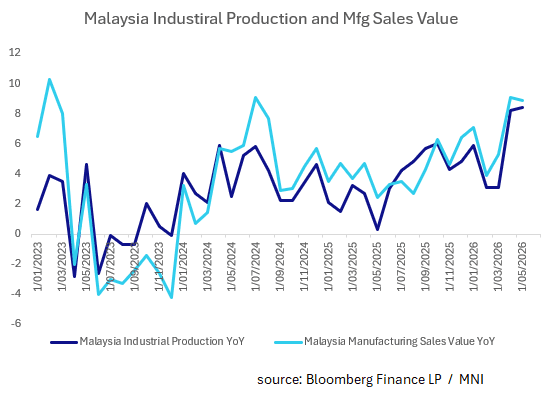
- Malaysia's May Industrial Production showed continued strength ahead of the BNM decision on rates later.
- Up +8.4%, Industrial Production remains significantly above it's 5-year average.
- The Mining sector expanded +19.8% (from +6.8% in April and led by oil) and manufacturing +6.6% (from +8.3% in April.)
- Manufacturing sales value moderated from April to +8.9% (prior +9.1%) - whilst remaining significantly above the 5-Yr average of +7.5%
- Whilst this data may be viewed as somewhat dated, it continues to show that the economy is performing well and that monetary policy needs no adjustment.
- We expect the BNM to remain on hold and the outlook from the meeting to be neutral.
- MGS bonds are better bid today with the 10-Yr down -4bps to 3.607%
SOUTH KOREA: 10-Yr Yields Continue Upward Trend; 1-Y Benefits from KOSPI Vol
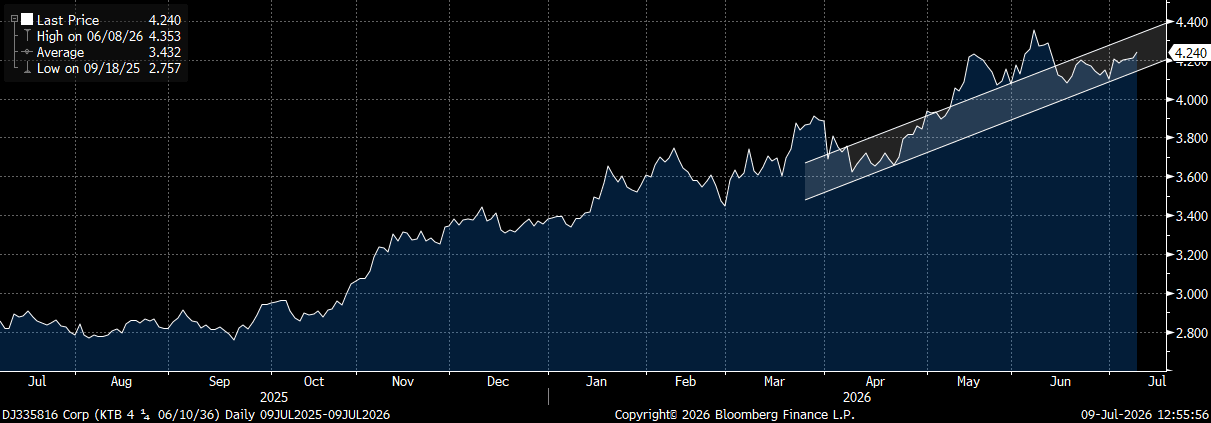
- KTBs are tracking global leads Thursday with strong moves higher in yields.
- The 10-Yr resumes its upward momentum and is up +4.5bps today at 4.285%
- The interest rate sensitive short end is higher also with the 3-Yr up +4bps at 3.82% and at their highest level in a month.
- 3-Yr bond futures are down -.14 to 102.97 and back below the 20-day EMA of 103.04.
- Next up for KTBs is the BOK rates decision on July 16; widely expected to result in a rate hike. Our current forecast suggests a hike at the July meeting, followed by 1-2 more hikes in 2026.
- Equity market volatility sees 1-Yr yields lower as investors continue to stop out of equities and lock in strong YTD profits, parking their cash in 10YR KTBs.
- Whilst there has been a reduction in short end issuance announced in July, opportunistically tomorrow sees a KRW1tn 1-Yr auction coming; which is likely to be well received
Fig 1: 10-Yr Yield Upward Trajectory
source: Bloomberg Finance LP / MNI
KRW: Eyeing Another 1500 Downside Test, Official Support, Equity Inflows Aid KRW
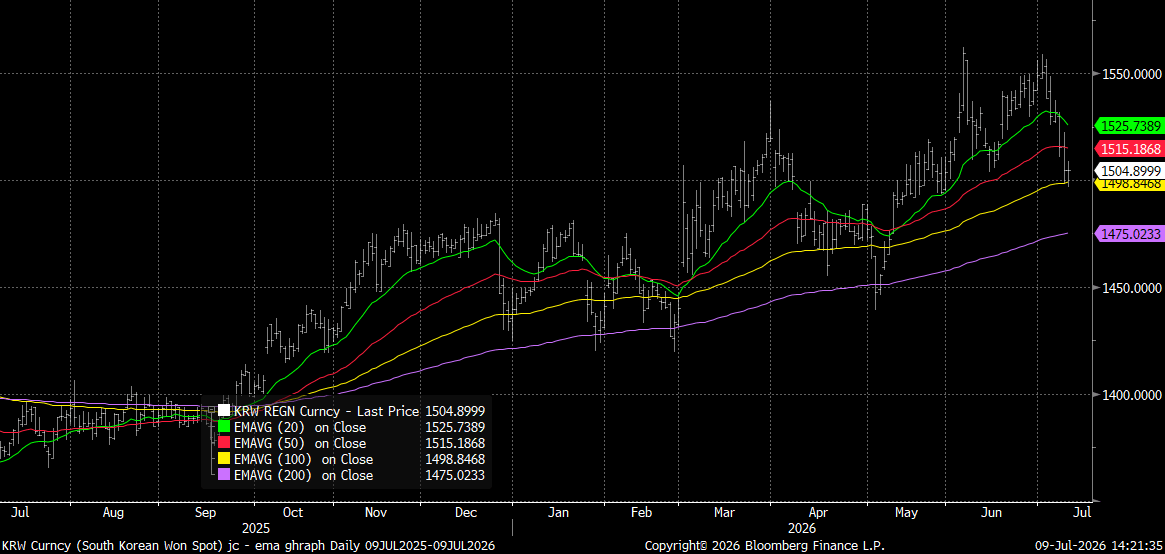
Spot USD/KRW is a little lower so far today, last in the 1502/03 region. We did lows of 1496.95 earlier but the pair rebounded. Yesterday we also saw a dip under 1500, but the pair retraced higher. This suggests some support below the 1500 figure level, which also coincides with the 100-day EMA support point, see the chart below. The RSI (14) is lower but not yet in oversold territory, last near 41.35. Official comments from South Korean official continues to highlight the policy focus on the won and are unlikely to stand in the way of further gains.
- BoK Governor Shin stated there is a strong chance that the won will gain versus the USD. The Governor also stated a rate hike is needed. Before that South Korea's Presidential policy chief Kim Yong-beom, noted that high USD/KRW levels are a temporary phenomenon. Kim's key point was it will take time for offshore corporate earnings to come back onshore (see our earlier bullet at this link).
- The offshore equity flow backdrop has turned less adverse as well. Yesterday we had $451.2mn in inflows, while positive trends have continued today (albeit modestly at $66mn). The Kospi is close to flat, but a firmer won backdrop, coupled with the sharp recent correction South Korean stocks, may be seeing offshore dip buyers re-emerge. This comes amidst what is expected to be a positive flow backdrop from the SK Hynix ADR.
- Still, T.D analysts caution on extrapolating positive won trends too far. They note: "...won weakness trend remains intact as USD is broadly expected to stay resilient until Fed rate hikes start to get priced out on weaker US data. History in recent years show any meaningful rebound in the won only occurred when the dollar was broadly weak." (via BBG)
Fig 1: Spot USD/KRW Versus Key EMAs
Source: Bloomberg Finance L.P./MNI
IDR: Macro Headwinds Overpower BI Line, USDIDR May Rise Further
- Renewed tensions in the Middle East and subsequent pressure on oil prices has added another pressure to the Rupiah follow yesterday's S&P DJI news.
- Yesterday's headlines from S&P DJI that Indonesia is set for potential market reclassification in their indexes has continued to weigh heavy on the Rupiah today.
- The BI held the line yesterday attempting to keep the USDIDR near to 18,000 - ultimately closing at 18,014
- With Brent up over 4.5% in the US trading day overnight, the USDIDR is up +64 to be near 18,070 / 18,078 Thursday.
- Perhaps capping the pace of the moves higher, USDIDR is now nearing overbought on the 14-day relative strength index with a score of +64 suggests that the currency pair is in bullish territory and experiencing strong upward pressure, as the USD has been consistently gaining value against the Indonesian Rupiah over the last two weeks.
- USD buyers are driving the price action here, as macro pressures (rising US yields, oil and the widening fiscal deficits) weigh heavily on the Rupiah along with the pressure from MSCI and S&P DJI.
- Whilst the BI has been intervening in the Rupiah via injecting dollars into the domestic spot foreign exchange market, the Domestic Non-Deliverable Forward (DNDF) market, and absorbing local liquidity through the bond market, the macro headwinds in the ST are likely to win out.
- Look for USDIDR to consolidate above 18,000 and into a new ST range of 18,000 - 18,250.
THAILAND: Q2 Consumer Sentiment Moderation Signals Slower Q2 Consumption
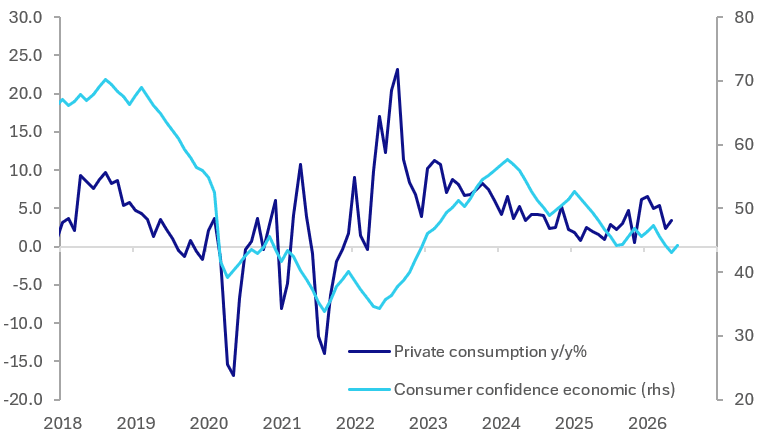
The University of the Thai Chamber of Commerce measure of consumer confidence rose 1.2 points to 50.7 in June, the highest since March, with the economic component up 1 point to 44.1 but still in pessimistic territory. The Q2 averages are lower than Q1 signalling that private consumption growth could slow from Q1’s 3.2% y/y. Business confidence was also lower and so it is likely that the economy slowed in Q2, which is unsurprising given the significant jump in geopolitical uncertainty and fuel prices at the start of the quarter. The Bank of Thailand believes that with inflation contained it can leave rates supportive of growth.
Thailand consumption
Source: MNI - Market News/LSEG
- Both present and future confidence improved to 34.5 from 33.6, still very pessimistic, and 58.7 from 57.3 respectively. Future income rose to 59.3 from 57.9, while employment remained below breakeven-50 level it rose 1.2 points to 48.7.
- The Constitutional Court announced today that the government’s proposed THB400bn/US$12bn (2.1% 2025 GDP) emergency loan scheme to support households and SME’s impacted by higher energy prices due to the Iran War was legal. The fund is also to accelerate the nation’s energy transition.
- Private consumption began to recover in May after three consecutive monthly declines. It rose 0.6% m/m bringing the annual rate to 3.4% up from 2.3%.
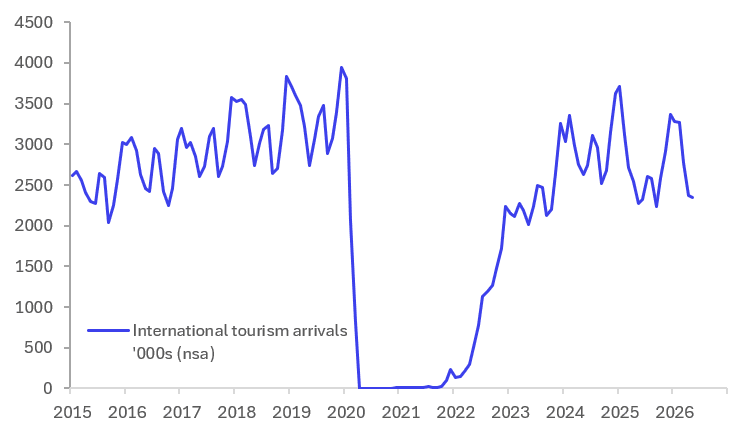
- The key tourism sector remains lacklustre with May posting its fifth decline in arrivals but they were still 3.5% higher than a year ago.
Thailand tourist arrivals
Source: MNI - Market News/LSEG
- The labour market remains solid with May employment growing 5.9% y/y up from 5.2%.
- BoT continues to monitor bank lending closely but it remains weak to individuals contracting 2.1% y/y in April – around the rate of the last eight months.
UP TODAY (TIMES GMT/LOCAL)
| Date | GMT/Local | Impact | Country | Event |
| 09/07/2026 | 0600/0800 | ** |  DE | Trade Balance |
| 09/07/2026 | - |  EU | ECB Lagarde & Cipollone at Eurogroup Meeting, Brussels | |
| 09/07/2026 | 1200/0800 | * |  US | NY Fed SOFR |
| 09/07/2026 | 1230/0830 | ** | US | WASDE Weekly Import/Export |
| 09/07/2026 | 1230/0830 | *** | US | Jobless Claims |
| 09/07/2026 | 1300/0900 | US | New York Fed President John Williams | |
| 09/07/2026 | 1300/0900 | * | US | NY Fed EFFR |
| 09/07/2026 | 1400/1000 | *** | US | NAR existing home sales |
| 09/07/2026 | 1430/1030 | ** | US | Natural Gas Stocks |
| 09/07/2026 | 1530/1130 | ** | US | US Bill 04 Week Treasury Auction Result |
| 09/07/2026 | 1530/1130 | * | US | US Bill 08 Week Treasury Auction Result |
| 09/07/2026 | 1700/1300 | *** | US | US Treasury Auction Result for 30 Year Bond |
| 09/07/2026 | 1730/1330 | US | New York Fed's Roberto Perli | |
| 09/07/2026 | 1930/2030 |  GB | BOE Breeden Panel on Monpol Implementation/Market Functioning | |
| 10/07/2026 | 0600/0800 | *** | DE | Germany CPI (f) |
| 10/07/2026 | 0600/0800 | *** | DE | Germany CPI (f) |
| 10/07/2026 | 0600/0800 | *** |  NO | CPI Norway |
| 10/07/2026 | 0615/0815 | EU | ECB Vujcic Panel at Greece Annual Economist Roundtable | |
| 10/07/2026 | 0645/0845 | *** |  FR | HICP (f) |
| 10/07/2026 | 0700/0300 | *** |  CZ | Czech Republic Final CPI |
| 10/07/2026 | 0800/1000 | * |  IT | Industrial Production |
| 10/07/2026 | - | *** |  CN | Money Supply |
| 10/07/2026 | - | *** | CN | New Loans |
| 10/07/2026 | - | *** | CN | Social Financing |
| 10/07/2026 | 1200/0800 | ** |  BR | Brazil Final CPI |
| 10/07/2026 | 1200/0800 | * | US | NY Fed SOFR |
| 10/07/2026 | 1230/0830 | * |  CA | Building Permits |
| 10/07/2026 | 1230/0830 | *** | CA | Labour Force Survey |
| 10/07/2026 | 1230/0830 | *** | CA | Labour Force Survey |
| 10/07/2026 | 1300/0900 | * | US | NY Fed EFFR |


