MNI EUROPEAN MARKETS ANALYSIS: China Prices Struggle
- China's stocks trade higher on slow start to the week, Japan out.
- NVIDIA to pay part of revenue from CHIP sales to US government.
- China's prices continue to struggle.
- The USD has traded softer in our session drifting back to the 1200 area.
- US lashes out at France over Palestine recognition.
US TSYS: Futures Trade Slightly Higher
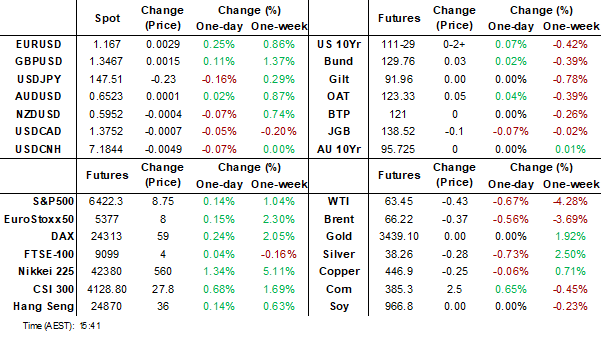
The TYU5 range has been 111-25+ to 111-29+ during the Asia-Pacific session. It last changed hands at 111-29, up 0-02+ from the previous close.
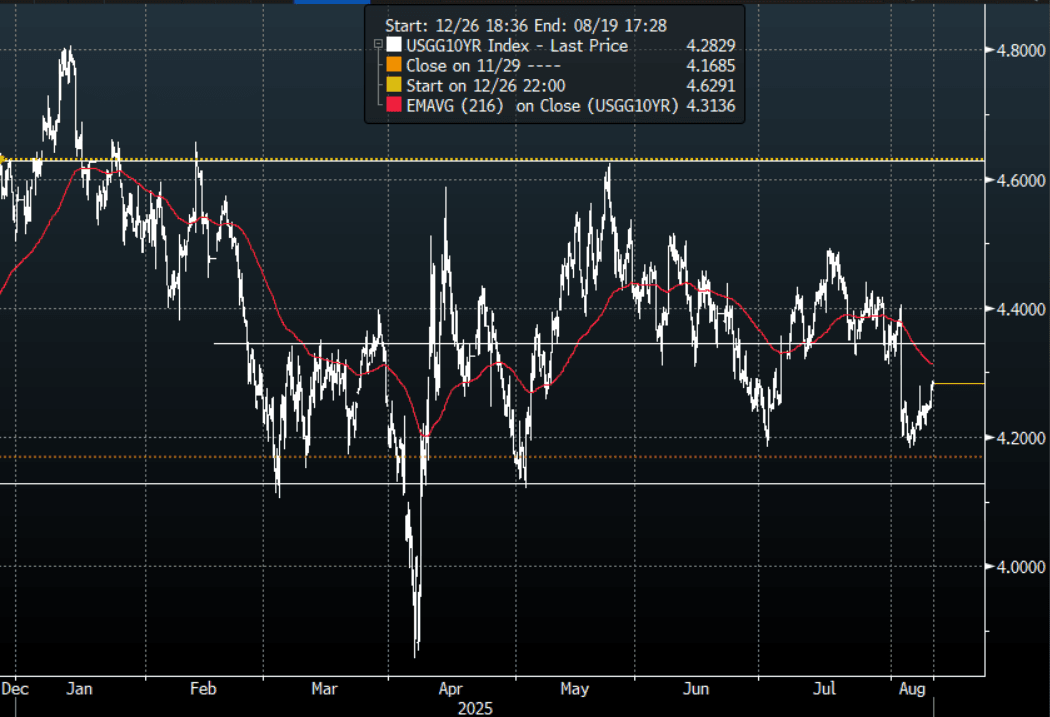
- The 10-year yield had a powerful move lower in reaction to the NFP data, breaking below its 4.30% pivot within the wider range 4.10% - 4.65%. This now turns momentum lower in yields and you could expect buyers of treasuries on bounces back towards 4.30/35% now looking to initially test the 4.10% area.
- Bob Elliott on X: “Used car prices have been a big negative on CPI for the last 3m. A notable difference from the broad trend of underlying used car prices going from a significant disinflationary pressure to a modestly inflationary one over the last year or so.”
MNI DATA - Tuesday’s CPI report headlines the US economic calendar with analysts expecting core CPI inflation to gain momentum in July as the acceleration in core goods inflation continues. We’re starting to get into larger tariff impacts on core goods but the largest could be reserved for Aug-Sep by some estimates. We are currently tracking unrounded core CPI estimates at around 0.32% M/M after the 0.23% in June at what would be the strongest M/M print since January.
Fig 1: 10-Year US Yield 2H Chart
Source: MNI - Market News/Bloomberg Finance L.P
AUSSIE BONDS: All Eyes On Tomorrow's RBA Decision
ACGBs (YM flat & XM flat) are unchanged on a local data-light day.
- MNI - The RBA decision is on Tuesday August 12 and is widely expected to cut rates 25bp to 3.60% given the further moderation in underlying inflation in Q2 and signs that the labour market has reached a turning point and is weakening. It had 50bp of easing for H2 assumed in its May projections. There will be an update to the RBA outlook provided with the decision but it is likely to be consistent with the Board's cautious approach to easing.
- There are also a number of key data releases too. Q2 wages print on Wednesday and July jobs data Thursday.
- Cash ACGBs are unchanged.
- Cash US tsys were closed during today's Asia-Pac session, with Japan out for a holiday.
- The bills strip is flat to -1 across contracts.
- RBA-dated OIS pricing is little changed across meetings today. A 25bp rate cut tomorrow is given a 97% probability, with a cumulative 62bps of easing priced by year-end.
- This week, the AOFM plans to sell A$1200mn of the 4.25% 21 December 2035 bond on Wednesday and A$1000mn of the 2.75% 2 1 November 2029 bond on Friday.
BONDS: NZGBS: Subdued Data Light Start To Week
NZGBs closed little changed, with benchmark yields flat t 1bp higher, after a subdued start to the trading week.
- Cash US tsys were closed during today’s Asia-Pac session, with Japan out for a holiday.
- Swap rates closed unchanged.
- With the next RBNZ meeting approaching (August 20), this week contains a number of high frequency releases that the MPC monitors and should give a sense for how the economy began Q3.
- July card spending is out Wednesday and while it is off its lows, growth has remained soft. There could be some payback in the month following the 0.5% m/m rise in June.
- On Friday, July monthly price series are released including food, travel, electricity and rents. Food and power price inflation have been trending higher while petrol and rents have been moderating.
- The July BNZ manufacturing PMI also prints on Friday. It returned to contractionary territory in May after five months signalling growth in the sector. In June, the pace of decline moderated with the index at 48.8 after 47.4.
- RBNZ dated OIS pricing closed unchanged across meetings. 23bps of easing is priced for August, with a cumulative 41bps by November 2025.
- On Thursday, the NZ Treasury plans to sell NZ$200mn of the 3.00% Apr-29 bond and NZ$250mn of the 2.75% Apr-37 bond.
FOREX: Asia FX Wrap - BBDXY Drift Lower Towards 1200 Support
The BBDXY has had a range of 1202.58 - 1204.84 in the Asia-Pac session, it is currently trading around 1202, -0.15%. The USD has traded softer in our Session drifting back to the 1200 area. The market is very quick to pounce onto anything that potentially justifies selling the USD but the US CPI out tomorrow night could potentially add some headwinds to this trade in the short-term. I suspect we see some paring back of USD shorts going into this print and then trade the reaction. A sustained break back below 1198 points to a retest of the lows, and a bounce back towards 1220/1230 should probably be faded initially.
- EUR/USD - Asian range 1.1642 - 1.1676, Asia is currently trading 1.1670. The pair has bounced nicely off the important 1.1300/1.1400 area. The market has stalled at its first attempt to challenge the resistance around the 1.1700 area, I would be surprised if it broke higher until we get the input from the US CPI tomorrow night.
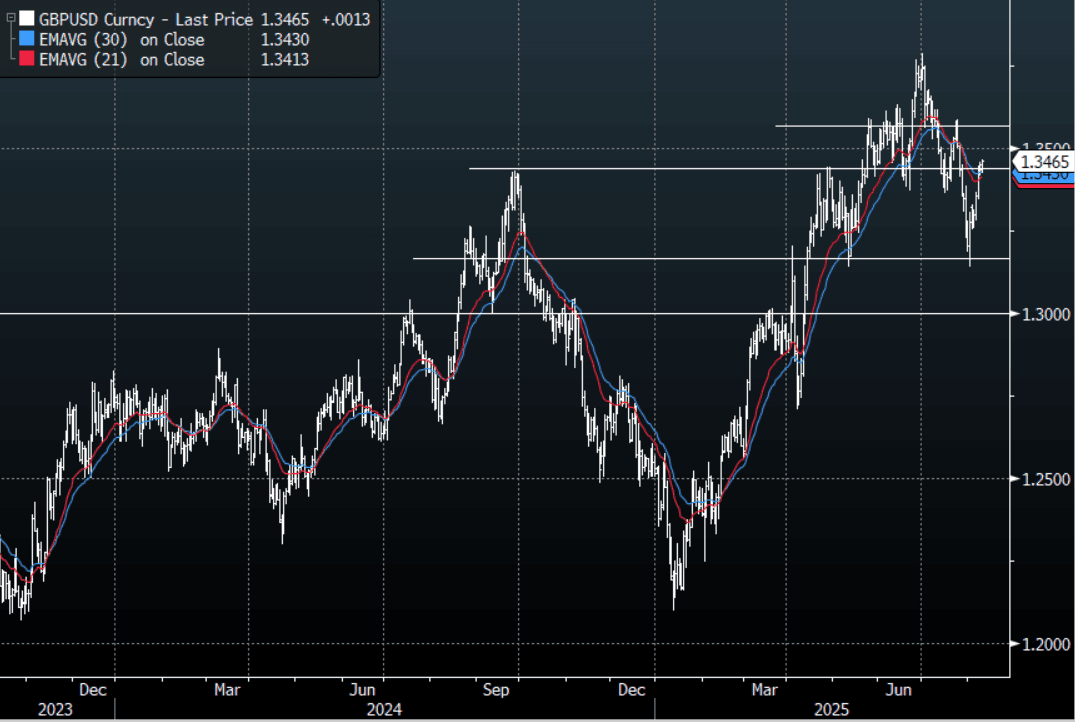
- GBP/USD - Asian range 1.3436 - 1.3468, Asia is currently dealing around 1.3465. The pair bounced nicely off the 1.3100/1.3200 support area. I would suspect sellers could be around on this bounce back towards 1.3450 initially looking to fade this bounce. US CPI tomorrow night will have a say on whether this area caps or not.
- USD/CNH - Asian range 7.1826 - 7.1909, the USD/CNY fix printed 7.1405, Asia is currently dealing around 7.1850. Sellers should be around on bounces while price holds below the 7.2200/2500 area and the PBOC manages the fix lower. Above 7.2500 and we could see a test of the USD Shorts.
- Cross asset : SPX +0.15%, Gold $3367, TYU5 111-29, BBDXY 1202.90, Crude Oil $63.46
- Data/Events : France BBG Economic Survey, EZ BBG Economic Survey, Germany BBG Economic Survey, Italy BBG Economic Survey/CPI/Trade Balance, Spain BBG Economic Survey
JPY: USD/JPY - Drifting On A 147 Handle - Eyes US CPI Tomorrow
The Asia-Pac USD/JPY range has been 147.43 - 147.79, Asia is currently trading around 147.45, -0.20%. USD/JPY is consolidating within a 146.50-148.00 range. Price has moved very quickly away from the pivotal 151/152 area much to the relief of Institutional Yen longs and the BOJ. Price is holding above the support area between 146.00/147.00, a move sub 145.00 is needed to turn momentum lower once more, until then the 145.00-151-00 range should dominate. US CPI tomorrow night will be an important input.
- MNI JAPAN: Ishiba Maintains Intention To Remain PM As LDP Critics Threaten Recall. The governing Liberal Democratic Party (LDP) has concluded a two-hour meeting of lawmakers from both houses of the National Diet. The formal reason for the assembly was to assess the fallout from the 20 July House of Councillors election, in which the LDP-Komeito governing coalition lost its majority in the upper chamber. However, the meeting was also a chance for LDP lawmakers to voice their displeasure with PM Shigeru Ishiba, whose critics blame for the party's poor performance.
- (Bloomberg) -- “Data on Japanese bond buying show a “deliberate realignment of Japanese portfolio investment away from US sovereign debt and toward the sovereign markets of the eurozone,” according to strategists at Mizuho.”
- “Carry traders are piling into high-yielding EM currencies as wagers on Fed rate cuts weaken the dollar.” - BBG
- Options : Close significant option expiries for NY cut, based on DTCC data: 147.00($470m).Upcoming Close Strikes : 150.25($1.47b Aug 13) - BBG.
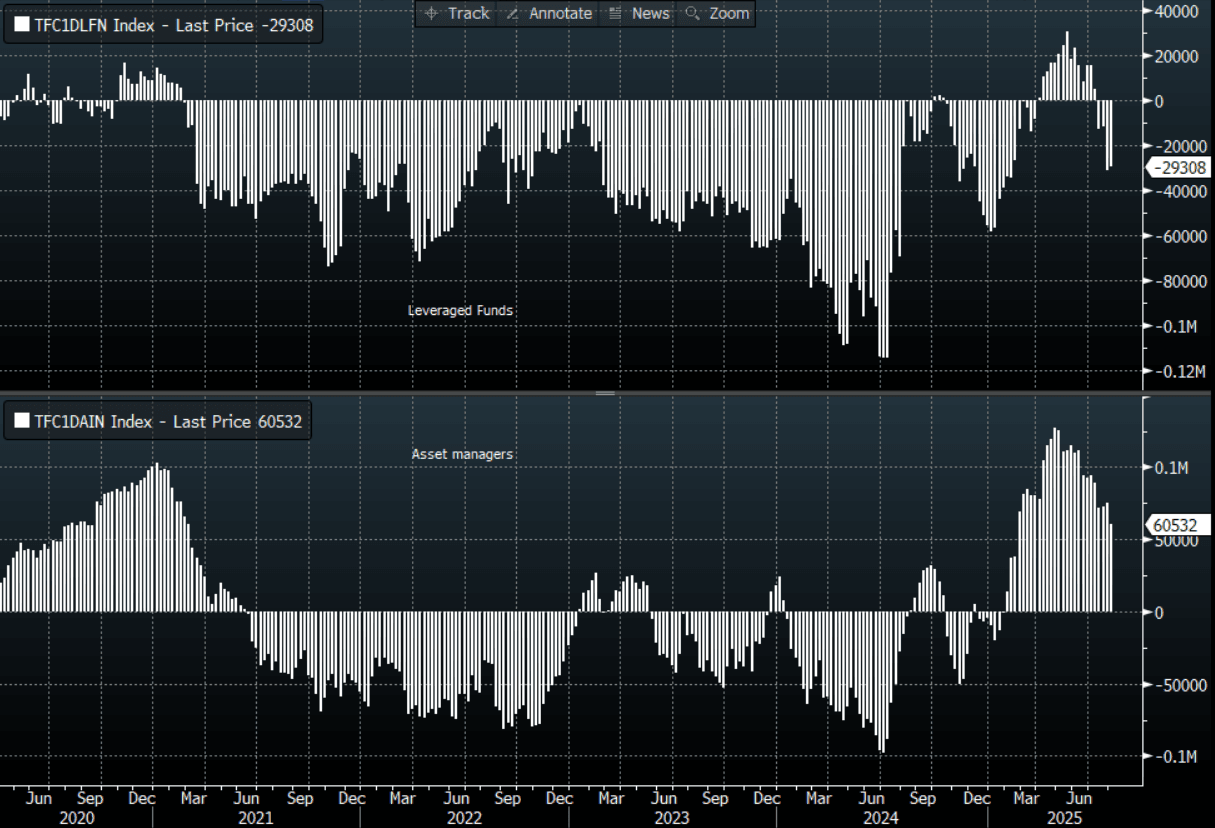
- CFTC data shows asset managers reduced their JPY longs +60532( Last +75119), leveraged funds slightly reduced their newly built short JPY position -29308(Last -31280).
Fig 1 : JPY CFTC Data
Source: MNI - Market News/Bloomberg Finance L.P
AUD/USD - Consolidates Above 0.6500, Eyes RBA Tomorrow
The AUD/USD has had a range of 0.6514 - 0.6528 in the Asia- Pac session, it is currently trading around 0.6525, +0.05%. A very quiet start to the week saw AUD/USD consolidate above 0.6500. Risk has traded a little higher in our session, E-minis +15%, NQU5 +0.15%.
- (Bloomberg) - “Reports that AMD and Nvidia will pay 15% of their China revenue to the US government should be a negative for those companies and for tech more broadly. Investors may shrug off the news or even welcome it in the short term as a sign that the companies can go on selling chips to China, but the longer-term outlook is that profit margins may narrow.”
- MNI - The RBA decision is on Tuesday August 12 and is widely expected to cut rates 25bp to 3.60% given the further moderation in underlying inflation in Q2 and signs that the labour market has reached a turning point and is weakening. It had 50bp of easing for H2 assumed in its May projections. There will be an update to the RBA outlook provided with the decision but it is likely to be consistent with the Board's cautious approach to easing.
- Options : Closest significant option expiries for NY cut, based on DTCC data: none. Upcoming Close Strikes : 0.6565(AUD783m Aug 12), 0.6600(AUD1.25b Aug 14) - BBG
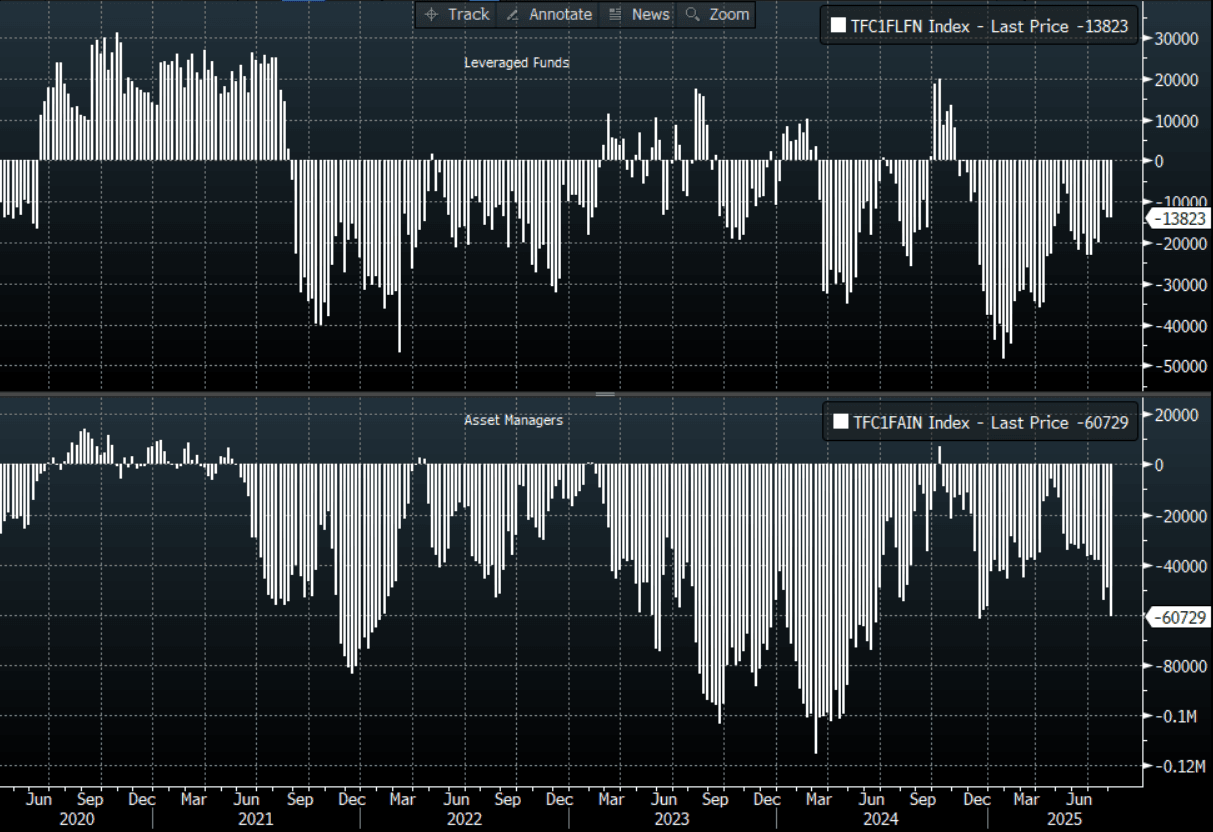
- CFTC Data shows Asset managers added to their shorts -60729(Last -49183), the Leveraged community added very slightly to their own shorts -13997(Last -13823).
- AUD/JPY - Asia-Pac range 96.18 - 96.38, Asia is trading around 96.20. The pair has bounced to test its first resistance around the 96.50 area. There should be sellers around here initially, a sustained break below 94.50/95.00 is needed to signal a deeper move lower or a break above 97.50 would reinstate the momentum higher.
Fig 1: AUD CFTC Data
Source: MNI - Market News/Bloomberg Finance L.P
Fig 1: GBP/USD Spot Daily Chart
Source: MNI - Market News/Bloomberg Finance L.P
NZD: Asia Wrap - NZD/USD Consolidates On A 0.59 Handle
The NZD/USD had a range of 0.5944 - 0.5962 in the Asia-Pac session, going into the London open trading around 0.5955, -0.02%. Risk has traded a little higher this morning, E-minis +0.20%, NQU5 +0.20%. NZD/USD bounced nicely off its 0.5850 support last week but depending on your view I would suspect sellers could return on any bounce back toward 0.6000/0.6050. For the moment firmly back in the 0.5850-0.6100 range looking for a catalyst to break and give clearer direction, US CPI tomorrow is an important input.
- "NZ'S LUXON: SEEING A TWO-SPEED ECONOMIC RECOVERY IN NZ, LAST THREE MONTHS HAVE BEEN CHALLENGING FOR ECONOMY. EXPECT FUTURE INTEREST RATE CUTS" - BBG
- MNI NZ: July Data Releases Ahead Of August RBNZ Meeting. With the next RBNZ meeting approaching (August 20), this week contains a number of high frequency releases that the MPC monitors and should give a sense for how the economy began Q3. July card spending is out Wednesday and while it is off its lows, growth has remained soft. There could be some payback in the month following the 0.5% m/m rise in June. On Friday, July monthly price series are released including food, travel, electricity and rents. Food and power price inflation have been trending higher while petrol and rents have been moderating.
- Kelly Eckhold(Westpac NZ) on LinkedIn - “Something to keep an eye on is the possibility that the reciprocal tariffs NZ got lumped with last week get removed by the courts. Sounds very possible as Trump is operating beyond his legal authority.”
- Options : Closest significant option expiries for NY cut, based on DTCC data: 0.5920(NZD583m), 0.5930(NZD646m), 0.5960(NZD301m). Upcoming Close Strikes : 0.5825(NZD300m Aug 14). - BBG
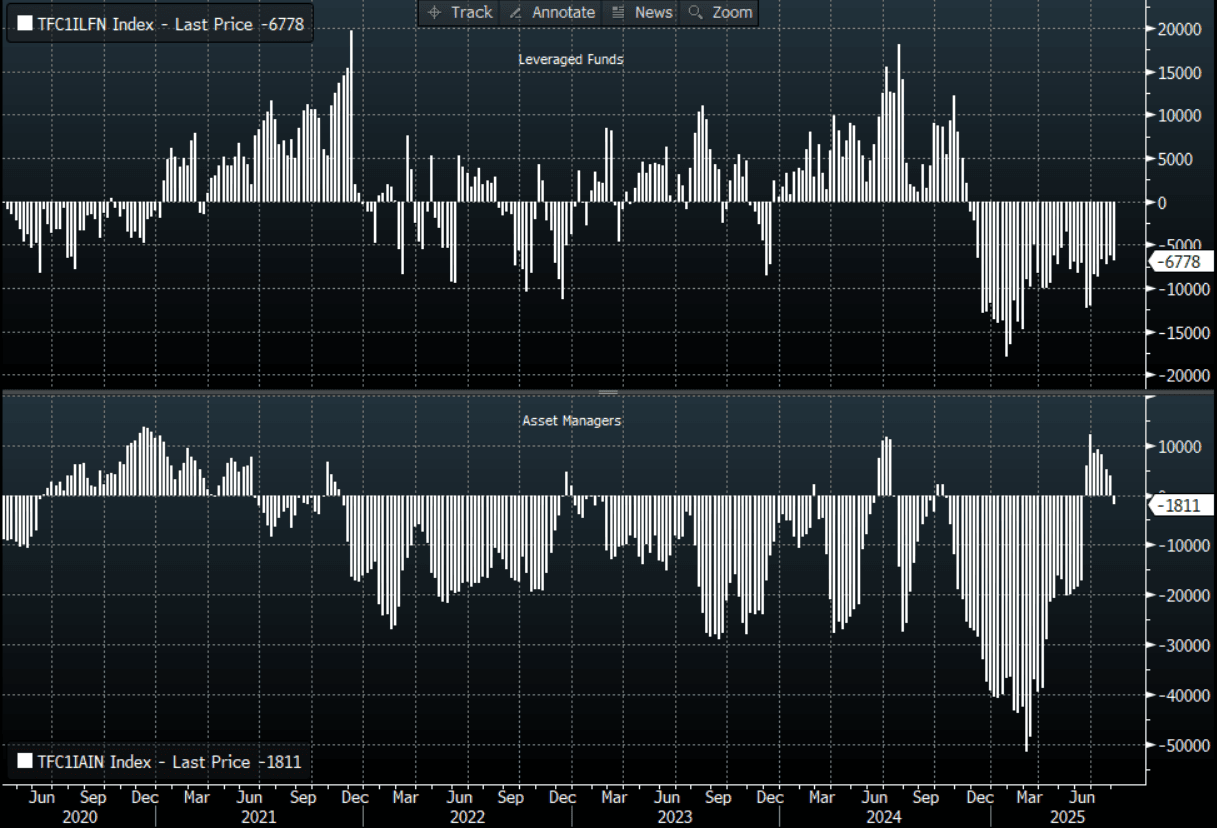
- CFTC Data shows Asset Managers have cut their longs completely and started to rebuild a short in the NZD -1811(Last +3903), the Leveraged community added to their shorts slightly -6778(Last -6250).
- AUD/NZD range for the session has been 1.0929 - 1.0960, currently trading 1.0940. The Cross continues to trade sideways after stalling towards the 1.1000 area once more. The range looks to be 1.0850-1.1000 for now.
Fig 1: NZD CFTC Data
Source: MNI - Market News/Bloomberg Finance L.P
ASIA STOCKS: China Leads the Way with Gains as Japan Out
Major bourses across the region delivered modest gains today, with Japan out.
- China's major bourses were all higher with the onshore outperforming. The Hang Seng was up a mere +0.19% whilst the CSI 300 rose +0.58%, the Shanghai Composite up +0.51% and the Shenzhen Comp up +1.40%.
- The KOSPI continued to trade the other way down moderately by -0.06% as it teeters with 3,200.
- The FTSE Malay KLCI gained +0.35% and the Jakarta Composite continues to power ahead up +0.78%.
- The FTSE Straits Times in Singapore is off -0.15% and the PSEI -0.98%.
- India's NIFTY 50 has started the week with modest gains of +0.15%
CHINA: Deflationary Pressures Remain in China
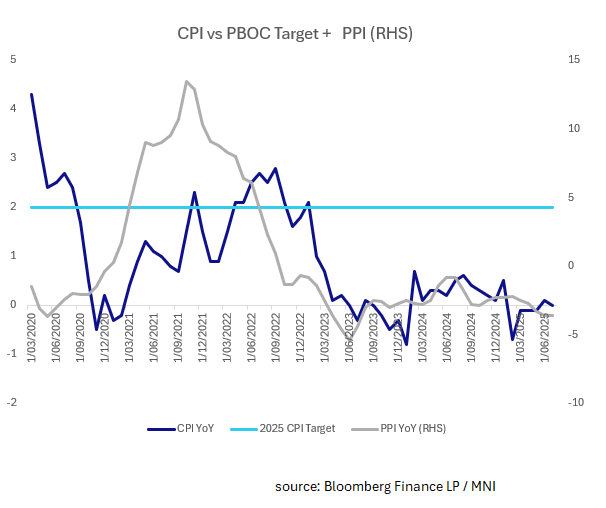
- The July release over the weekend for China's inflation data confirmed more of the same as deflationary pressures remain.
- China's July CPI release was 0.0%, from 0.1% in June.
- The July PPI release was -3.6%, in line with June's -3.6%. PPI has not produced a positive print since September 2022.
- The PBOC (People's Bank of China) has set a CPI (Consumer Price Index) inflation target of around 2% for 2025. This target was reaffirmed at the National People's Congress in early March, alongside a real GDP growth target of around 5%. Whilst the 1Q and 2Q GDP remain on target (2Q GDP printed at +5.2%) CPI continues to lag.
- The government is ramping up the 'anti-involution' approach aimed at curbing the price wars. It is currently viewed as one of the critical issues for the economy. The campaign is aimed at curbing intense, often unproductive, competition, particularly in industries with overcapacity, leading to price wars and declining profits. The campaign seeks to promote healthier competition, improve product quality, and enhance overall economic stability.
OIL: Oil Continues Sell Off On Chance Of Ukraine Peace Deal
Crude has declined over August and that downtrend continued during today’s APAC session. Excess supply concerns continue to be the driver. With Presidents Trump and Putin meeting on Friday to discuss Ukraine, the prospect of an easing of sanctions on Russian energy exports has surfaced possibly adding to already ample global output. WTI is down 0.7% to $63.41/bbl off the intraday low of $63.02. Brent is 0.6% lower at $66.21/bbl after falling to $65.81. The USD index is down 0.2% but is not supporting dollar-denominated oil.
- There is talk that the agreement being negotiated between Russia and the US involves Ukraine ceding land to its neighbour. However, on the weekend President Zelensky stated Ukraine would not agree to forgoing territory and the EU insists that Ukraine be part of the talks. While a peace agreement continues to seem elusive, a ceasefire could drive Brent below $65/bbl and possibly $60 based on Westpac estimates.
- Ukraine said that it hit a major refinery in Russia’s Saratov region as it continues to target energy infrastructure.
- With tariffs and OPEC output normalization, attention is centered on supply/demand fundamentals. A number of reports are published this week with the US EIA short-term energy outlook & OPEC August report on Tuesday and the IEA’s August monthly update on Wednesday.
GOLD: Uncertainty Over US Gold Tariffs Pressuring Market
Gold prices are 0.6% lower at $3378.7/oz during today’s APAC session. They fell to a low of $3367.79 before stabilising. The yellow metal has sold off as markets wait for clarification on the tariff-status of US gold imports. Stronger risk appetite with equities rallying is also pressuring bullion. In addition, President Trump and Putin are scheduled to meet on Friday in Alaska to discuss a peace deal for Ukraine potentially reducing geopolitical risks.
- Gold was exempted from US tariffs in April but last week officials stated that 100oz and 1kg bars would face import duties introducing increased uncertainty into the market and risking the seamless operation of trade, according to Bloomberg.
- The disappointing July US jobs data returned bullion close to the top of its recent range and corrections are still seen as corrective. Today’s trough remained above initial support at $3268.2, 30 July low. Initial resistance is at $3409.2, 8 August high.
- Silver is down at -0.7% to $38.08 off the intraday low at $37.924. The trend remains bullish though and the metal is trading above initial support at $36.216, 31 July low. Initial resistance is at $39.655.
- The US dollar is weaker (BBDXY -0.2%). Equities are rallying with the S&P e-mini up 0.2%, Hang Seng +0.2% and TAIEX +0.5% but KOSPI flat. Oil prices continue trending lower with WTI -0.7% to $63.43/bbl. Copper is flat.
- There are few events coming up on Monday. Italian July CPI and June trade are released later. US CPI on Tuesday will be the main focus of the week but Friday’s July retail sales and preliminary August Uni of Michigan consumer sentiment will also be monitored.
METALS: Copper(HGU5) - Consolidating Toward 450.00
The range Friday night for the HGU5 contract was 441.50 - 449.05, Asia is currently trading around 447.00, +0.04%. Copper has found a base around 435.00 and is consolidating after the huge move lower resulting from the Trump administrations move to differentiate between refined metal and semi-processed products when applying tariffs. The market has been caught wrongfooted and the lack of a decent bounce after such a huge move highlights the positioning issue. Any bounce back to 465-480 should find sellers initially.
- The LME cash market closed Friday night around 9692.45.
- (Bloomberg) -- “Codelco restarted underground activities at its biggest copper mine, El Teniente, a little more than a week after suffering Chile’s deadliest mining accident in decades. The state-owned company restarted mining late Saturday at areas that were deemed safe by Chilean mining and labor authorities, it said in a statement. Operations there are scheduled to return to normal on Sunday. New sections of the mine, near where the July 31 collapse occurred, will remain off limits as an investigation continues.”
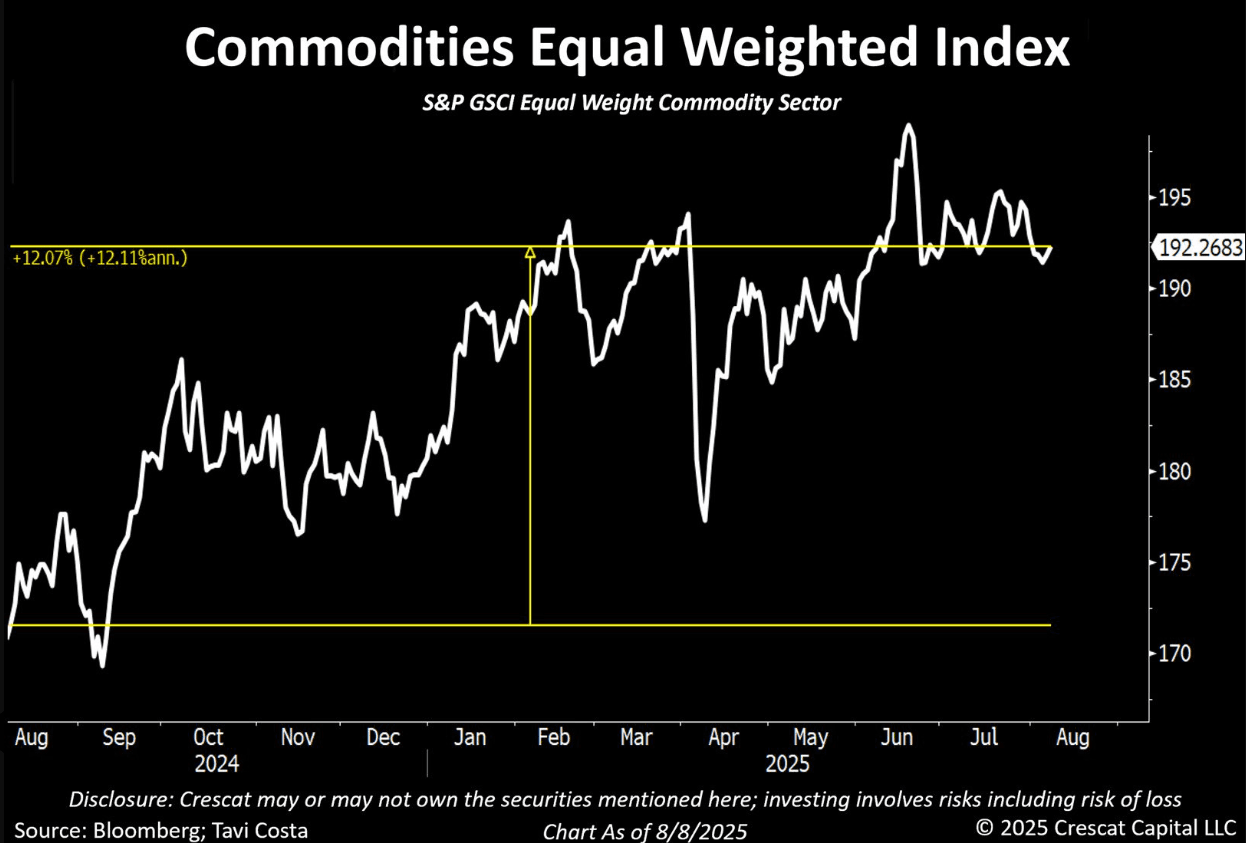
- Otavio Costa on X: “It's interesting to see some people claim inflation is slowing. The equal-weighted commodities index is up 12% in the past year. That’s real-world inflation. Meanwhile, US money supply just hit a new high, and the dollar is weakening sharply against other currencies, including emerging markets. Inflation is far from contained, in my view.” See Fig.1 Below.
Fig 1 : Commodities Equal Weighted Index
Source: MNI - Market News/@TaviCosta
UP TODAY (TIMES GMT/LOCAL)
| Date | GMT/Local | Impact | Country | Event |
| 11/08/2025 | 0600/0800 | *** |  NO NO | CPI Norway |
| 11/08/2025 | 0800/1000 | *** |  IT IT | HICP (f) |
| 11/08/2025 | - | *** |  CN CN | Money Supply |
| 11/08/2025 | - | *** | CN | New Loans |
| 11/08/2025 | - | *** | CN | Social Financing |
| 11/08/2025 | 1530/1130 | * |  US US | US Treasury Auction Result for 13 Week Bill |
| 11/08/2025 | 1530/1130 | * | US | US Treasury Auction Result for 26 Week Bill |
| 12/08/2025 | 2301/0001 | * |  GB GB | BRC-KPMG Shop Sales Monitor |
| 12/08/2025 | 0430/1430 | *** |  AU AU | RBA Rate Decision |
| 12/08/2025 | 0600/0700 | *** | GB | Labour Market Survey |
| 12/08/2025 | 0600/0700 | *** | GB | Labour Market Survey |
| 12/08/2025 | 0600/0700 | *** | GB | Labour Market Survey |
| 12/08/2025 | 0900/1100 | *** |  DE DE | ZEW Current Expectations Index |
| 12/08/2025 | 0900/1000 | ** | GB | Gilt Outright Auction Result |
| 12/08/2025 | 1000/0600 | ** | US | NFIB Small Business Optimism Index |
| 12/08/2025 | 1100/1200 | GB | BOE APF Quarterly Report | |
| 12/08/2025 | 1230/0830 | * |  CA CA | Building Permits |
| 12/08/2025 | 1230/0830 | *** | US | CPI |
| 12/08/2025 | 1230/0830 | *** | US | CPI |
| 12/08/2025 | 1230/0830 | *** | US | CPI |
| 12/08/2025 | 1255/0855 | ** | US | Redbook Retail Sales Index |


