MNI EUROPEAN MARKETS ANALYSIS: A$ Aided By Bullock Comments
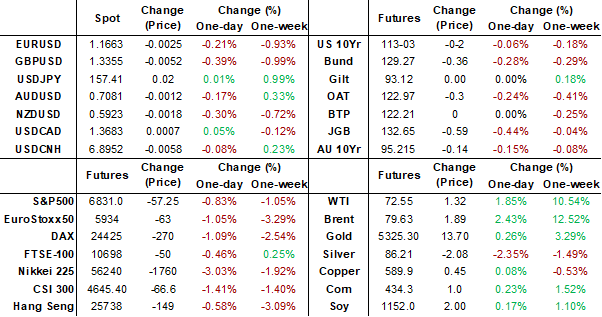
- Focus remains on Iran conflict headlines, with little signs of de-escalation (the US stating strikes would intensify). Oil prices are higher, but Brent is under early Monday highs. US equity futures are down, as is sentiment for much of the region.
- The USD is trying to push higher, but A$ outperformance was aided By RBA Bullock remarks (March is a live meeting), while CNH has outperformed post the CNY fixing.
- Eurozone inflation data headlines Tuesday’s data calendar, before the UK spring statement.
MARKETS
US TSYS: Inflation Fears Grip; Watch for 10-Yr to Test 4.10%
The sell off in USTs followed through into Asia Tuesday with the 10-Yr bond future down -01 at 113-01 with volumes relatively high, suggesting decent two way flow.
Cash was weaker again after the overnight lead in with yields up 1 - 2bps. Fears over inflationary pressures are driving yields higher with longer dated treasuries (the most sensitive to inflation) underperforming.
- The 2-Yr was up +0.8bps at 3.486%
- The 5-Yr was up +1.4bps at 3.626%
- The 10-yr was up +1.9bps at 4.057%
- The 30-Yr was up +2.7bps at 4.709%
YIelds remain towards the bottom of the 1 month range, suggesting that there is ample room for further rises. Look for the 10-Yr to test 4.10% in the coming sessions.
Tuesday Calendar:
- 03/03 -- Wards Total Vehicle Sales
- 03/03 0955 NY Fed Williams moderates discussion
- 03/03 1130 US TSY - $90B 6W bill auction
- 03/03 1155 MN Fed Kashkari Bbg investment confernce
Source: Bloomberg Finance L.P. / MNI
GLOBAL POLITICAL RISK: Iran Conflict- Few Signs Of De-Escalation, Shipping Down
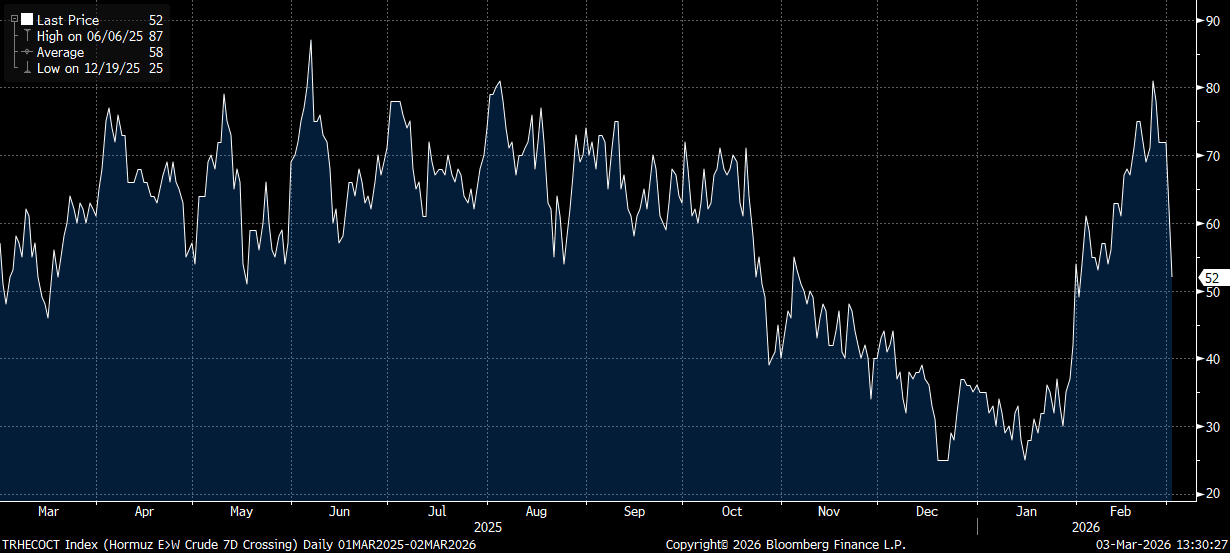
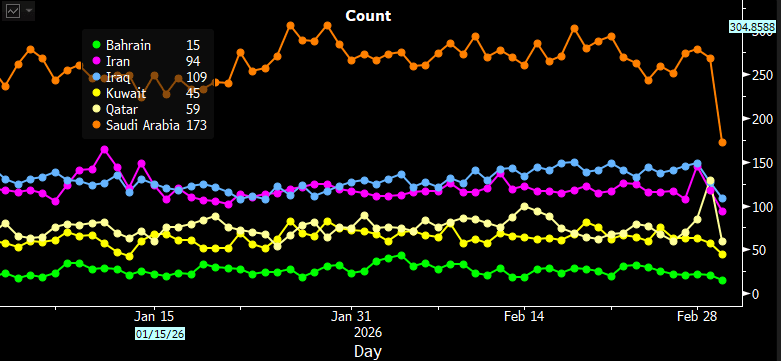
This bullet wraps up some of key news flow since the start of the Asia Pac session around the Iran conflict. At face value, it suggests little in the way of de-escalation signs. As at yesterday the rolling 7 day total of crude oil tankers crossing the Strait (East>West) was down to 52 (recent highs were above 80 for this metric), see the first chart below. Other data shows a sharp fall (to yesterday) in ships calling port at various Middle East countries, see the second chart below. Saudi Arabia is the orange line.
- Via Rtrs there was an early headline around that the Strait of Hormuz was not closed despite Iran saying as much overnight. The Fox News Reporter was quoting the US Central Command.
- CNN noted that the US is preparing for a pick up in activity over the next 2 hours, but also noted that critical missile stocks are running low.
- Drones also struck the US embassy in Saudi Arabia, but there were no reports of causalities. Trump stated that there will be a response for the attack on the US embassy in Saudi Arabia and for the US service members killed (via Rtrs), but didn't elaborate.
- Trump also stated he didn't think there would be a need for troops on the ground (again via Rtrs), after Trump said he wouldn't rule out such an option overnight.
- Israel PM Netanyahu also spoke on Fox News noting this would not be an endless war and that action will quick and decisive. He added that Saudi-Israel peace is possible once the action concludes (via BBG).
- Trump Special Envoy Witkoff also spoke with Fox News stating that it was impossible to make a deal with the Iranians and that they insisted they had a right to enriched uranium. Witkoff said the meeting was not positive. We don't exactly what meeting Witkoff is referring to but assume it means prior to the conflict, when negotiations were still taking place.
- Oil prices are up on the day so far, benchmarks +2% higher. Brent was last around $79.40/bbl, still short of intra-session highs from yesterday's open ($82.37/bbl).
Fig 1: Hormuz Strait (East>West) Crude Oil tankers crossings (7 day rolling total)
Source: Bloomberg Finance L.P./MNI
Fig 2: Ships Port Calling By Select Middle East Country
Source: Bloomberg Finance L.P./MNI
JGBS: At Session Cheaps After 10Y Auction Shows Mixed Results
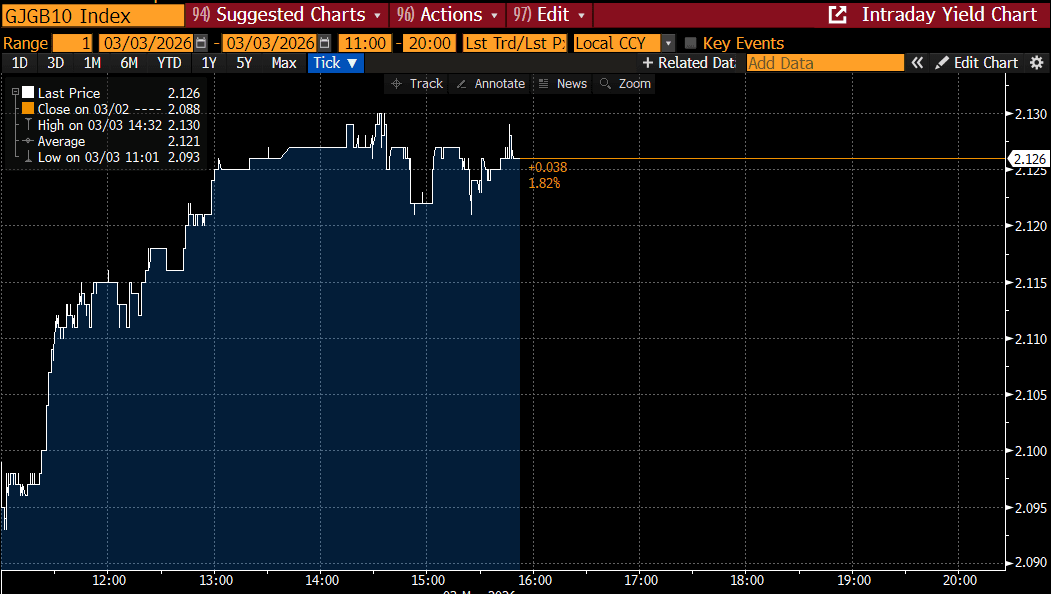
JGB futures are sharply weaker and at session lows, -64 compared to settlement levels, after today's 10-year supply.
- (Bloomberg) " The Iran war is rekindling inflation concerns across financial markets, sapping the outlook for global bonds. Traders have offloaded government debt since Monday as they game-plan how a prolonged conflict in the Middle East may ramp up oil and supercharge inflation."
- The 10-year JGB auction delivered mixed results, with the low price failing to meet expectations at 99.77, according to the Bloomberg dealer poll. However, the cover ratio increased to 3.3043x from 3.0196x. The tail also lengthened slightly to 0.06 from 0.05.
- This performance came with an outright yield that was 10-15bps below than the level of last month's auction and ~25bps lower that the cycle high. The 2s/10s yield curve was also ~10bps flatter last month’s auction and around 35bps below its a cycle high.
- Cash US tsys are flat to 3bps cheaper, with a steepening bias, in today’s Asia-Pac session after yesterday’s heavy losses.
- Cash JGBs are 2-6bps cheaper across benchmarks out to the 30-year, and 1.5bps richer beyond.
- Swap rates are 1-3bps higher.
- Tomorrow, the local calendar will see S&P Global Composite & Services PMIs and Consumer Confidence Index.
Source: Bloomberg Finance LP
JAPAN DATA: Q4 Capex Rebounds, Led By Non-Manufacturing, Profits Also Rise
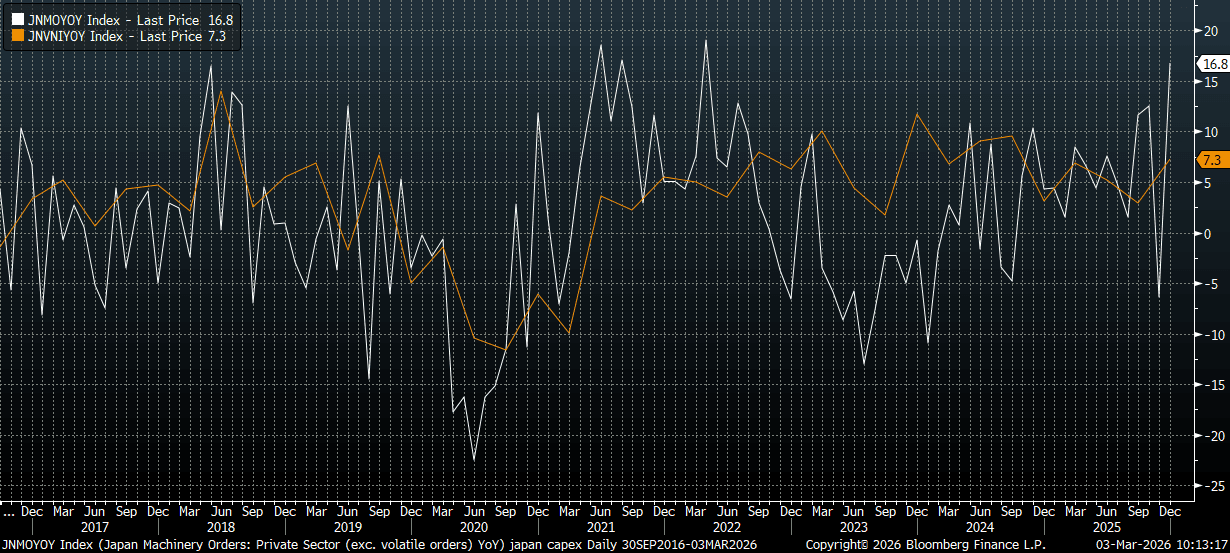
Japan Q4 capex was stronger than forecast. We rose 6.5%y/y for the headline (3.0% was projected, while 2.9% was the prior outcome). Ex software we rose 7.3%y/y (3.9% was forecast, 2.9% was the prior outcome). Company profits were also better than forecast, rising 4.7%y/y (3.0% was forecast), but this was down from Q3's heady 19.7% rise. The capex rise fits with the better end to core machine orders for late 2025. The chart below plots this series, the white line, versus capex (ex software) the orange line. Given the reasonable start to 2026 export growth, we may see better momentum continue into the first part of this year (notwithstanding Middle East conflict risks) in terms of business spending plans.
- In q/q terms capex was up 3.5% (ex software rose 4.0% q/q). The detail showed that non-manufacturing, up 5.4%q/q drove the rise, while manufacturing was -0.2%q/q (after Q3's -5.6% outcome). The initial Q4 GDP estimate showed business spending was a modest 0.2%q/q.
- Profits rose 1.6%q/q, after a 3.8% gain prior. The gain was led by the manufacturing side and the authorities will be hopeful this aids a supportive wages backdrop. The earlier data showed loosening in labour market tightness as the unemployment rate edged up.
Fig 1: Japan Capex (Ex Software) & Core Machine Orders Y/Y
Source: Bloomberg Finance L.P./MNI
JAPAN DATA: Unemployment Rate & Job-To-Applicant Ratio Show Weaker Trends
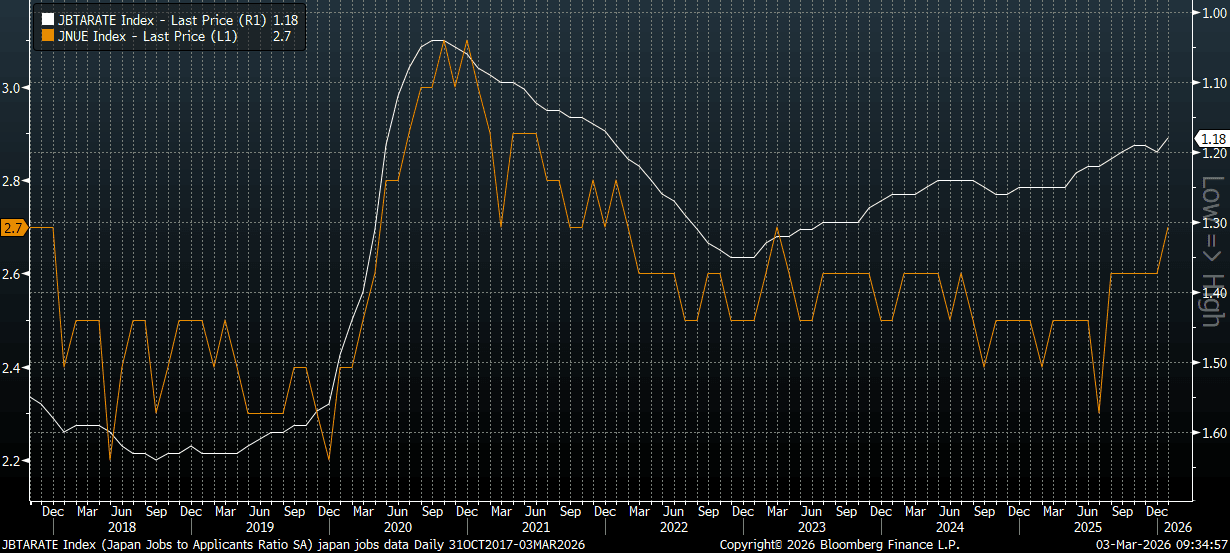
Japan's Jan jobless rate edged up to 2.7%, versus a 2.6% forecast (which was also the prior outcome). The job-to-applicant ratio fell to 1.18, versus 1.20 forecast (which was also the prior outcome). The jobless rate is plotted below (the orange line) and is back to early 2023 highs, while the job-to-applicant ratio, which is also plotted below (the white line) and inverted. It is back to levels last seen in early 2022, and has mostly been on an upward trend since the start of 2023. The focus will be on improving the growth outlook, which is a key focus point for the Takaichi government. A softening labour market backdrop points to less upside pressure in wage outcomes.
- This fits with other data released as part of today's release, with job offers down 5.4%y/y, while new job offers, were down -4.6% y/y. This is up from Nov lows in y/y terms for both series. In m/m terms both series were down a touch.
Fig 1: Japan Unemployment Rate & Job-To-Applicant Ratio
Source: Bloomberg Finance L.P./MNI
AUSSIE BONDS: Sharply Weaker With Global Bonds, RBA Gov Comments Also Weigh
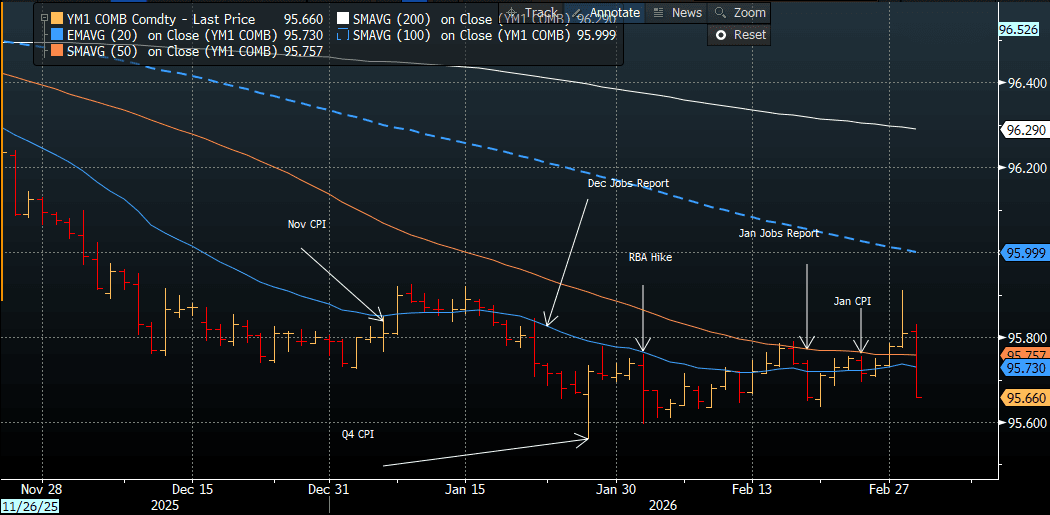
ACGBs (YM -10.0 & XM -9.0) are sharply weaker in line with global bonds, as the haven bid sparked by the weekend's US and Israel strikes on Iran faded.
- The market was also under pressure following RBA Governor Bullock’s comments today. In the Q&A after today’s speech, she noted that every central meeting is live and that she didn't want people to assume that the central bank would only move after quarterly inflation prints.
- The latest ACGB Mar-47 auction saw strong demand, with the weighted average yield coming in 0.99bps through mid-yields. Moreover, the cover ratio was high at 4.7167x. The AOFM plans to sell A$900mn of the 4.75% 21 October 2037 bond on Wednesday and A$800mn of the 1.50% 21 June 2031 bond on Friday.
- Cash US tsys are flat to 2bps cheaper, with a steepening bias, in today’s Asia-Pac session after yesterday’s heavy losses.
- Cash ACGBs are 8-10bps cheaper with the AU-US 10-year yield differential at +68bps.
- The bills strip has bear-steepened, -5 to -9.
- RBA-dated OIS pricing shows tightening across all meetings, with the probability of a 25bp hike rising from 30% for March to 121% by June and 182% by December 2026.
- Tomorrow, the local calendar will see Q4 GDP.
Bloomberg Finance LP
AUSTRALIA DATA: Net Export Drag To Q4 GDP Less Than Forecast, Govt Spend To Add
Australia's Q4 net exports contribution to GDP cut -0.1pps off growth, the same as the Q3 drag. The market expected a -0.3ppts drag, so a slightly better than expected outcome. The ABS also notes that total public demand will contribute 0.3ppt to Q4 growth. This comes ahead of tomorrow's Q4 GDP print. The market consensus is a 0.7%q/q rise (prior 0.4%) and y/y pace of 2.2% (prior 2.1%). The q/q forecast range is 0.5-1.0% at this stage. The focus will be on the domestic demand impulse, particularly as the economy bumps up against capacity constraints.
- RBA Governor Bullock noted earlier that every RBA meeting is live. If we see signs of stronger domestic growth in Q4 last year, it would likely add, at the margins, to rate hike expectations.
- Other data today showed a wider than expected current account deficit -$A21.1bn, versus -A$16.5bn forecast (Q3's outcome was
-A$18.3bn). The ABS noted: ‘The current account balance recorded its second consecutive fall, as the net primary income deficit widened by $2.5 billion.’ The wider primary income deficit was due to a $1.6 billion rise in primary income paid to overseas investors, driven by stronger dividends paid by Australian firms. Adding to this was a decrease of $0.9 billion in income received from Australian investment overseas. The $1.3 billion surplus on goods and services remained steady for the December quarter 2025, as export growth was fully offset by import growth." - Finally, Jan building approvals fell by 7.2%m/m, well below the +5.0% forecast rise (and after a -14.9% dip in Dec). The private sector houses component rose 1.1% after a 1.2% Dec gain. Weakness for the second straight month was in the apartment/townhouse segment.
AUSTRALIA DATA: Q4 GDP Forecast Firms To 0.8%Q/Q After Stronger Partials
The consensus expectation for Q4 GDP growth in Australia has been nudged higher. Now it sits at 0.8%q/q, and 2.3% y/y. This morning, before the last run of Q4 GDP partials (see this link), the consensus was for a 0.7%q/q rise and 2.2%y/y gain (so a 0.1ppts increase). The consensus forecast range for the q/q outcome sits at 0.5 to 1.2%. If the 0.8%q/q outcome is realized it would be the strongest rate of growth since end 2022 (when growth was +0.9%q/q).
- Westpac notes: "We have revised our December quarter GDP nowcast higher, reflecting firmer public investment (+0.1ppts) and a larger contribution from public inventories (+0.2ppts). The latter largely represents a payback from the drag recorded last quarter, rather than a signal of stronger underlying activity."
- It adds: "Australia’s recovery accelerated sharply over the final quarter of 2025, with the economy expanding an estimated 1.1%qtr to be up 2.6%yr in year‑ended terms – the strongest quarterly growth rate since December quarter 2016 outside of the covid pandemic."
RBA: Bullock-Every Meeting Live, Less Wiggle Room On Inflation Given Starting Pt
In the Q&A after her speech, RBA Governor Bullock noted that every central meeting is live and that she didn't want people to assume that the central bank would only move after quarterly inflation prints. Bullock stressed this was not a prediction for the March meeting (held on Mar 17), but noted that inflation is at 3.8% and the unemployment rate at 4.1%, so the board will have to judge if more needs to be done to ensure inflation returns to the 2-3% target over the medium term.
- Bullock acknowledged that Australia has a little less wiggle room from risks of a potential oil price shock (in light of the renewed conflict in the Middle East), given the high starting point for inflation. She added the board would be watching inflation expectations closely. If they become de-anchored then rates will have to go up Bullock added.
- The impact of a energy price shock for the Australian economy was hard to judge, as she said while Australia was a net commodity exporter, it also imported most of its oil needs.
- If it was a longer term conflict, risks become more skewed to impacting economic activity negatively Bullock stated.
BONDS: NZGBS: Cheaper With Global Bonds Haven Bid Is Unwound
NZGBs closed 4–5bps cheaper in line with global bonds, as the haven bid sparked by weekend strikes — with the United States and Israel attacking Iran early Saturday — faded amid a sharp rise in oil prices and renewed inflation concerns.
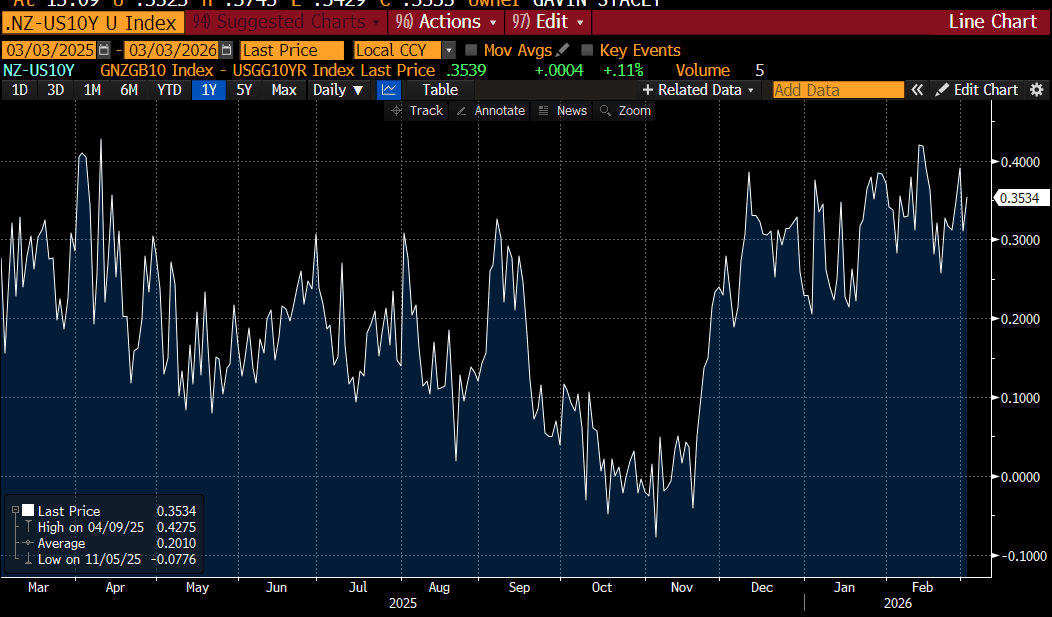
- In relative terms, NZ-US and NZ-AU 10-year yield differentials closed 1bp and 3bps lower, respectively.
- (Bloomberg) “RBNZ Governor Anna Breman will deliver a keynote speech to Business NZ’s CEO Forum in Auckland on March 24. The speech will touch on the current economic outlook, drawing on insights from the February Monetary Policy Statement. Chief Economist Paul Conway will deliver a speech to the Financial Adviser Conference on March 25.”
- NZ Finance Minister Willis, in response to questions, said history suggests that global conflict tends to cause short term volatility in markets, but that over time they settle back close to previous level. - BBG
- Swap rates closed 3-4bps higher.
- RBNZ-dated OIS pricing closed little changed across meetings. No tightening is priced for April, while December 2026 assigns 31bps.
- Tomorrow, the local calendar will see Terms of Trade and ANZ Commodity Price data.
- On Thursday, the NZ Treasury plans to sell NZ$250mn of the 1.50% May-31 bond and NZ$200mn of the 4.5% May-35 bond.
Bloomberg Finance LP
FOREX: USD - BBDXY Looking To Challenge 1195-1200
The BBDXY has had a range today of 1195.13 - 1196.96 in the Asia-Pac session; it is currently trading around 1196. The BBDXY built on the move that started in Asia yesterday as the USD pushed higher, challenging the 1195-1200 resistance. The market has been very bearish the USD especially against EM so it was interesting to see the USD remain well supported against EM and Oil affected currencies, even as US stocks reversed their earlier losses to close flat on the day. The market is not positioned for this, especially in EM where liquidity is at a premium. USD/Asia has moved higher today led by USD/KRW(+1.61%). On the day, watch to see if the USD can continue to build on this strong start to the week and potentially break above the important 1195-1200 area in the coming days. A sustained break above 1200 could potentially signal a deeper pullback.
- EUR/USD - Asian range 1.1683-1.1707, Asia is currently trading 1.1690. The pair remained heavy as the USD built on its gains and oil added to the pair's headwinds. The price does not look great for the bulls now and a sustained close below 1.1700 could signal the potential for a deeper pullback toward the 1.1400-1.1500 area. On the day, having clearly broken out of its recent range I would be looking for rallies to now be faded initially. The first sell-zone is back toward 1.1725-1.1745 and then the 1.1800 area, looking for the move lower to now build for a potential test back toward 1.1500.
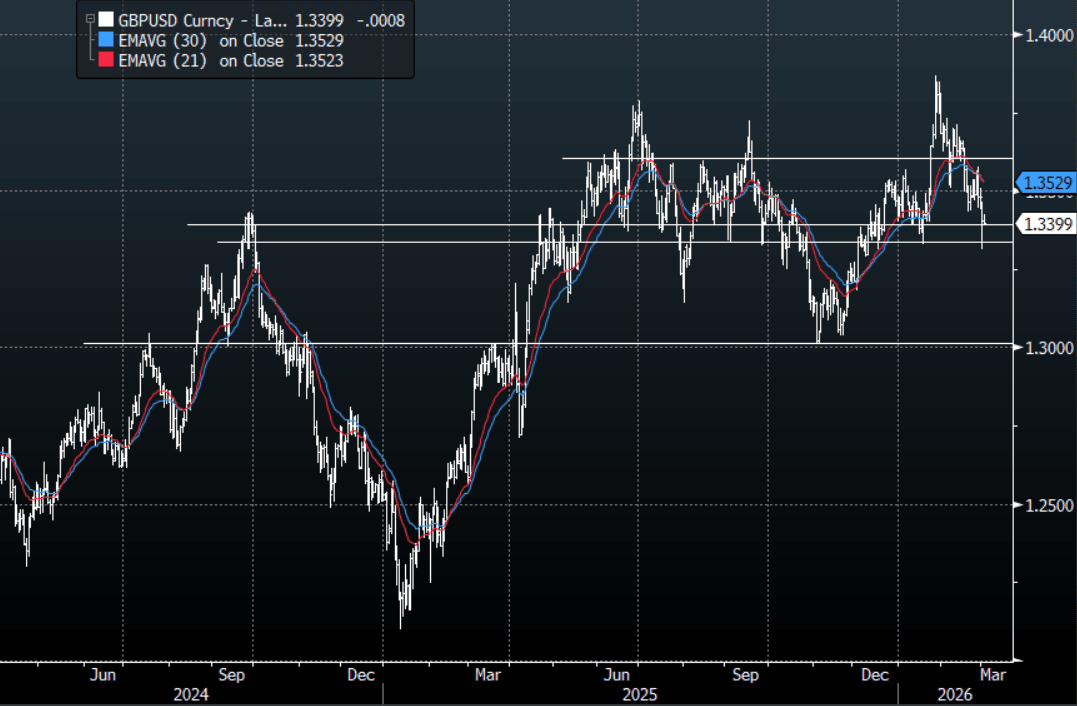
- GBP/USD - Asian range 1.3392-1.3425, Asia is currently dealing around 1.3400. GBP broke through 1.3400 and collapsed lower but could not maintain the move and is back around the breakout level once more. It really needs to hold above the pivotal 1.3300 area for any chance of a base to form. On the day, I suspect rallies toward 1.3450-1.3500 will continue to be faded as the USD looks to build on its gains. Sellers will be looking for the 1.3300 to be challenged, a break could signal a potential top is on place.
- Cross asset : SPX -0.65%, Gold $5375, US 10-Year 4.045%, BBDXY 1196, Crude Oil $62.62
- Data/Events : 11:00 a.m.: Italy February CPI, 11:00 a.m.: Eurozone February CPI, 3:55 p.m.: Fed’s Williams Speaks, 4:30 p.m.: ECB’s Kocher Speaks, 4:40 p.m.: ECB’s Sleijpen Speaks, 5:45 p.m.: Fed’s Kashkari Speaks, UK Chancellor Rachel Reeves delivers her Spring Statement.
Fig 1: GBP/USD Spot Daily Chart
Source: MNI - Market News/Bloomberg Finance L.P
JPY: USD/JPY - Consolidates Gains As It Looks To Test 157.50-158.00
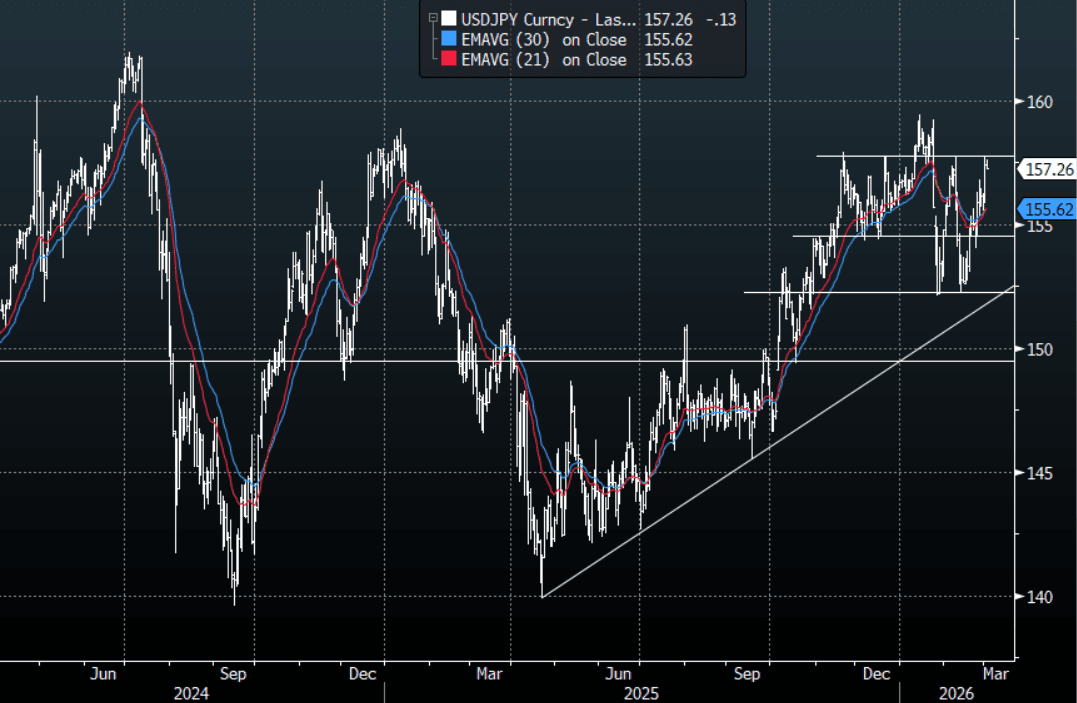
The USD/JPY range today has been 157.18-157.60 in the Asia-Pac session, it is currently trading around 157.25, -0.10%. USD/JPY has been consolidating its recent gains as it looks to challenge this 157.50-158.00 area. The days of the Yen being a safe-haven looks like they have passed, and the momentum higher has been re-asserted as it reacts to the combination of higher oil and a reinvigorated USD. The Yen has even underperformed in the crosses in this environment which just underlines its current malaise. On the day, with the upward momentum reasserted dips are likely to again be supported, first support is back toward 156.40-156.80 and then 155.50. A break above 158.00 and the market will again be looking toward the 160.00 area and then beyond. Expect the jaw-boning by officials to get louder but for now I think we are still a fair way away from them getting involved.
- "JAPAN FINMIN KATAYAMA: HAVING SEEN DOLLAR BEING BOUGHT AS SAFE HAVEN CURRENCY. WILL TAKE APPROPRIATE ACTION WHEN MONITORING SITUATIONS. INTERVENTION IS INCLUDED IN THE JOINT STATEMENT WITH US LAST YEAR” - [RTRS]
- MNI AU - Japan Unemployment Rate & Job-To-Applicant Ratio Show Weaker Trends: Japan's Jan jobless rate edged up to 2.7%, versus a 2.6% forecast (which was also the prior outcome). The job-to-applicant ratio fell to 1.18, versus 1.20 forecast (which was also the prior outcome). The focus will be on improving the growth outlook, which is a key focus point for the Takaichi government. A softening labour market backdrop points to less upside pressure in wage outcomes.
- "TAKAICHI: CHANCE OF SUPPLEMENTARY BUDGET ISN'T ZERO" - BBG
- Options : Close significant option expiries for NY cut, based on DTCC data: 155.00($532m), 155.50($699m), 157.00($1.36b). Upcoming Close Strikes : 153.00($1.16b March 5), 153.25($1.27b March 6) - BBG.
- The USD/JPY Average True Range(ATR) for the last 10 Trading days: 128 Points
Fig 1 : USD/JPY Spot Daily Chart
Source: MNI - Market News/Bloomberg Finance L.P
AUD/USD - Bullock Adds Tailwind To AUD Demand As It Holds Above 0.7100
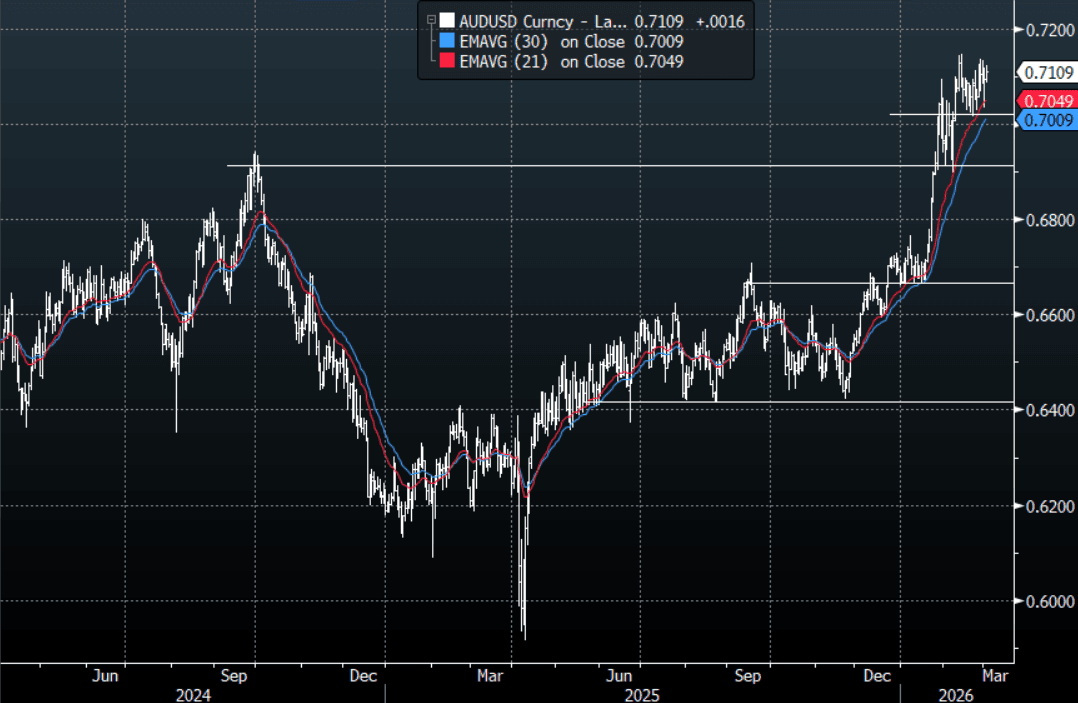
The AUD/USD has had a range today of 0.7087-0.7123 in the Asia- Pac session, it is currently trading around 0.7110,+0.25%%. The AUD has continued its impressive ability to ignore the turmoil happening in the market as it continues to outperform particularly in the crosses, Bullock's speech added to the support. Asian markets got hit hard today being led by a large collapse in the KOSPI which was down over 5% at one point. The AUD has been a favoured long and continues to see strong buying on dips. On the day, it looks like 0.7040-0.7120 as the market tries to get a handle on the geopolitical fallout. A sustained break below 0.7000 is needed to signal a potential deeper pullback, but back above 0.7120-0.7130 and the bulls will have regained control and they would be looking to retest the pivotal 0.7150/0.7200 area.
- MNI AU - RBA-Dated OIS Firms After RBA Governor Speech And Q&A: RBA-dated OIS are firmer today after RBA Governor Bullock, in the Q&A after today's speech, noted that every central meeting is live and that she didn't want people to assume that the central bank would only move after quarterly inflation prints.
- MNI AU - AU Net Export Drag To Q4 GDP Less Than Forecast, Govt Spend To Add: Australia's Q4 net exports contribution to GDP cut -0.1pps off growth, the same as the Q3 drag. The market expected a -0.3ppts drag, so a slightly better than expected outcome. The ABS also notes that total public demand will contribute 0.3ppt to Q4 growth. This comes ahead of tomorrow's Q4 GDP print. The market consensus is a 0.7%q/q rise (prior 0.4%) and y/y pace of 2.2% (prior 2.1%). The q/q forecast range is 0.5-1.0% at this stage. The focus will be on the domestic demand impulse, particularly as the economy bumps up against capacity constraints.
- Options : Closest significant option expiries for NY cut, based on DTCC data: 0.6934(AUD830m), 0.6950(AUD551m), 0.7020(AUD585m). Upcoming Close Strikes : 0.6950(AUD933m Mar 5), 0.7000(AUD1.39b Mar 5), 0.7150(AUD1.35b Mar 5) - BBG
- The AUD/USD Average True Range for the last 10 Trading days: 65 Points
Fig 1: AUD/USD spot Daily Chart
Source: MNI - Market News/Bloomberg Finance L.P
NZD/USD-Trades In The Middle Of Its Range, Albeit With A Heavy Tone
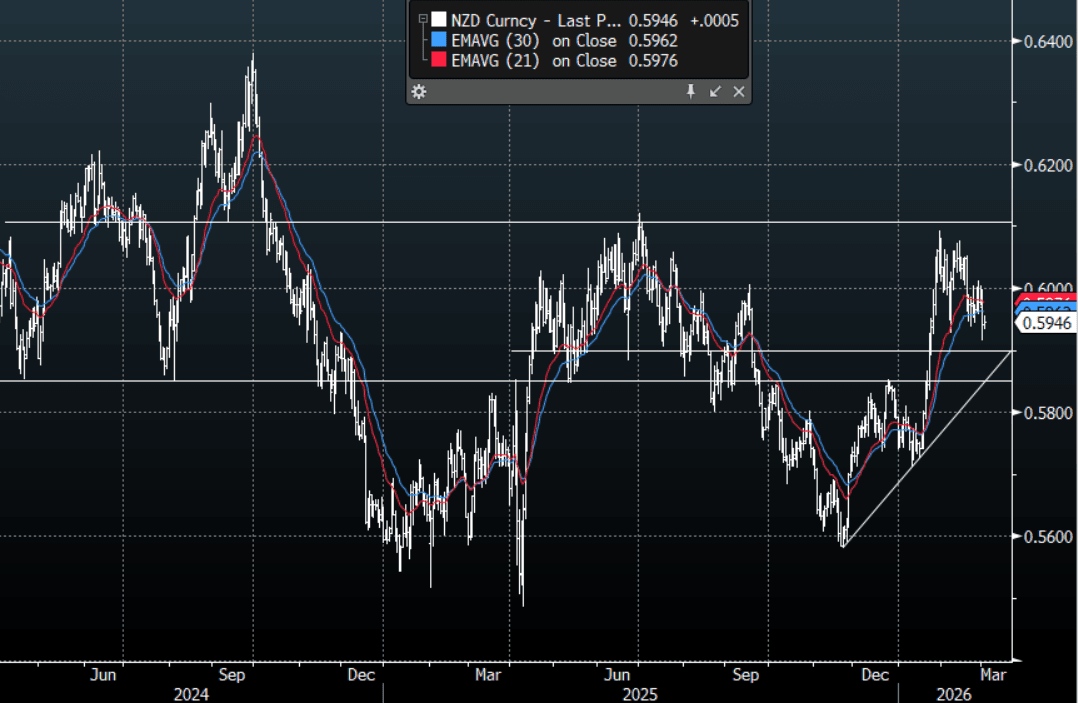
The NZD/USD had a range today of 0.5934-0.5956 in the Asia-Pac session, it is currently trading around 0.5945. The NZD has traded sideways still within its recent range even as Asia saw risk come under big pressure with the KOSPI leading the move lower. The pivotal resistance toward 0.6100-0.6150 continues to cap for now and the dovish read of the RBNZ has delayed its challenge in the short-term and the global turmoil has just added to its headwinds. On the day, price still remains in its 0.5885-0.6015 range albeit with a heavy tone. I suspect rallies will continue to be faded while the USD gets bought as a safe haven, a sustained break below 0.5885/0.5900 could potentially signal a deeper pullback.
- MNI AU - NZ Jan Jobs Filled Up, But Stop/Start Nature Of Job Rises Continues: The stop/start nature of the NZ jobs recovery continued in Jan. Filled jobs rose 0.2%m/m, after a revised 0.3% fall in Dec (which was originally reported as a flat outcome). In y/y terms filled jobs were down 0.2%. The m/m profile has been -0.2% in Oct last year, +0.5% in Nov, -0.3% in Dec and now +0.2% in Jan. Hence there isn't clear signs of a consistent pick up in labour demand. This will feed into RBNZ thinking around holding rates lower as it waits for firmer evidence of economic recovery feeding into the labour market (before it tightens rates). The central bank did state at its last meeting that a rate hike was possible by year end but this wasn't set in stone in terms of its OCR outlook.
- Options : Closest significant option expiries for NY cut, based on DTCC data: none. Upcoming Close Strikes : 0.5950(NZD894m March 5), 0.6000(NZD322m March 6) - BBG
- The NZD/USD Average True Range for the last 10 Trading days: 53 Points
Fig 1: NZD/USD Spot Daily Chart
Source: MNI - Market News/Bloomberg Finance L.P
ASIA STOCKS: KOSPI Back Below 6k; Regional Tourism, Travel, Autos all Struggle
As Korea reopened after yesterday's holiday the catch up was brutal with falls of -5.2%, taking the KOSPI back below 6,000. High flying AI stocks which are up 50-60% year to date fell heavily with SK Hynix down over 8% and Samsung Electroncis 9%. The euphoria for AI tech stocks has seen retail buying in South Korean tech stocks increase significantly in 2026, marking a reversal from the heavy selling seen in 2025. Investors have been encouraged by authorities to redirect capital away from US tech into local names to support the industry.
China's bourses are all down despite earlier attempts by the Hang Seng to rally. Falls are modest for the major indexes, the exception being the tech heavy Shenzhen down -1.3%. Technology & Semiconductor names saw sharp losses. Investors are pivoting away from growth-heavy tech stocks due to fears that rising energy costs will fuel global inflation, potentially delaying anticipated interest rate cuts.
Oil price rises hit the NKY today with airlines and autos hit hard whilst refiners fell over 5% on news that the Straits of Hormuz was shut. Banks continued where they left off Monday with heavy falls whilst defense stocks saw a sharp reversal as traders locked in profits after massive gains on hopes of increased military spending.
SE Asian bourses are outperforming the region today with modest gains. The FTSE Malay is up +0.8% given the surge in oil prices dragging Singapore, and Jakarta with it. The SE Thai in Malaysia ignored the signals falling as rising oil prices are expected to hit an already struggling tourist industry.
OIL: Brent Nears $80, US Strikes Set to Intensify
- After declining modestly at the open, oil prices have surged throughout the day in Asia with the rapid escalation of conflict in the Middle East following U.S. and Israeli strikes on Iran over the weekend.
- The most critical factor is the effective closure of the Strait of Hormuz, a narrow waterway through which roughly 20% of the world's daily oil supply (approximately 20 million barrels) flows. Reports of drone strikes damaging Amazon data centres and other critical infrastructure in the region have further spooked markets. Two drones struck near the US Embassy in Riyadh, pulling Saudi Arabia into a widening conflict among Iran, the US and Israel, and prompting President Donald Trump to vow retaliation.
- WTI opened lower in the Asia trading day trading down to $70.41 before a mid morning surge up to new intraday highs of US$72.77 bbl - a gain of +2.05%
- Brent had traded down at the open to $78.38 before strong gains saw it reach US$79.74 bbl - a gain of +2.6%.
- Senior U.S. officials have indicated that a significant expansion of strikes targeting Iranian missile and naval assets is prepared for the next 24 hours which could see further, significant appreciation of prices as Trump vows 'Whatever it Takes'
Gold Nears January Highs, Readies Test of $5,400 Again
- Gold has traded in a $5,329 - $5,380 range Tuesday drawing close to the January high of $5,417.
- Currently near 5,367 / 5,369 gold has gained +0.80% Tuesday as it appears ready to test $5,400 again having failed in its attempt Monday.
- Following the January 28 high gold fell almost 14%, sending shockwaves through commodity markets and sending multiple online trading platforms bust.
- Singapore is intensifying its focus of being a regional gold hub, tapping local and international banks including JPMorgan Chase & Co. and UBS Group AG to help boost liquidity and make the most of demand from wealthy investors. (per BBG)
- Hong Kong’s Mandatory Provident Fund Schemes Authority is looking into allowing mandatory retirement funds’ investment in gold-backed exchange-traded funds, Sing Tao Daily reports, citing Chairwoman Ayesha Macpherson Lau as saying during a committee meeting at the city’s legislature. (per BBG).
- The gold-to-oil ratio is currently at a historically extreme level of approximately 75:1, nearly five times the long-term historical average of 16:1. Historically, when this ratio exceeds 30:1, it tends to revert violently. For the ratio to normalize to its 16:1 average with gold at current levels, oil would need to almost quadruple.
SOUTH KOREA: 3-Yr Bond Futures Fall Most YTD, BOK on Alert
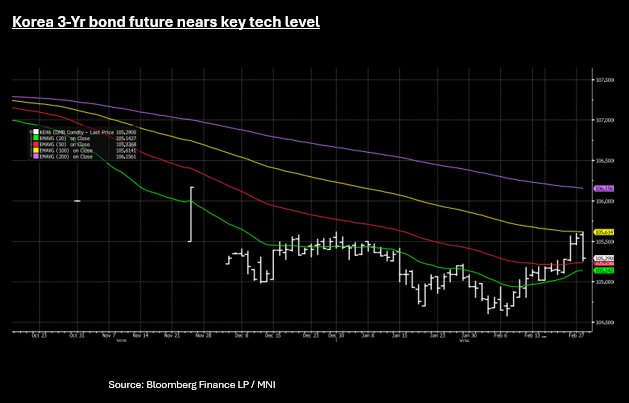
- Korea's 3-Yr bond future has had its biggest one day fall year to date, before easing back from morning lows.
- From Friday's close of 105.54, it opened lower with the 3-Yr reaching 105.25, before settling near to 105.29 - down -0.26.
- The losses take the 3-Yr near to its downside resistance via the 50-day EMA at 105.236. Below the 20-day EMA is at 105.14.
- The 10-Yr future is down also by -0.69 at 112.16, having touched a low of 112.05 earlier, just below the 50-day EMA of 112.09.
- KTB yields continue to climb with the 2-Yr at 2.92% +8.9bps and the 10-Yr at 3.52% +6.9bps.
- Governor Rhee Chang-yong convened a special meeting this morning to assess the impact of weekend airstrikes. The BOK announced it will operate a round-the-clock monitoring system in coordination with its overseas offices to track real-time changes in domestic financial and FX markets. Officials emphasized their readiness to take "appropriate action" and implement scenario-based response measures to minimize economic impact and stabilize financial markets if volatility becomes excessive.
- In late February 2026, Governor Rhee stated that recent market pricing, which saw KTB yields shooting upward since November, was "somewhat overdone". He described current interest rate levels as "excessive" and expected yields to decline as immediate rate-hike concerns subside.
- At that time the 2-Yr reached a peak of 3.01%
CHINA: Bonds Ignore Global Leads, RRR Cuts Preferred
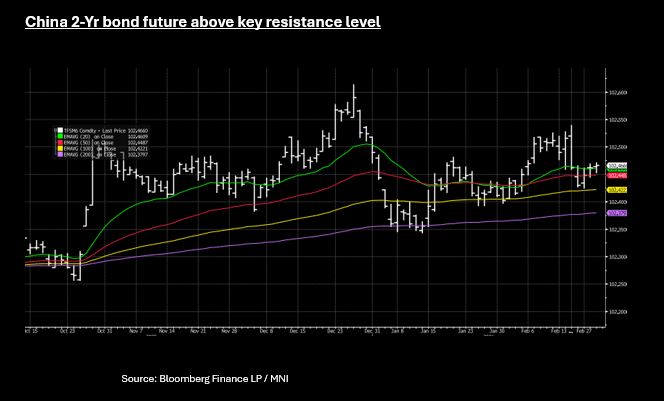
- Despite a strong sell off in regional bonds on inflation fears, China bond futures are flat to modestly lower Tuesday reverting to their usual uncorrelated behaivour.
- The 10-Yr down -0.02 to 108.49, consolidating its position above all major moving averages.
- The 2-Yr is up +.01 at 102.466, attempting to consolidate above the 20-day EMA of 102.46.
- The 10-Yr CGB is testing 1.80% again, down -.01 in yield Tuesday.
- Growing speculation for a policy response from the NPC could be supported by the growing uncertainty in global markets. Current thinking is the most likely response is a RRR cut to 8.50% from 9.00% which is estimated to release CNY1tn. An injection in early 2026 would likely be designed to help banks absorb fresh quotas of central and special local government bonds. In February 2026, the PBOC identified a 3.2 trillion yuan liquidity gap caused partly by heavy government bond issuance.
- According to reports in the China Daily, the PBOC is shifting its framework to increasingly rely on government bond transactions for liquidity management, further tightening the link between released RRR funds and the bond market.
- This increases the chance of a resetting of the range in the 10-Yr to 1.70 - 1.80%..
ASIA FX: CNH Outperforms Post CNY Fixing, HKD Rallies Back To Mid Point
Asia FX is mixed in the first part of Tuesday trade. A standout on the positive side has been the yuan. The USD/CNY fixing was set notably lower than Monday's outcome and error shrank, despite broader USD gains through Monday trade. This was a signal to the market the authorities may want to curb USD/CNY upside, perhaps with concerns around a higher energy import bill driving up domestic cost pressures. In any case, USD/CNH got to lows of 6.8751 before stabilizing. We were last around 6.8930, while Monday highs were at 6.9133. Spot USD/CNY is lower but found support sub 6.8800.
- The strong CNY fixing is likely to reinforce outperformance of CNY in basket terms. The BBG tracker is now at 98.90, fresh highs back to April last year.
- Headlines from BBG has also crossed that the US's Bessent and China's He Lifeng will meet mid March (the end of next week) ahead of the expected Trump-Xi summit. If this materializes it would allay fears of US-China relations being derailed by the recent Iran conflict.
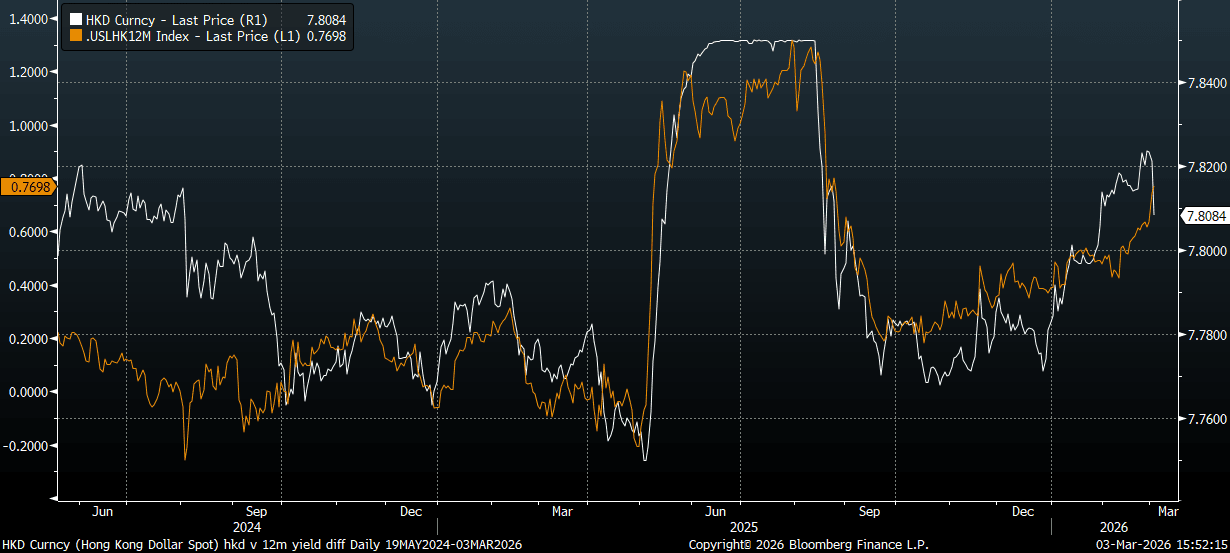
- Spot USD/HKD is also lower, last back under 7.8100. Earlier highs were above 7.8200. If maintained this would be the biggest gain since August last year for HKD, without a clear obvious catalyst. There is no lower US-HK rate differential sponsorship for this move yet (see the chart below). The 200-day EMA is around 7.8000.
- Regional equities are all in the red, although losses for China and Hong Kong markets are less significant compared to elsewhere.
Fig 1: USD/HKD & US-HK 12mth Rate DIfferential
Source: Bloomberg Finacne L.P./MNI
ASIA FX: USD/KRW Spot Near Previous Cycle Highs, PHP Sell-off Continues
Elsewhere, conditions are either close to flat, or weaker versus the USD. The standout is USD/KRW spot, as onshore markets played catch up after yesterday's holiday. We have rallied through 1460, getting to session highs of 1467.80. Given we are close to earlier cycle highs above 1480 we wouldn't be surprised to see increased intervention risks. The authorities noted earlier that they will be monitoring markets. The Kospi has slumped while local bond yields have surged on inflation concerns from the oil price spike.
- USD/TWD is higher as well, in spot terms near 31.57, still sub recent highs near 31.70.
- USD/PHP has continued to climb, now in the 58.35/40 region. The oil price rise, along with the Philippines poor starting point for its external trade position, a clear headwind. President Marco said that FX trends would have to be watched.
- Thailand markets are out today, while USD/MYR is modestly higher, last above 3.9300 (but still sub Monday highs). The oil price rise likely helping to some extent.
- USD/IDR is very steady last around 16870, little changed for the session. BI intervention likely helping curb the pair.
UP TODAY (TIMES GMT/LOCAL)
| Date | GMT/Local | Impact | Country | Event |
| 03/03/2026 | 0700/0200 | * |  TR TR | Turkey CPI |
| 03/03/2026 | 0745/0845 |  FR FR | Budget Balance | |
| 03/03/2026 | 1000/1100 | *** |  EU EU | EZ HICP Flash |
| 03/03/2026 | 1000/1100 | *** | EU | EZ HICP Flash |
| 03/03/2026 | 1000/1100 | *** | EU | EZ HICP Flash |
| 03/03/2026 | 1000/1000 | ** |  GB GB | Gilt Outright Auction Result |
| 03/03/2026 | 1000/1100 | *** | EU | EZ HICP Flash (2dp) |
| 03/03/2026 | 1000/1100 | *** |  IT IT | Italy Flash Inflation |
| 03/03/2026 | - | GB | OBR Spring Forecast | |
| 03/03/2026 | 1355/0855 | ** |  US US | Redbook Retail Sales Index |
| 03/03/2026 | 1455/0955 | US | New York Fed's John Williams | |
| 03/03/2026 | 1510/1010 | US | Kansas City Fed's Jeff Schmid | |
| 03/03/2026 | 1655/1155 | US | Minneapolis Fed's Neel Kashkari | |
| 04/03/2026 | 2200/0900 | * |  AU AU | S&P Global Final Australia Services PMI |
| 04/03/2026 | 2200/0900 | ** | AU | S&P Global Final Australia Composite PMI |
| 04/03/2026 | 0030/1130 | *** | AU | Quarterly GDP |
| 04/03/2026 | 0030/0930 | ** |  JP JP | S&P Global Final Japan Services PMI |
| 04/03/2026 | 0030/0930 | ** | JP | S&P Global Final Japan Composite PMI |
| 04/03/2026 | 0130/0930 | *** |  CN CN | CFLP Manufacturing PMI |
| 04/03/2026 | 0130/0930 | ** | CN | CFLP Non-Manufacturing PMI |
| 04/03/2026 | 0145/0945 | ** | CN | S&P Global Final China Services PMI |
| 04/03/2026 | 0145/0945 | ** | CN | S&P Global Final China Composite PMI |
| 04/03/2026 | 0145/0945 | ** | CN | S&P Global Final China Manufacturing PMI |
| 04/03/2026 | 0730/0830 | *** |  CH CH | CPI |
| 04/03/2026 | 0815/0915 | ** |  ES ES | S&P Global Services & Composite PMI (f) |
| 04/03/2026 | 0845/0945 | ** | IT | S&P Global Composite & Services PMI (f) |
| 04/03/2026 | 0850/0950 | ** | FR | S&P Global Composite & Services PMI (f) |
| 04/03/2026 | 0855/0955 | ** |  DE DE | S&P Global Composite & Services PMI (f) |
| 04/03/2026 | 0900/1000 | ** | EU | S&P Global Composite & Services PMI (f) |
| 04/03/2026 | 0900/1000 | IT | Unemployment | |
| 04/03/2026 | 0930/0930 | ** | GB | S&P Global Composite & Services PMI (Final) |
| 04/03/2026 | 1000/1100 | ** | EU | EZ PPI |
| 04/03/2026 | 1000/1100 | ** | EU | EZ Unemployment |
| 04/03/2026 | 1000/1100 | *** | IT | GDP (f) |
| 04/03/2026 | 1045/1145 | EU | ECB Cipollone Panel at European Investment Bank Group Forum | |
| 04/03/2026 | 1200/0700 | ** | US | MBA Weekly Applications Index |
| 04/03/2026 | - | CN | Chinese People's Political Consultative Conference | |
| 04/03/2026 | 1330/1430 | EU | ECB de Guindos Remarks at American Academy, Berlin |


