US TSYS: Late SOFR/Treasury Option Roundup
SOFR & Treasury options trade outlined below: robust SOFR & Tsy put volumes on net, better early put...
Want to read more?
Find more articles and bullets on these widgets:
Historical bullets
AUDUSD TECHS: Bullish Theme
- RES 4: 0.7310 1.00 proj of the Mar 30 - May 6 - Jun 30 price swing
- RES 3: 0.7278 High May 6 and key resistance
- RES 2: 0.7201 High May 29
- RES 1: 0.7181 76.4% retracement of the May 6 - Jun 30 bear leg
- PRICE: 0.7155 @ 17:56 BST Aug 25
- SUP 1: 0.7075 20-day EMA
- SUP 2: 0.7044/0.6922 50-day EMA / Low Jul 29
- SUP 3: 0.6907 Low Jul 8
- SUP 4: 0.6865 Low Jun 30 and the bear trigger
A bull cycle in AUDUSD remains intact for now and the pair has been trading closer to its recent highs. Price remains above the 50-day EMA, at 0.7044. Last week’s move higher delivered a breach of 0.7120, the 61.8% retracement of the May 6 - Jun 30 bear leg. The move higher strengthens the current bull theme and sights are on 0.7181, the 76.4% retracement point. Support to watch is the 50-day EMA at 0.7044.
US DATA: Richmond Fed Surveys Affirm Softer Services, Solid Manufacturing Theme
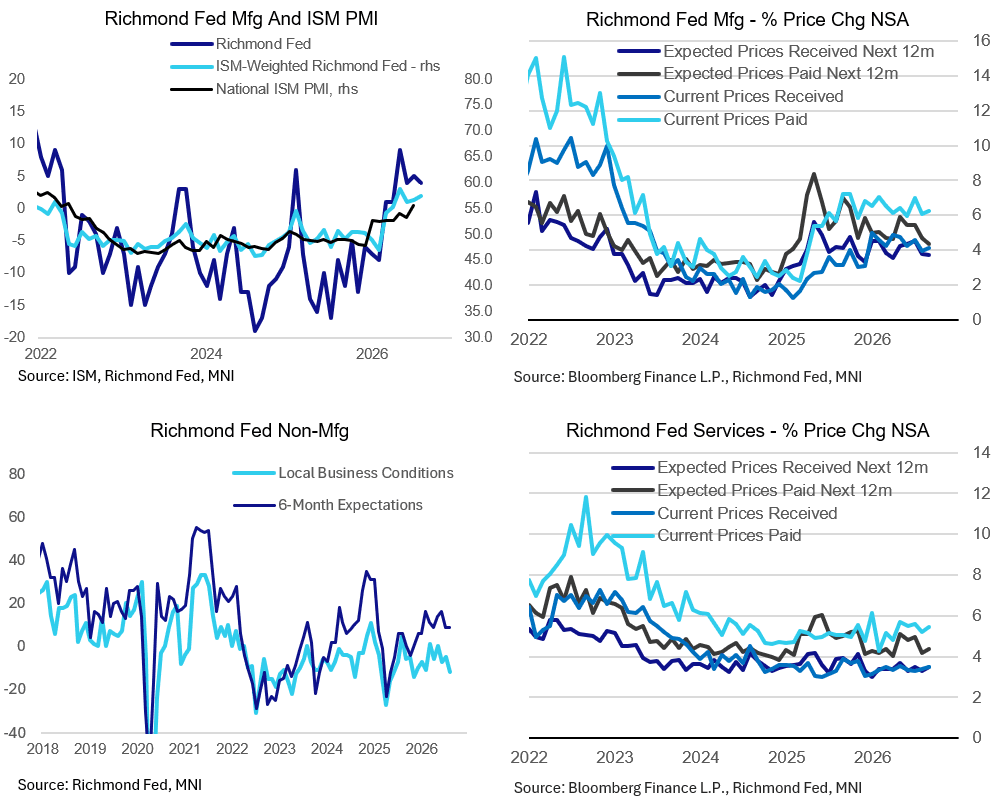
The Richmond Fed's Fifth District surveys showed softer activity and slightly higher prices in August compared with July, among both manufacturing and services firms. But as with other regional Fed surveys this month, manufacturing conditions – including activity remaining around its strongest levels in the past 4 years - appeared to be much stronger than in services/nonmanufacturing.
- The manufacturing composite gauge ticked down to 4 from 5 prior, vs consensus for a rise to 7; as such it remains around recent levels in solidly expansionary territory. We would characterize this report as slightly softer than in the last couple of months to be sure.
- However, declines in New Orders and Employment (worst since February) came alongside relatively steady Delivery Times, and were offset by a 3-month high in Shipments and a 4-month jump in Inventories - meaning the ISM Manufacturing-weighted PMI equivalent rose to a 3-month best 57.4 from 56.6 by MNI's calculations.
- On the services side, the composite's fall to -12 marked the weakest since November 2025 and defied consensus for an uptick to -3 from -5 prior. Demand fell to a 6-month low with sales/revenue at a 15-month worst. Defying these deteriorations was employment, which rose to a joint-5-month high.
- Price pressures picked up across both surveys. For services, current prices paid rose sharply to 5.5% (on a 12-month lookback basis - July's 5.2% was a 4-month low), with received ticking higher to 3.5% for a 4-month high (3.4% prior); expected paid/received prices also rose. And for manufacturing, the 6.2% paid was an uptick from 6.1% prior, with received likewise rising 0.1pp to 4.1%; here, expected price changes pulled back sharply, including paid to a 19-month low and received to a 5-month low.
FED: Senate Democrats Query Warsh On Possible Reduction In FOMC Meetings
Writing "we are concerned that a thinner meeting schedule would cripple the Committee's ability to respond to fast-moving economic conditions, and amounts to a unilateral rewriting of how the Federal Reserve communicates with markets and the American public", six Senate Democrats have asked Fed Chair Warsh to answer multiple questions on proposed changes to then meeting schedule within the next week. Below are the questions:
"Given that reporting indicates a revised schedule could be finalized before the Committee's next required meeting in September, please submit written answers to the following questions no later than September 2, 2026:
- Please confirm whether the FOMC's regularly scheduled meeting dates for 2026 and 2027, as previously published, remain in effect, or whether any of those dates are under consideration for cancellation or postponement.
- At your Senate confirmation hearing, you testified that four meetings a year was "not enough," and that "having more meetings than that is appropriate." Please reconcile that testimony with your current consideration of a reduced meeting schedule, whether your position on this question has changed since your confirmation and, if so, on what basis.
- Please describe any analysis that the Federal Reserve has conducted regarding the impact of a reduced meeting schedule on the Committee's capacity to respond to changes in inflation, employment, and financial stability. Please provide copies of any such analysis.
- Please identify the specific statutory authority under which the Federal Reserve would implement a change of this kind, and clarify whether the Board of Governors, the full FOMC, or some other body has voted on or approved this proposal.
- Did the Federal Reserve consult with, or notify Congress, market participants, task force members, or other stakeholders prior to public reports of this change? If so, with whom and when?
- Do you intend to alter the current cadence of post-meeting press conferences, and if so, how?
- Please state whether this change is intended to be permanent or is being considered on a trial basis, and if the latter, what criteria will be used to evaluate its success or failure."
- (PDF of the full letter here)
- Recall from the July meeting minutes: "The Chairman observed that six scheduled meetings per year, held roughly every two months, would allow more information to accumulate between meetings than under current practice and provide policymakers and the staff more time to consider strategic monetary policy issues. " The NY Times had reported in early August that "Mr. Warsh, who was presiding over his second meeting as chairman, left the impression that a revised schedule could be decided on before the next meeting in mid-September, even if the changes would not be carried out until later."


