ASIA FX: KRW Can't Re-Test 1500, Still +2.5% July To Date, USD/CNH Breaks Lower
In North Asia FX, CNH has rallied, supported by on-going CNY fixing gains, while KRW has struggled, despite a generally softer USD backdrop and fresh FX rhetoric from the authorities. Taiwan markets are out today due to a typhoon.
- Spot USD/CNH has fallen around 0.20% so far today, the pair last near 6.7830. This largely matched BBDXY index falls, with focus on a sharp JPY rally (as the FinMin called for greater Pension investment in Japan assets, sparking JPY repatriation hopes). USD/CNH got to lows of 6.7785 before stabilizing. This breaks a run of generally higher lows in the pair since mid June. The USD/CNY fixing also printed under 6.8000 for the first time since 2023, so underpinning the resilient yuan backdrop against firmer USD index levels.
- Next week we get June trade data, along June home prices and activity figures, along with Q2 GDP. Market consensus expects annual GDP growth to cool to +4.5% YoY, down from +5.0% expansion recorded in Q1. Weak consumer spending and a lingering housing slump have impacted Q2 activity. June's retail sales data will reveal whether mid-year promotions moved the needle. Early indicators point to soft household confidence, making private consumption the biggest drag on the Q2 print and has prompted further government support. Still, weaker data outcomes have yet to impact yuan sentiment, with valuations, the firmer CNY fixing bias and corporate FX conversion all outweighing.
- Spot USD/KRW hasn't been able to re-test sub 1500, the pair last near 1511, up around 0.20% so far today, leaving the won underperforming broader USD softness. The authorities noted the local FX is still out of line with economic fundamentals, but they expect greater exporter support in H2 for the won (via forwards). Equity outflow pressures have slowed as the Kospi rebounds, but it is too early to say if a trend improvement is here. SK Hynix inflows will be in focus up to the middle of July, although the won is up 2.5% so far in July, with MYR (up 0.41%) so some outperformance is potentially already priced in.
- Next week, focus will be on the BoK. A rate rise would be a step forward in combating inflation but also help to support the struggling Won. Long held concerns about the overheated property market would be met with a rate rise also. A rate rise in July is consensus and we see the growing likelihood for 1-2 further rate rises this year.
Want to read more?
Find more articles and bullets on these widgets:
Historical bullets
US TSYS: Cheaper As Oil Rallies On M/E Headlines, Focus Turns To CPI Data
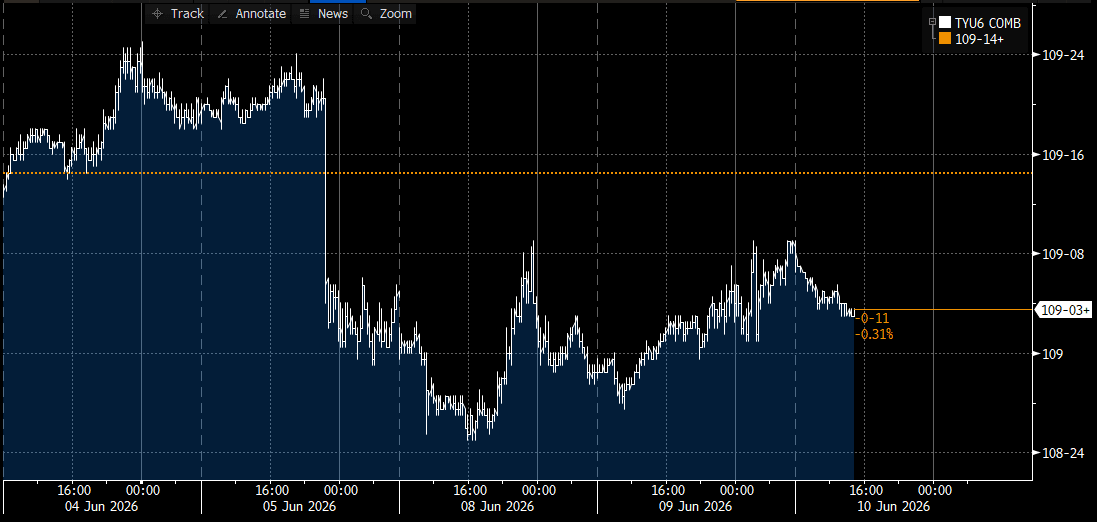
TYU6 is dealing at 109-03, -0-04 from closing levels in today's Asia-Pac session.
- Cash bonds US tsys 2-3bps cheaper in today's Asia-Pac session.
- Oil prices rallied early in APAC trading after news of US attacks on military sites in southern Iran in retaliation for its downing of a US helicopter. They were then supported again by reports of further explosions in southern Iran, which the US confirmed were close to the Strait of Hormuz.
- Also Iran targeted US bases in Kuwait, Jordan and Bahrain and warned countries in the region not to allow the US to use their territory. Once the US said that its action was completed, oil prices eased and are currently slightly higher on the day and above the intraday low.
- The focus now turns to today’s May CPI data. Inflation is expected to moderate to a still elevated pace in May, with MNI unrounded consensus pointing to 0.51% M/M for headline CPI and 0.23% M/M for core CPI. It should see headline CPI jump further to 4.2% Y/Y with a risk of 4.3% (strongest since Apr 2023) whilst core CPI would see a more modest acceleration to 2.8-2.9% Y/Y (strongest since Sep 2025).
Bloomberg Finance LP
AUSSIE BONDS: Modestly Richer, US Tsys Cheaper, AU-US10Y Diff At YTD Lows
ACGBs (YM +3.0 & XM +1.5) are modestly richer on a data light session.
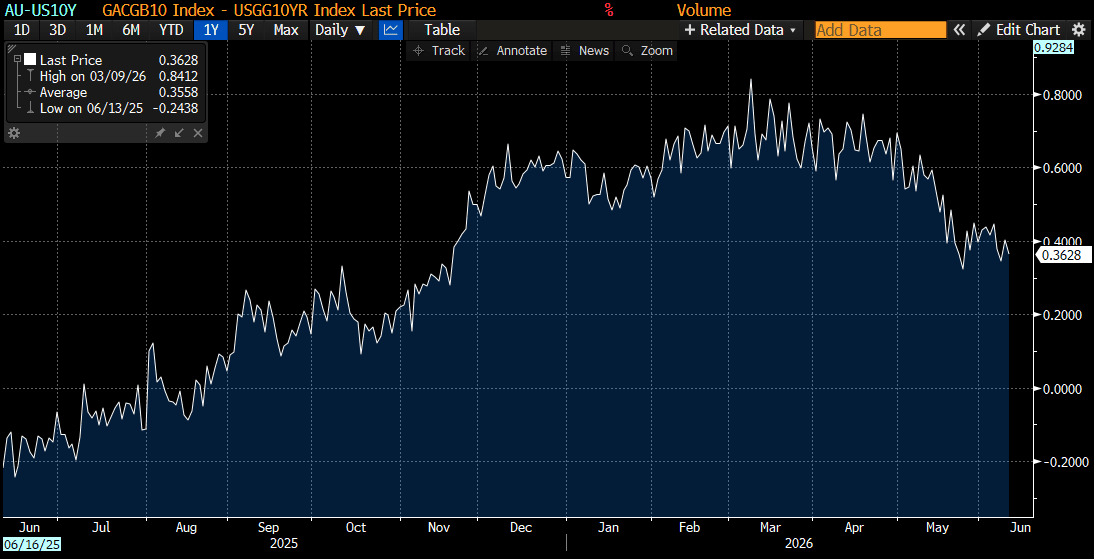
- With cash US tsys 2-3bps cheaper in today’s Asia-Pac session, the AU-US 10-year yield differential is 2bps lower at +36bps, the lowest level this year.
- Oil prices rallied early in APAC trading after news of US attacks on military sites in southern Iran in retaliation for its downing of a US helicopter. They were then supported again by reports of further explosions in southern Iran, which the US confirmed were close to the Strait of Hormuz.
- Cash ACGBs are 1-3bps richer with the 3/10 curve steeper.
- The latest ACGB Oct-37 auction saw solid demand, with the weighted average yield coming in 0.59bps through prevailing mid-yields, according to Yieldbroker, continuing the trend of firm pricing at recent ACGB auctions. Moreover, the cover ratio rose to a solid 4.2450x from 3.7389x
- The bills strip pricing is +2 to +5 across contracts.
- RBA-dated OIS pricing shows tightening across all meetings, with the probability of a 25bp hike rising from 6% for June to 52% by September and 80% by December 2026.
- Tomorrow, the local calendar will see Consumer Inflation Expectation data.
Bloomberg Finance LP
ASIA STOCKS: Rising Inflation Risks / Weaker Tech Sees Bourses Lower
After yesterday's bounce major equity bourses in the region were weak again Wednesday as oil headed higher and uncertainty in the US Iran war dampened risk appetite. The NIKKEI is down -1.7% as all major AI Tech names (bar Tokyo Electron) fell today between 3-4%. Domestic economic data added to the market's unease. Japan's PPI jumped by 6.3% YoY in May, vastly outstripping analyst forecasts of 5.6%. The spike was primarily driven by soaring energy costs and the ripple effects of regional conflicts on critical shipping lanes. Investors are becoming increasingly concerned about potential rate hikes both in Japan and the US ahead of Wednesday's May US CPI, with expectations it could rise to +4.2% and bring forward a rate hike in the US.
The KOSPI fell heavily today with SK Hynix and Samsung down over 7%. Given the launch recently of leveraged AI ETFs in Korea, the liklihood going forward for the AI / tech names is higher volatility given the increased leverage.
China stocks fell today as surging domestic wholesale inflation, a broad global retreat from technology sectors, and escalating U.S.-Iran military tensions heavily weighed on investor sentiment. Whilst over the last year the relationship between PPI and CPI has broken down, the fact that the driver of the higher PPI is oil - and oil price rises impact almost everything - could see a reestablishment of the relationship and spell higher CPI in the months to come. Onshore bourses the CSI 300 and Shanghai are both down around -1% whilst Shenzhen is down -2% and Hang Seng -1.1%


