IRAN: IRAN'S IRGC NAVY: WE WARN AGAINST USING ALTERNATIVE ROUTES IN THE STRAIT
IRAN'S IRGC NAVY: WE WARN AGAINST USING ALTERNATIVE ROUTES IN THE STRAIT OF HORMUZ - [RTRS]...
Want to read more?
Find more articles and bullets on these widgets:
Historical bullets
EURGBP TECHS: Bearish Threat
- RES 4: 0.8747 76.4% retracement of the Feb 27 - Mar 16 bear leg
- RES 3: 0.8742 High Mar 31 and Apr 1 and a bull trigger
- RES 2: 0.8731 High May 18
- RES 1: 0.8694 Intraday high
- PRICE: 0.8634 @ 15:37 BST Jun 22
- SUP 1: 0.8618 Low May 25
- SUP 2: 0.8610 Low Mar 16 and the bear trigger
- SUP 3: 0.8597 Low Aug 14 ‘25
- SUP 4: 0.8576 Low Jul 2 ‘25
A sharp sell-off Monday in EURGBP highlights a bearish threat and recent gains appear to have been corrective. Note that moving average studies are in a bear-mode position and this also continues to highlight dominant downtrend, suggesting gains are corrective. The key support and bear trigger lies at 0.8610, the Mar 16 low. Key short-term resistance has been defined at today’s 0.8694 high.
BOC: Analysts Don't See Broadening Inflation Threat In May Data
Some Canadian analyst takes on May's CPI report below. Overall analysts saw little sign of energy prices bleeding through convincingly into broader, more persistent inflation in the data. Predictably, we didn't see any BOC rate view changes vs pre-release/post-June BOC, with the overwhelming consensus being for a hold through 2026 with hikes in 2027 (the exceptions: BMO sees hold through both years, Scotia sees hikes starting in Q4 2026).
- BMO: "After a string of lower-than-expected core results in previous months, May's heavy headline reading stings somewhat. However, the reality is that core remains essentially right on target, and the recent big pullback in oil prices—if sustained—will deliver some important relief on headline readings in coming months. Still, the persistence of food inflation is a significant thorn, and we have to rate this one as a mild disappointment overall—it's never good news to see the overall inflation rate track above 3%, even if it is for one month only."
- Desjardins: "So far, higher energy prices do not appear to be feeding meaningfully into underlying inflation ...Air transportation prices rose 7.4%, reflecting growing airline operating costs, particularly for jet fuel. However, price pressures were not limited to energy. Some goods-related categories continuing to see notable gains, including fresh fruit (5.3%). Durable goods advanced 1.9%, partly reflecting higher prices for computer equipment, software and supplies (3.9%) due to strong demand tied to AI data centre investment...Despite today’s headline inflation print, it is unlikely to influence a change in interest rate policy given limited movement in underlying inflation. Our latest outlook expects inflation to peak in Q2 2026, followed by a gradual slowdown. Although further surprises cannot be ruled out, this points to the peak in price pressures potentially being behind us."
- National: "Since inflation in Canada was already well under control before the recent oil shock, we have argued that the Bank of Canada should look through the rise in energy prices and leave interest rates unchanged for now. This morning's inflation report does not alter that view. Core inflation remains generally contained. The economy is showing some signs of improvement after two difficult quarters, with recoveries in GDP growth, the labour market, and the housing market. However, subdued core inflation suggests that the economy continues to operate with some excess supply. In a loose labour market, wage growth has slowed significantly, and we doubt that workers are well positioned to negotiate compensations. In this context, we believe that the risk of second-round effects, such as wage-driven inflation stemming from higher energy prices, remains limited, especially since some relief is already expected as early as June with the de-escalation in the Middle East. In our view, interest rates do not appear accommodative in an environment characterized by geopolitical uncertainty and ongoing trade tensions with Washington. Overall, current conditions continue to support a patient approach from the Bank of Canada."
- RBC: "The Bank of Canada has repeatedly highlighted the risk that higher oil prices could eventually feed through to a broader range of goods and services prices. However, there remains limited evidence of such spillovers in the May inflation report. Inflation pressures continue to be concentrated in a relatively small number of categories, while broader measures of price growth remained contained. That is consistent with our view that while higher energy costs can gradually filter through supply chains, a weak economy and still-elevated labour market slack are limiting businesses' ability to pass higher costs on to consumers. Overall, the May report suggests headline inflation remains heavily influenced by energy prices while underlying inflation trends continue to move broadly in line with the Bank of Canada's inflation target."
- TD: "Despite the upside surprise on the headline print, the market is deciding to focus on stable core inflation - leaving rates essentially unchanged prior to the print. BoC pricing has been comparatively stable during June, and it feels the market is experiencing some selling exhaustion around headlines and data surprises (or shifting to express these views further out the curve). Our thesis around the BoC remains unchanged, and if anything, this just re-affirms they can remain patient on the sidelines as impacts from the Iran war materialize in the data."
US: Americans Want Iran Conflict Ended Despite Concerns Over Strategic Success
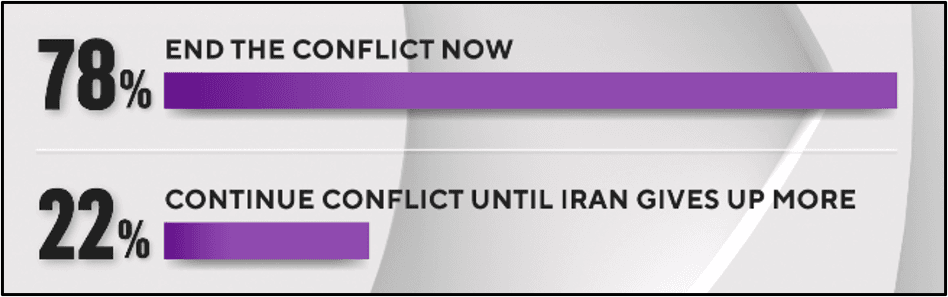
A new survey from CBS News/YouGov has found that 78% of Americans want to see the conflict with Iran ended now, despite large majorities believing that the US, “did not succeed in its strategic or economic interests” and concerns that the war, “has not been worth the costs.”
- CBS notes, “Specifically, most Americans suspect Iran's nuclear program has not been permanently stopped, and that Iran will not stop threatening its neighbors… few feel the U.S. has made Iran's people safe and free or changed Iran's leadership to one that is pro-U.S.,” and, “A majority believe Iran will still threaten its neighbors in the region.”
- The report adds, "There are some divisions inside the president's party about the approach from here.
- A sizable four in 10 Republicans say the conflict should continue until Iran gives up more: that subgroup also overwhelmingly thinks it's not acceptable to leave the current regime in power in Iran."
Figure 1: “The Conflict with Iran: What Should the US do now?”
Source: CBS News/YouGov


