FOREX: Huge Risk Boost Has Moderate Impact on USD, Cross/JPY Shifts Lower
Apr-17 17:16
- Risk sentiment received a significant boost on Friday, as latest headlines indicate substantial progress towards peace deals in the Middle East. Energy prices have plummeted prompting an associated surge for both equities and bonds. Initially, the dollar sold off as expected, prompting the DXY to bridge the gap to Feb 27 (pre-war) closing levels, however the index is comfortably off its lows as we approach the weekend close.
- The contained price action and USD reversal has raised some eyebrows, but it could be the relatively limited appetite in currency markets has restricted the dollar from meaningfully breaking out. Cross/JPY has held the bulk of its move lower, which makes sense given the concurrent moves for both energy prices and core yields.
- Having flagged a bull channel earlier in the session, USDJPY’s swift break below 159.00 has accelerated downside momentum, which has been bolstered by a break of the 50-day EMA, which intersected today at 158.13.
- Pre-war levels remain much further down for USDJPY, perhaps a reason for the pair’s relative weakness today. Technical supports are located at 156.46 and 155.85, the March 05 and 02 lows respectively.
- The Australian dollar now remains among the strongest G10 performers on the session amid the risk optimism, setting up a very positive close for AUDUSD close to the 0.72 handle, the highest weekly close since H1 ‘22. With the bull trigger cleared this week, AUDUSD’s next technical target would be 0.7296, the top of a bull channel drawn from the Apr 9 ‘25 low.
- EURUSD rallied to a 1.1849 high before reversing the entirety of the intra-day rally, sliding back towards unchanged levels around 1,1785 as we approach the close. Initial key support to watch lies at 1.1660, the 50-day EMA.
- China LPR Decision and Canada CPI highlight the economic calendar on Monday.
Want to read more?
Find more articles and bullets on these widgets:
Historical bullets
CHF: USD Maintains Bullish Tilt, CHF Underperforms Ahead of SNB
Mar-18 17:14
- Since the earlier spike higher for energy prices, the associated dollar rally has lost steam, with the DXY sitting around 15pips off the earlier session highs as we approach the March Fed decision.
- While the moderate fade for the dollar has been most notable against the likes of AUD and NZD, higher core yields have kept the Swiss Franc on the backfoot, with USDCHF printing fresh session highs and testing 0.7900 at typing. Recent highs at 0.7923 remain the immediate points of reference on the topside. Moving average studies appear to be turning in a positive direction for USDCHF, with solid support now found around the 0.7815 mark.
- The weaker franc has also boosted EURCHF on Wednesday, which has now extended its bounce from 0.8981 cycle lows to over a big figure. Most recent price action has seen EURCHF breach its 20-day EMA, which had acted as good resistance since mid-Jan. Further strength would focus in on the 50-day at 0.9142.
- Analysts see a hold at 0.00% at Thursday’s SNB meeting as the probable outcome. Against the backdrop of Swiss inflation printing close to the lower boundary of the SNB’s definition of price stability, focus will be on any signals on the balance of risks around CHF appreciation on the one hand against higher energy prices on the other. Our full preview is here: https://mni.marketnews.com/4rxK0VD
US: President Trump's Approval Rating Hits Low Amid Iran War Fallout
Mar-18 17:13
US President Donald Trump's approval rating has hit a new low of net -15.3%, surpassing a previous low of -15% on February 15, amid the fallout from the Iran war and global energy crisis, according to Silver Bulletin.
- The outlet noted in a previous update, "We’re no longer seeing a rally-around-the-flag effect — meaning a boost in presidential popularity at the beginning of a conflict — but Trump’s support hasn’t declined either... If the war results in additional American casualties, or if gas prices continue to spike, it’s entirely possible that Trump’s approval rating will decline as a result."
- In a new survey today, YouGov recorded a significant spike in economic pessimism. Morning Consult reports that Iran has "further eroded Trump’s standing amid cost concerns", and Semafor notes that US diesel prices surpassed $5 per gallon on Tuesday for the first time since 2022.
- Axios writes, “Diesel fuels the shipping economy. Higher prices to fuel tractor-trailers, trains and many ships can ripple through supply chains and raise costs for nearly everything.”
Figure 1: President Donald Trump's Approval Rating
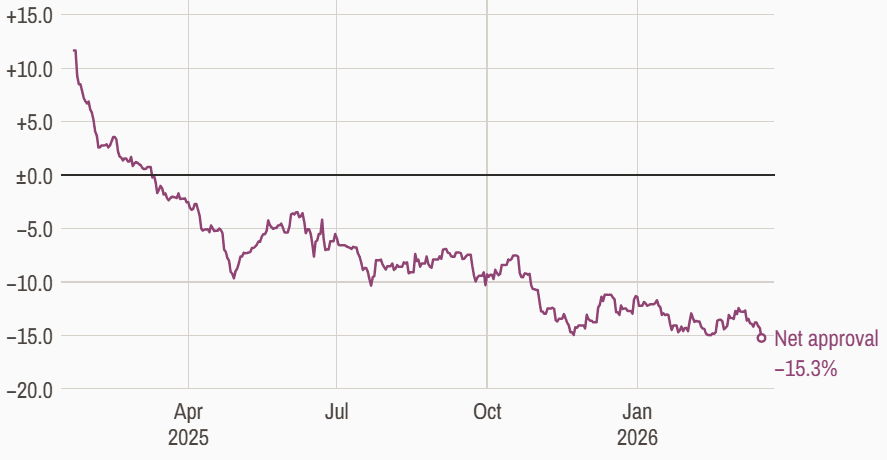
Source: Silver Bulletin
FED: Statement: 1, 2, or 3 Dissenters? (2/2)
Mar-18 16:54

- A change to the forward rate guidance would of course be impactful, but given prevailing uncertainty and Committee discord over the path forward, we doubt there is sufficient decisiveness to make an amendment here.
- The Statement added “extent and timing” in December to signal that after 3 consecutive cuts, the easing bias remains but the pace has slowed and the next move will be data-dependent. That’s still enough to convey the Committee’s optionality and non-commitment on future rates.
- There’s no doubt that the undercurrent for guidance is in a hawkish direction, with the January meeting minutes noting “Several participants indicated that they would have supported a two-sided description of the Committee's future interest rate decisions, reflecting the possibility that upward adjustments to the target range for the federal funds rate could be appropriate if inflation remains at above-target levels.”
- MNI’s Instant Answers questions for the meeting include a tally of dissenters. Gov Miran looks likely to dissent (again) in favor of a 25bp reduction, and he may again be joined by Gov Waller who said in February that his decision on the meeting would be a “coin flip” that would be decided by the incoming February payrolls and CPI data. A third dissent – by Gov Bowman – is unlikely (she didn’t dissent in January) but not unthinkable.
- Indeed many analysts expect 3 dissents.
- The Implementation Note could at some point include a tweak of administered rates, including a nudge lower in the interest rate paid on reserve balances from the current 3.65%, or the standing repo facility rate of 3.75%. We continue to include these in our Instant Answers, just in case – once again we don’t expect any move at this meeting.
- Additionally the Fed is due to update soon on its reserve management purchase tempo. It has said it will dial back purchases from the existing $40B/month once the mid-April tax season (which drains reserves / liquidity) is at an end. The current NY Fed bill buying schedule runs through April 7, with the new one due to be published April 13, so we wonder if there will be a signal provided ahead of time as to the exact size of future monthly RMPs.


