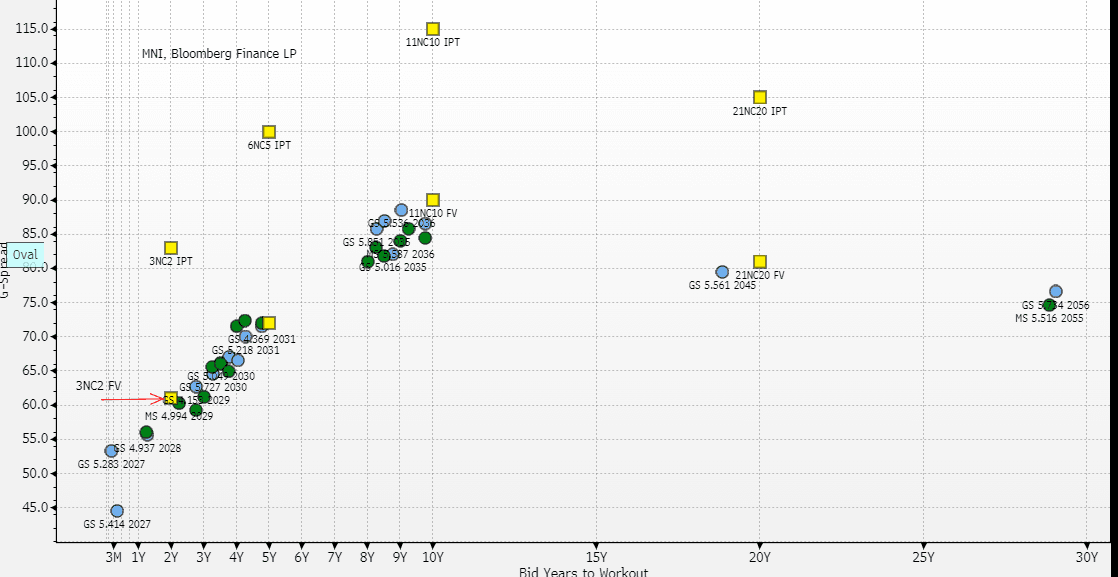
US IG FINANCIALS: Goldman Sachs $Benchmark Debt Offering in 6 Parts FV
- MNI FV 3NC2 +61a, 6NC5 +72a, 11NC10 +90a, 21NC20
- IPT 3NC2 low 80s, 6NC5 +100a, 11NC10 +115a, 21NC20 +105a
- IPT 3NC2 FRN, 6NC5 FRN: SOFR Equiv
- FV
- Issuer: Goldman Sachs Group Inc/The (GS)
- Format: SEC registered, senior unsecured
- A2/BBB+/A (expected)
- Bookrunners: GS
Want to read more?
Find more articles and bullets on these widgets:
Historical bullets
EQUITY TECHS: E-MINI S&P: (H6) Corrective Pullback
- RES 4: 7100.00 Round number support
- RES 3: 7048.21 2.0% Upper Bollinger Band
- RES 2: 7014.00 High Oct 30 and the bull trigger
- RES 1: 6932.25/6988.00 High Dec 15 / 12
- PRICE: 6864.50 @ 14:28 GMT Dec 16
- SUP 1: 6830.94 50-day EMA
- SUP 2: 6785.50 50.0% retracement of the Nov 21 - Dec 11 rally
- SUP 3: 6737.71 61.8% retracement of the Nov 21 - Dec 11 rally
- SUP 4: 6684.50 Low Nov 24
A bull cycle in S&P E-Minis remains intact and the latest pullback - for now - is considered corrective. Initial support to watch is 6830.94, the 50-day EMA. A clear break of this average would signal scope for a deeper retracement. Note that the key support and reversal trigger lies at 6583.00, the Nov 21 low. For bulls, a resumption of gains would refocus attention on the key resistance and bull trigger at 7014.00, the Oct 30 high.
US TSY FUTURES: BLOCK: Mar'26 2Y Sale
- -5,000 TUH6 104-11.5, post time bid at 0929:08ET, DV01 $199,000.
- The 2y contract trades 104-11.38 last (-.25)
US DATA: Unemployment Rate Jump Driven By Prime Joblessness, But Caveats Abound
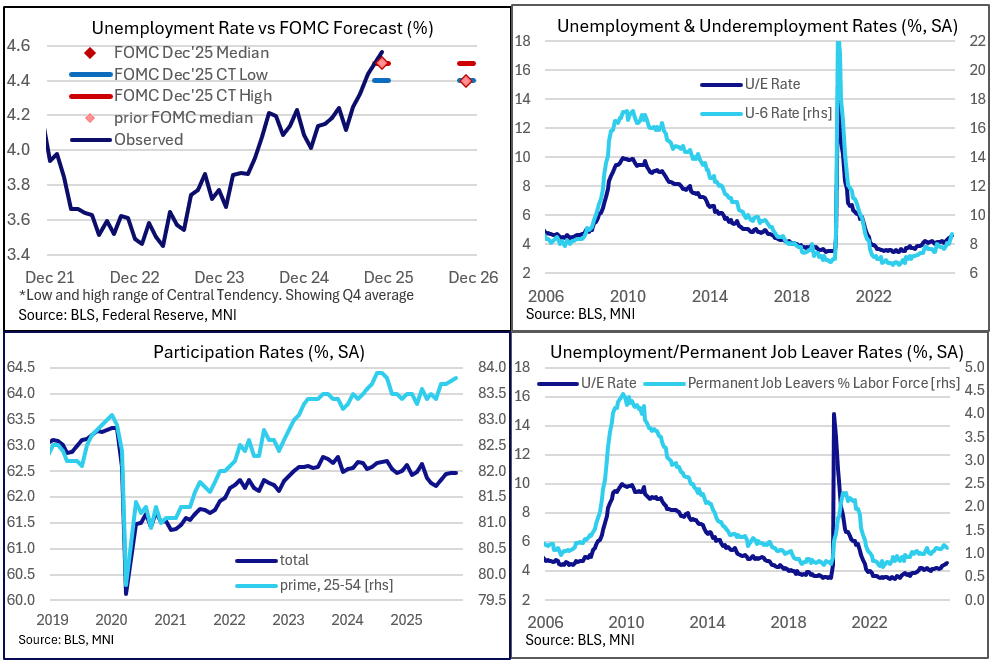
The rise in the unemployment rate to 4.56% unrounded in November from 4.44% in September represented a higher-than-expected reading and a fresh high for joblessness since September 2021. Analyst median consensus was 4.5%, with many more leaning toward 4.4% unrounded than 4.6% - and while the interpolated 0.06pp average monthly increase implies a slower pace of rises vs the preceding 3 months, this puts the U/E rate on track for an overshoot of the FOMC's 4.5% median expectation for Q4.
- Prime-age unemployment rate picked up to 3.91% (highest since Oct 2021) from 3.65% over the course of the two months, with the 0.26pp rise far outpacing the 0.12pp overall increase. And other signs of loosening, the U-6 underemployment rate jumped to 8.7% from 8.0%, easily the highest since August 2021, while the teenage unemployment soared 3.1pp to 16.3%, a post-August 2020 high. And employment grew by just 96k over 2 months, after rising an average 270k in each of September and August.
- However, there are many caveats to the above that imply some oddities in November's collection, above and beyond the late and longer survey period.
- The actual number of unemployed rose only 228k over the two months, an average of 114k which would be on the low side of the preceding 4 months' change.
- And this was driven too by re-entrants to the workforce: 293k over 2 months, a figure not seen since 2021, and arguably a sign of increased confidence in the labor market. In contrast, job leavers totaled only 34k (171k of which were due to temporary layoff, with -136k not on temporary layoff - both outsized numbers for these series and unclear whether affected by the federal shutdown). Permanent job losers fell, both in raw numbers and as a % rate of the workforce (1.13% from 1.18%).
- With participation ticking marginally higher to 62.47% from 62.45%, amid a 323k 2-month rise in the labor force, the overall unemployment rate was nudged higher. Prime-age participation increased 0.1pp to 83.8%, highest since September 2024. For 16-24 it jumped 0.4pp to 55.9%, highest since April (partly explaining the teenage unemployment jump), with 55+ dipping 0.2pp to 37.9% as part of a secular trend that brought it to the lowest level since 2006.
- Prime employment-population dipped to the lowest since July.