US NATGAS: EPNG – Force Majeure - Line No. 1204 – Dilkon to Leupp
Aug-06 20:01
EPNG has declared a force majeure on Line No. 1204 downstream of the Dilkon Compressor Station in Na...
Want to read more?
Find more articles and bullets on these widgets:
Historical bullets
US TSYS: Tsys Extend Late Session Lows, Iran Oil Waiver Revocation
Jul-07 19:59
- Risk sentiment retreated late Tuesday after the US Treasury revoked General License X issued on June 21, 2026 and issued Iran-related General License X1 today. Revocation comes after several vessels transiting the Strait of Hormuz, including from Saudi Arabia and Qatar, were attacked by Iranian forces - authorizations for Iranian crude imports into the US made on June 21st is no longer authorized.
- Treasuries extend late session lows: TYU6 tapped 109-07.5 (-13), 10Y yield +.0678 to 4.5371%. First key support to watch is 109-06, the Jun 22 low. Clearance of this level would be bearish. A resumption of gains would open 110-14, a Fibonacci retracement.
- Cross asset update: US$ index gaining (BBDXY +1.81 at 1220.70), WTI Crude extended rally: WTI +3.90 at $72.45/bbl. Stocks remain weaker, IT and Industrial sector shares leading the decline.
- Projected rate hike pricing rose vs. late Monday levels (*): Jul'26 at +6.8bp (6.3bp), Sep'26 at +19.2bp (+16.9bp), Oct'26 at +24.8bp (+21.8bp), Dec'26 +33.9bp (+30.1bp). The June FOMC meeting minutes (out Jul 8 at 2pm ET) will bring more scrutiny than the typical releases, given the
significant changes in both communications strategy and Committee rate leanings that occurred at the meeting. - The goods & services trade deficit was a little smaller than expected in the full May release at $77.6bn (sa, cons $78.4bn) after a downward revised $54.6bn (initial $55.9bn) in April. It was driven by the goods deficit sliding to $106.5bn from $82.9bn (broadly implied by the advance goods-only data) whilst the services surplus was little changed at $28.9bn after $28.3bn.
- ADP private employment increased an average 21k in the four weeks to Jun 20. It's the softest reading since mid-March as the weekly tracker continued to slowly moderate after some particularly strong ~40k increases in late March/early April and then again in early May.
- Look ahead to Wednesday: After the RBNZ meeting, the focus will turn to the FOMC minutes of the June meeting, the first with Chair Warsh at the helm. Elsewhere, RBA Assistant Governor Hunter is due to participate in a panel discussion about macroeconomic policy.
FED: June FOMC Minutes: Analysts Eye Views Of The Balance Of Risks (4/4)
Jul-07 19:56
Some analysts' expectations for the July FOMC minutes:
- BofA: "markets will focus on the discussion around rate hikes and task forces."
- Deutsche: "we will look for details about the growing chorus of calls for rate hikes and the “family fight” Warsh described in his presser."
- JPMorgan: “We don’t expect material format changes…but the risks clearly tilt toward less transparency in Fed communications.”
- NatWest: "could show some “behind the scene discussions” around the “good family fight” Chair Warsh mentioned at his FOMC presser and recent ECB policy panel appearance".
- TD: "may reveal more about the policy debate than Chair Warsh did at his press conference. The apparent "family fight" likely focused on whether policy was restrictive enough given rising inflation risks. While "many" participants likely saw a case for both hikes and holding steady this year, the Committee's recent hawkish tilt suggests "most" could have favored renewed tightening if inflation continues to surprise to the upside. There is also a risk the minutes provide limited detail, reflecting both the shorter post-meeting statement and Chair Warsh's efforts to curb forward guidance."
- Wells Fargo: "We will look ... for any signs of what could shift a divided Committee from a hold toward rate hikes. The dot plot from the last meeting made clear that policymakers are split on whether rate hikes are warranted, but with forward guidance getting tamped down under Chair Warsh, the Fed's reaction function remains uncertain in terms of what exactly would build broader support for more restrictive policy. We will be looking to whether a majority of participants view the recent pickup in inflation as persistent enough to warrant additional tightening or as primarily a temporary supply-shock. We will also be interested to see the extent to which Committee members view the labor market/the demand side of the economy as an inflationary problem. While the minutes may lean hawkish, we continue to view recent inflation strength as being driven largely by supply side factors, including tariffs and energy, that should fade over time. Since the June meeting, oil prices have fallen further, which should help ease concerns that energy-related inflation will broaden further. And the June employment report showed no signs that the labor market is overheating or contributing to broader inflationary pressures. We thus continue to expect the FOMC to keep the funds rate on hold for the foreseeable future."
- Wrightson ICAP: "will be scrutinized for hints about how the committee views the balance of risks on each side of its dual mandate.
FED: June FOMC Minutes: Eyeing Reforms And Policy Implementation (3/4)
Jul-07 19:50
Communications/Task Forces: Of course, we also wonder whether the Minutes will follow the usual format given Chair Warsh’s drive to revolutionize FOMC communications. The June Statement was completely revamped and truncated, with a seeming emphasis on inflation fighting ("The Committee will deliver price stability"), and no reference to forward guidance, thus ending the long-standing easing bias.
- Warsh promised regime change and took the opportunity at the June press conference to announce the formation of five task forces focused on: communications, the balance sheet, economic data, productivity and jobs, and the Fed’s inflation framework. Warsh said on July 1 that this week (Jul 6-10) we could hear some announcements on some appointments for those task forces; in the Minutes we will be looking for any of the Committee’s discussions on those topics though we would expect them to be preliminary at best.
Eyeing Policy Implementation Language: The discussion around the language on monetary policy implementation is also of interest.
- Amid a complete overhaul, the Statement introduced "The Committee reaffirmed its policy of maintaining ample reserves in the banking system". Previously that was implicitly understood to be the FOMC's position on reserve management; now it's codified in the statement. The reason for this may have been twofold. First, it's well-known Warsh wants to shrink the Fed's balance sheet considerably, and affirming the commitment to an ample reserve regime in the Statement shows there won't be an imminent shift.
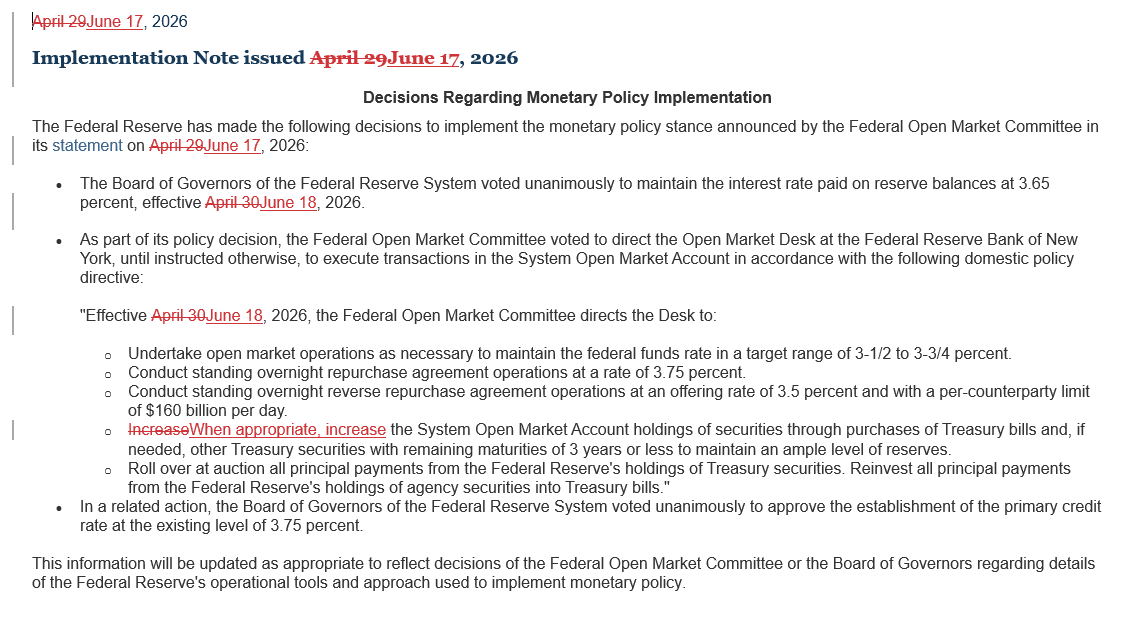
- Second, the Implementation Note accompanying the decision subtly changed a key line on the NY Fed's instructions on reserve management purchases: instead of directing the Desk to "increase" holdings via bill purchases, it now says "when appropriate, increase" them. That apparent conditionality means the RMP program is very much flexible from month-to-month; the latest $10B/month of purchases could be dialled back to zero for example. But the commitment to ample reserves in the statement was probably intended to alleviate any lingering concerns that the Fed is moving in that direction, and Warsh has said that it would take a significant amount of time for any meaningful balance sheet reduction to be achieved.