BONDS: EGBs-GILTS CASH CLOSE: Curves Bear Steepen On The Week
European bonds posted a second consecutive mixed session Friday, with Gilts outperforming EGBs. * I...
Want to read more?
Find more articles and bullets on these widgets:
Historical bullets
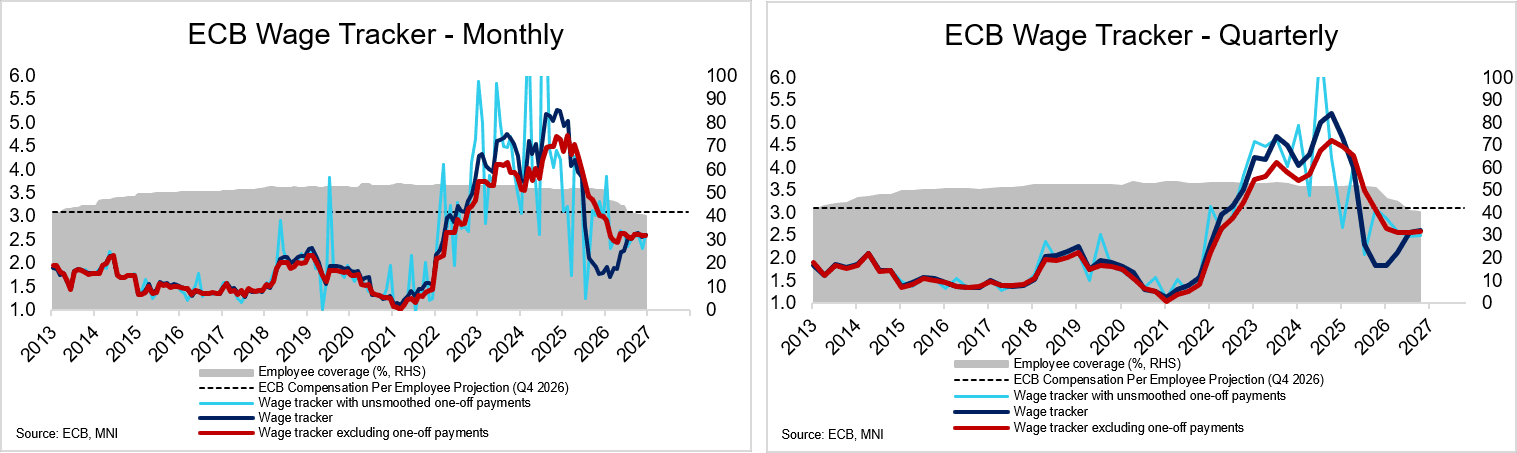
ECB: Macro Since Last Meeting - Wage Tracking: No Sign Of Second Round Effects
Stable Negotiated Wage Growth In Latest Tracker Update
- The ECB wage tracker update (link) was consistent with Lagarde's press conference comments:
- "ECB wage tracker updated with wage agreements signed up to end-May 2026; forward-looking horizon remains unchanged at end-December 2026"
- "Forward-looking information remains unrevised and indicates stable negotiated wage growth at around 2.6% by end-2026"
- "ECB wage tracker with unsmoothed one-off payments at 3.0% in 2025 and 2.6% in 2026"
3mma Indeed Wage Tracker Remains Below 2025 Average Rate
The Indeed posted jobs wage tracker was 2.76% Y/Y in June, after 2.80% in May and 2.06% in April. It pushes the 3mma Y/Y rate up to 2.54% (vs 2.31% prior). Although this metric has ticked up from recent lows, it remains below the 2025 average of 2.62%.
- Posted wages were broadly steady in Germany (2.95% Y/Y vs 2.97% prior; 22.6k observations) but accelerated from a low rate in France (1.84% Y/Y vs 1.18% prior; 58.2k observations).
- Italian wages (16k observations) were 2.55% Y/Y (Vs 2.53% prior) while Spain (just 3k observations) slipped back to 3.30% Y/Y (vs 4.65% in May, 3.14% in April).
- More forward-looking wage signals will be available next week, with the SAFE survey of small businesses due on Monday and the CTS (Corporate Telephone Survey) due Friday.
ECB: Macro Since Last Meeting - Sentiment: Services Improve From Low Base
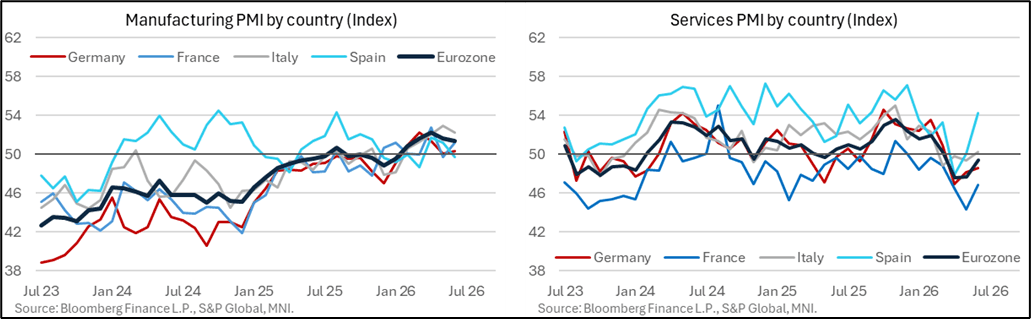
PMIs: Service activity improves in June after two particularly weak months
- An improvement in the services PMI after two particularly weak months, albeit still in contraction territory, helped lift the composite back to the breakeven 50 level after the 48.5 in May was its lowest since late 2024. It’s very much a story of a relative improvement.
- Eurozone manufacturing: 51.4 in June (cons/flash 51.3) after 51.6 in May – 4-month low
- Eurozone services: 49.4 in June (cons/flash 48.9) after 47.7 in May – 3-month high
- Eurozone composite: 50.0 in June (cons/flash 49.5) after 48.5 in May – 3-month high
- Press release (link): "At 50.0, the headline index was up from 48.5 in May and indicated a stabilisation in output, following two months of decline. The overall stabilisation in output was a consequence of growth in manufacturing being offset by a further (but slower) decline in services.”
- “Helping to lift the eurozone economy out of its downturn were sharper expansions in business activity in Italy, Spain and Ireland. While the currency bloc's two largest nations – Germany and France – remained in contraction, rates of decline eased from May. In fact, the reduction in German private sector output was only marginal.”
- “Business activity across the euro area managed to stabilise in June despite a further reduction in demand. New business volumes fell for a fourth successive month, although the contraction was marginal and the joint-slowest seen over this period (matching March).”
Consumer confidence: Improving but still bleak
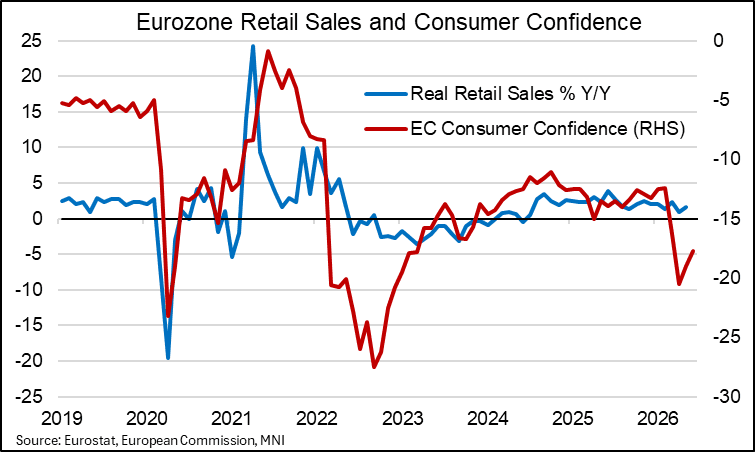
- Consumer confidence in the European Commission survey improved for a second month in June to -17.7 via a low of -20.5 in April at what had been its lowest since Dec 2022.
- It continues to see consumer confidence hold up much better than after Russia’s invasion of Ukraine in 2022 but the index is still easily below pre-Iran war levels closer to -12 or -13 and the 2000-2019 average (which we put less weight on owing to a potential structural break in the historical relationship following the pandemic).
- The relationship with consumer spending is weak, as is often the case in countries beyond the Eurozone as well, although the survey directionally hints at weak consumption with already elevated household savings rates.
- The preliminary July results will be released this Thursday at 3pm, i.e. 90 minutes after the ECB decision.
ECB: Macro Since Last Meeting - Price Expectations: Cooling/Benign
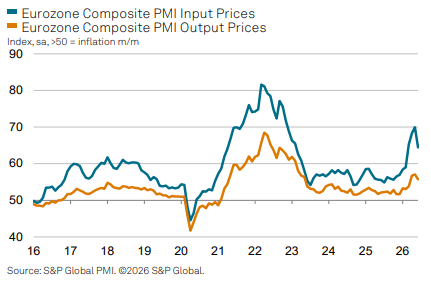
PMI Price Components Cool After Sharp Increases (Released Jul 3)
- Composite PMI June final (Jul 3): “A marked easing of inflation rates since May was a key finding from the latest PMI survey data. Although input prices rose sharply and at a pace that was above the historical trend, the rate of increase was the softest in four months. Output charges were subsequently raised by the smallest margin since March.”
- This survey was collected 11-25 June 2026.
Fairly Benign SAFE Survey Results Caveated By Survey Period (Released Jul 20)
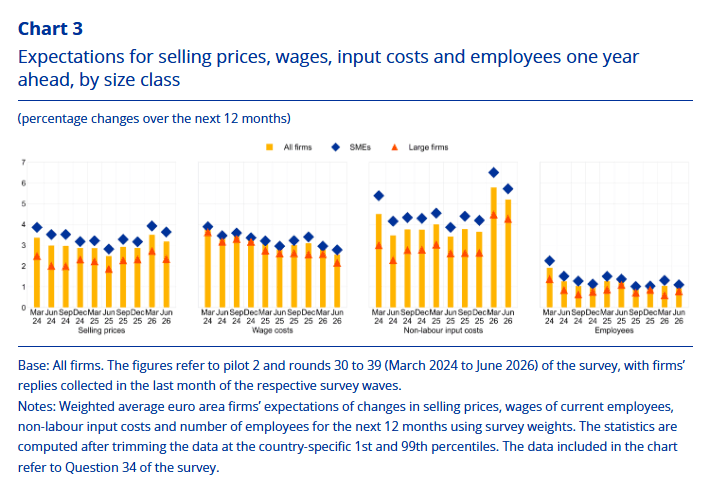
The main caveat for the Q2 SAFE survey is the survey period, which was 21 May to 26 June 2026 - so doesn't capture the latest re-escalation of tensions in the Middle East. Looking through that (large) caveat, the own price/wage expectations details look fairly benign. However, there was an uptick in 5-year ahead inflation expectations, and the share of respondents reporting upside risks to these expectations was high (65%).
- "On average, firms expected selling prices, non-labour input costs and wage expectations to rise more moderately over the next 12 months. Firms expected selling prices to increase by 3.2% (down from 3.5%), while non-labour input costs, including energy, were projected to rise by 5.2% (down from 5.8%). Wage expectations eased further and were expected to increase by 2.5%, down from 2.8% in the previous quarter"
- "Firms' inflation expectations remained broadly unchanged while the dispersion of expectations over the short term decreased. Median one-year-ahead and three-year ahead inflation expectations stood at 3.0% (unchanged), while median five-year-ahead inflation expectations increased slightly to 3.1% (from 3.0% in the previous quarter). The risk assessment for firms' five-year-ahead inflation outlook was broadly unrevised, with the share reporting upside risks prevailing at 65%.