EQUITIES: E-Mini S&P Trend Set-Up Still Bullish Despite Post-Fed Weakness
Jul-30 09:00
EuroStoxx 50 futures continue to trade in a range. The trend set-up remains bullish and the key shor...
Want to read more?
Find more articles and bullets on these widgets:
Historical bullets
FOREX: Dollar on Front Foot, USDJPY Probing Overnight Highs
Jun-30 08:55
- The US dollar index trades on the front foot Tuesday, erasing the Monday pullback and keeping the bullish theme firmly intact. While net G10 adjustments have been relatively contained, there has been obvious attention on USDJPY, which shot through 162.00 overnight to reach a new forty-year high of 162.41.
- Headlines crossed from Japanese Finance Minister Katayama, who confirmed with U.S. that 'decisive' action was an option in the FX market, although these comments have been unable to turn the tide today. Fundamental headwinds for the yen and some relative resilience in the crosses might make immediate intervention less likely, combined with the fact that action from earlier in the year did not garner the desired outcome.
- Most recent strength has seen the pair return to the overnight highs, and notably, there is 1.87bn worth of expiries rolling off at 162.50 today. Scope is seen for an extension towards 163 and 163.56, the top of a bull channel drawn from Feb 12 low.
- New BOJ member Sato noted both pros and cons of a weak currency, adding that high FX volatility isn’t desirable and that policymakers need to watch its impact on prices.
ECB VIEW: Goldman Sachs & J.P.Morgan Still Look For September Hike
Jun-30 08:45
The latest sell-side views that we have seen point towards the likelihood of a September hike from the ECB. ECB-dated OIS currently prices ~16.5bp of tightening though that juncture. (66% odds of a 25bp hike being delivered over that horizon), after President Lagarde closed the door to the Bank deploying a forceful approach.
- J.P.Morgan: Lagarde argues for the ECB’s established framework of the three tests: the inflation outlook, underlying inflation momentum and the strength of transmission. The three tests have been further enhanced with published scenarios, which can help markets understand the ECB’s reaction function to rapid changes in the size/persistence of the shock. That enables markets to quickly and correctly price in the ECB’s likely response, which buys the ECB some time to observe how the shock evolves. This allowed the central bank to wait from March until June. The decision to eventually raise rates in June was robust, i.e. consistent also with a “mild” scenario. Lagarde added that energy futures are currently in the range of the scenarios, which were all conditioned on three hikes. This suggests that, while the situation can still change from here, she currently retains a clear bias towards raising rates further at a “measured” pace. In our view, a hike in September remains very likely.
- Goldman Sachs: Lower energy prices have reduced headline inflation pressure since the June ECB meeting. But even the ECB staff’s milder scenario points to a persistent inflation overshoot, with core inflation peaking around 2.6% and staying above target through 2028. The upcoming data is likely to be key, especially on core inflation. We believe that broadly in-line data will be sufficient to convince the Governing Council to hike in September despite lower energy prices, and this remains our baseline. But the hurdle for a hold is low if the data come in weaker and our probability-weighted policy path remains below market pricing.
SONIA: 1yr Calendar Spreads outlook
Jun-30 08:39
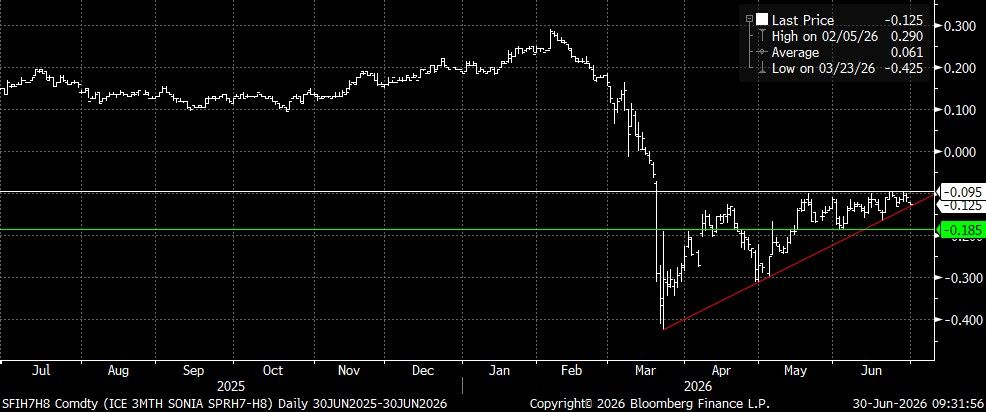
- SONIA 1y Calendar Spreads: the support trendline can pretty much be drawn on all the spreads (see chart).
- The SFIH7/H8 suggest a rising wedge (bearish signal), although the War, UK Politics and Data will dictate where Rates will be going.
- Still favour downside risk in some of those spreads (flatteners).
The spreads are trading at:
- SEP 26-SEP 27: 10.5.
- DEC 26-DEC 27: -6.
- MAR 27-MAR 28: -12.5.
- JUN 27-JUN 28: -12.5.
- SEP 27-SEP 28: -6.5.
- DEC 27-DEC 28: 0.5.
- MAR 28-MAR 29: 5.
(Chart source: MNI/Bloomberg Finance LP).