SOFR OPTIONS: Call Spread vs Call
SFRU6 96.18/96.25cs vs 96.31c x3, bought the cs for 2 in 3k....
Want to read more?
Find more articles and bullets on these widgets:
Historical bullets
UK FISCAL: /GILTS: Sell-Side Wary Of Risks After Burnham's Flexibility Comment
Initial sell-side reaction to fiscal policy under new UK PM Burnham focuses on his comments re: deploying flexibility within the existing fiscal rules framework and potential for increased defence spending under Chancellor Healey (given his resignation as Defence secretary under former PM Starmer in protest against current levels of defence spending). Risks somewhat predictably seem to lean in a gilt-negative direction, with the knee-jerk reaction to Burnham’s “flexibility” comments being bear steepening:
- Berenberg: The new Chancellor has already announced that the government will abolish VAT on energy bills, but as it was only charged at 5% this will cost little - about £1bn per annum (0.03% of GDP), half of the size of the energy bill subsidies that the previous Chancellor Rachel Reeves bought in in April. The small scale of the giveaway and Healey’s commitment to meet the existing borrowing rule with a buffer against global uncertainty should comfort bond investors. Set against this, Healey’s resignation as defence secretary because of insufficient funding suggests that he will raise military expenditure. How Healey will raise the revenue to fund a larger uplift in the defence budget remains to be seen.
- ING: Compared to peers, sterling rates remain elevated, and while that is mostly an inflation story, the political risk premium also seems to be rising. We now estimate that the risk premium for 10Y gilts is close to 20bp, which is a few basis points short of the risk premium preceding last year’s Budget. In practice, that means there still is some upside, especially if Labour wants to test the flexibility of financial markets
- Nomura: The administration has wasted no time in making announcements, but so far has said that it will stick to the fiscal rules - albeit making use of their flexibility. With Burnham having talked about his premiership being a “circuit breaker” for the UK and his plans to make bold policy decisions, this is unlikely to be achieved by tinkering at the edges. Markets will therefore be on high alert for any shifts in economic policy that could ultimately compromise the UK’s fiscal and monetary policy framework. For the time being, we believe the potential sensitivity of the gilt market to the perception, or reality, of the Treasury pursuing risky fiscal strategies will prove to be a sufficient brake on the government’s fiscal and monetary ambitions.
- Rabobank: Burnham commented that he will use ‘flexibility’ within the fiscal rules. This could hint at the possibility of putting some debt to fund infrastructure projects on the books of public financial institutions, which will still have to be absorbed by the market. In the short-term, Burnham has promised measures to ease cost-of-living pressures. He kicked this off this morning with the news that VAT on household electricity bills will be cut from October. The market is now bracing itself for a list of further announcements. This suggests that funding issues will remain at the fore of the market’s mind and hints that Burnham’s honeymoon may be short-lived.
- TD Securities: Focus shifts to whether the government can fund higher defence budget and cost-of-living measures while preserving fiscal credibility. Though Burnham has reaffirmed his commitment to the fiscal rules, he signalled a willingness to use the flexibility within them to support investment. Reference to this fiscal flexibility came with a strong bear steepening move in gilts. The key risk for markets is that the government continues to emphasise popular spending measures without providing sufficient clarity on how they will be financed. If greater details do not emerge before the Budget, concerns over fiscal credibility, combined with elevated oil prices, could push 10-year gilt yields back toward their May peak of 5.20%.
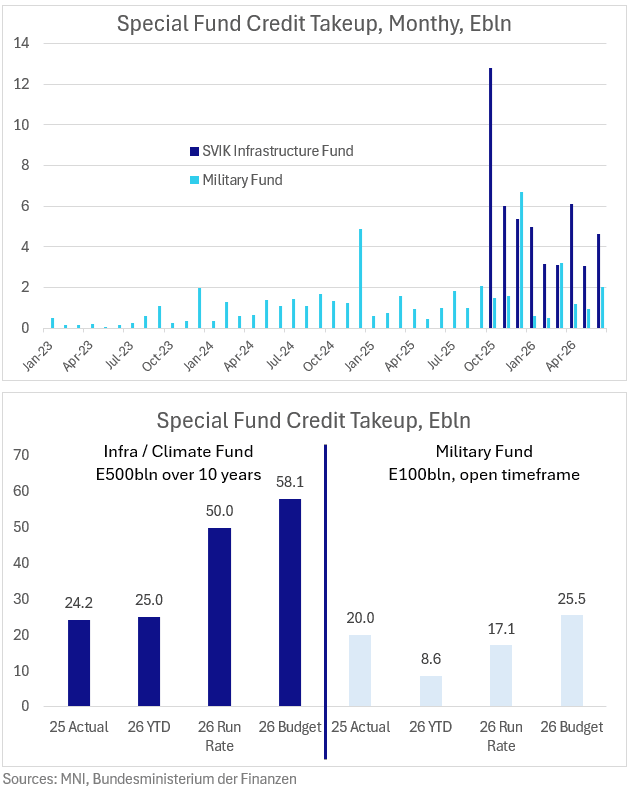
EUROPEAN FISCAL: German Special Fund Takeup Picks Up But YTD Too Slow (2/2)
Special fund takeup meanwhile has picked up a little for both infrastructure and military vehicles but YTD run rates still point towards some degree of shortfall against FY targets.
- Specifically, the SVIK (infra) fund took up E4.6bln of credit last month after May's E3.0bln, but the E25.0bln seen YTD remains below target for the E58.1bln 2026 plan.
- The military fund take-up of E2.0bln in June represents a pickup from a mere E1.0bln in May, but the YTD run rate of E 8.6bln also continues to compare rather unfavourably with the E25.5bln target for 2026 (some one-off large scale orders could tilt that later in the year). Military fund take-up amounted to E20bln in 2025.
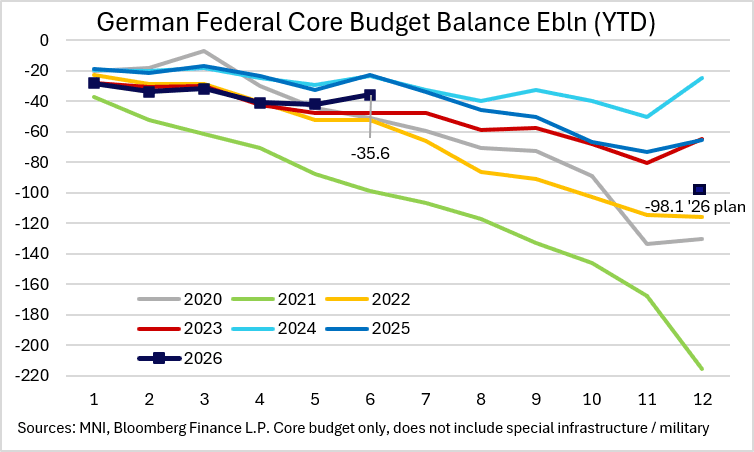
EUROPEAN FISCAL: German H1 Budget Deficit Running Below Norms Vs FY Budget (1/2)
German government fiscal data showed a core budget surplus in June, leaving a YTD budget deficit wider than in 2024 or 2025 but smaller than in previous years. It sees tracking a bit below the expected deficit pace when comparing the full year 2026 target with historical norms, which could limit fiscal impulse expectations, although predictive power is limited at this stage with deficits fluctuating throughout the year.
- In the core budget, June saw a surplus of E6.4bln (vs surpluses of E9.8bln in June 2025 and E5.4bln in June 2024) after a May deficit of just E1.0bln.
- That brings the YTD (H1) deficit to E35.6bln (36.3% of FY26 plan) vs E23.0bln in 2025. Whilst wider than in 2025, the H1 deficit is still below 2023 comparables (was E47.8bln in 1H23) when a FY deficit of just E64.9bln was reached. For context, the 2026 plan looks for a core deficit of E98bn.
- YTD federal revenues decreased 2.0% Y/Y to E207.0bln, with E44.3bln in June. The YTD decline comes on the back of lower tax revenues, driven by "EU resources" which are deducted in the calculation. Interestingly, "net wages tax revenue was up on the year by about 2% in June. This outcome is markedly lower than the growth rates posted at the start of the year and probably reflects the ongoing weakness of the labour market", the Finance Ministry adds.
- YTD expenditures rose 3.6% Y/Y to E242.5bln, with June alone seeing E37.8bln after May's E36.3bln. Key drivers of the YTD pickup continue to be a) loans to the employment agency and healthcare providers and b) consumptive spending, while (core budget) fixed asset investments are down 9.3% Y/Y YTD at E2.2bln.