EGBS: Bund Yields Little Changed Amid Uncertainty Around Iran-Oman Hormuz Deal
* 10-year Bund yields are unchanged at 3.11%. Market focus remains on developments in the Middle E...
Want to read more?
Find more articles and bullets on these widgets:
Historical bullets
BONDS: EGBs & Gilts Off Lows After Initial Supports Give Way
Late Asia/early London selling pressure in bonds came as oil firmed after fresh attacks on vessels in the Middle East and Iran once again stressed the need for U.S. compliance to the MOU before final talks can take place.
- Bears broke the 20-day EMA in Bund futures (126.25) and 2.95% in yield terms but couldn’t force a test of the June 22 low (126.01) and 3.00% before the sell off stalled.
- German yields 2-3bp higher, with the belly leading the sell off.
- EGB spreads to Bunds little changed.
- OATs not seeing much impetus as Marine Le Pen awaits the verdict of her appeal against a five-year ban from public office. If that verdict is upheld she will not be able to run in next year’s Presidential election, paving the way for Jordan Bardella to lead the French far-right in that poll.
- Spread vs. Bunds back to ~78.5bp after the recent move above 80bp as French political angst and fresh worry re: delayed fiscal tightening came to the fore in late June.
- Gilt futures traded down to 88.42, through first support at the July 2 low (88.58), exposing the June 22 base (88.30). A break through the latter would increase the threat to the bullish technical picture.
- Yields 1.5-2.5bp higher, curve bear steepens.
- Greater than usual focus on the BoE’s FSR (due for release at 10:30 London). There are expectations for some tweaks to the leverage ratio (either today or further down the line), which could divert further capital into gilts. Front end/belly ASW longs have become a favoured position amongst the sell-side as a result.
- 7-Year gilt supply passed smoothly this morning.
ECB: Panetta - Fragile Outlook With Risks To Inflation And Growth
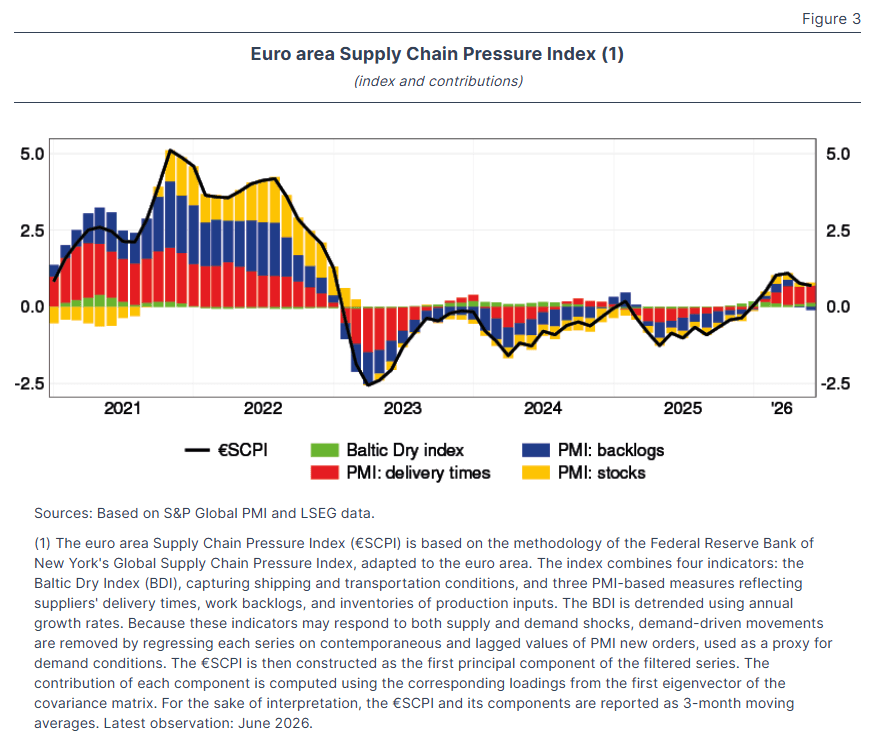
ECB’s Panetta gave a keynote speech (link) at the ESCB ChaMP conference in his first public remarks since late May. Typically one of if not the most dovish of the Governing Council, he was dovish on net - the ECB must look beyond the immediate price increases stemming from the US-Iran conflict – but also warned that while US-Iran negotiations may lead to lower energy prices than in the June baseline projections, the outlook remains fragile. The below chart highlights the far more contained supply chain pressures than in 2021-22. See the full link for a further discussion on structural forces also clouding the macroeconomic outlook.
- He warns on two “misleading” simple answers to the recent energy crisis:
- “The first is that central banks should simply 'look through' temporary supply shocks. This view underestimates the scale and possible persistence of the current shock. The hit to global energy supply has been large. Damage to production and transport infrastructure could affect prices even if the conflict subsides. The governance of the Strait of Hormuz - a critical chokepoint not only for oil and gas, but also for fertilizers, aluminium, and other industrial inputs - remains uncertain. This is reflected in incipient strains on supply chains”
- “The second misleading answer is that the current episode is a replay of the dramatic spike in energy prices of 2022, and that the ECB should therefore react forcefully, as it did then, to prevent inflation from becoming entrenched. But this is not a replay of 2022. Demand is weaker. Real interest rates are higher. The shock has affected oil prices more than gas prices; this matters because oil prices tend to generate weaker and less persistent inflationary effects than gas prices.” Citing higher capacity to import LNG and a higher share of renewables in electricity generation, these “developments have reduced - though not eliminated - the euro area's vulnerability to energy shocks.”
- “The ECB must navigate between these two extremes. It must neither dismiss the shock as temporary nor respond as if the economy were in the same position as four years ago.”
- “This dual nature makes these shocks especially difficult for monetary policy. They raise inflation through costs and lower it through demand. Their net effects depend on the relative strength and persistence of these channels. This is why central banks must look beyond the immediate price increases. They must assess whether the shock is likely to trigger second-round effects, whether expectations remain anchored, and to what extent weaker demand will contain inflationary pressures over the medium term.”
- “The ongoing negotiations between the United States and Iran may lead to lower energy prices than assumed in the June baseline projections. But the outlook remains fragile. Upside risks to inflation continue to coexist with downside risks to growth. This requires constant monitoring of geopolitical developments, energy markets, supply chains, wages and inflation expectations. It also requires that monetary policy avoid committing to a predetermined path.”
EGB OPTIONS: Bobl Put Spread seller
OEQ6 115/114.5ps, sold at 18 down to 17.5 in 7.4k.


