ASIA: ASEAN Sees Mixed But Steady Manufacturing Growth
Despite Indonesian manufacturing contracting for the first time in almost three years, the July S&P Global ASEAN PMI was relatively stable at 51.6 indicating moderate industrial growth in the region with Vietnam and Thailand outperforming. Orders growth rose but was domestically-driven as export orders fell again with shipping having an impact. The outlook improved for the seventh straight month though. However, cost inflation picked up and was passed on with output inflation rising again, which central banks will monitor closely as they contemplate easing.
- Indonesia’s manufacturing PMI fell to 49.3 from 50.7, signalling a contraction in activity driven by falling output and orders and a resultant drop in employment. The contraction in exports improved moderately but it seems the weakness is due to shipping delays. The problems in the Red Sea also impacted inputs. Cost inflation saw some improvement in July but the previous rise due to rupiah depreciation and higher commodity prices resulted in output inflation rising. Confidence in the outlook for sales and market conditions improved.
- In contrast, Thailand saw the PMI improve to 52.8 from 51.7, highest since June 2023, with positive new orders growth returning and a subsequent increase in output and employment. Orders growth was also above trend. Cost inflation fell again but selling inflation remained above the pre-Covid average. Producers remain optimistic.
- The Philippines was another country driving regional output growth with the PMI steady at 51.2 as domestic demand improved, but slowed from overseas, and employment grew. Even though input inflation rose to a 5-month high, selling prices grew at a slower rate. The Philippines also reported shipping problems due to port congestion. Output is cautiously expected to improve over the year ahead.
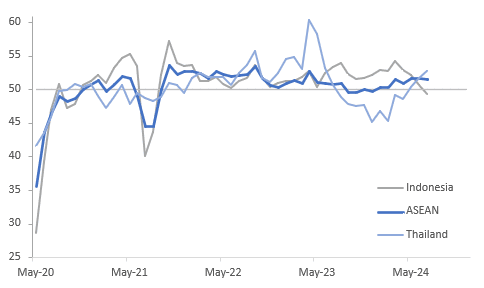
Source: MNI - Market News/Bloomberg
Want to read more?
Find more articles and bullets on these widgets:
Historical bullets
CHINA PRESS: Low Land Sale Revenue Could Need More Debt Issuance
Authorities issuing additional local government special refinancing bonds for resolving hidden debts in H2 cannot be ruled out, given the 14% y/y decline in land revenue from January to May, according to Wang Qing, chief macro analyst at Golden Credit Rating. Wang noted that broad fiscal expenditure, which combines general public and government fund budget expenditure, fell by 2.2% year-on-year during January to May, which was not conducive to the counter-cyclical role of current fiscal policy. (Source: 21st Century Business Herald)
CHINA PRESS: PBOC May Sell Treasuries To Curb Falling Bond Yields
The People’s Bank of China may start selling treasury bonds after deciding to borrow from selected primary dealers, in a bid to increase bond supply and curb falling yields of medium- and long-term bonds, Shanghai Securities News reported citing analysts. The central bank has repeatedly warned of maturity mismatch and interest rate risk from holding large amounts of longer-term bonds, the newspaper said. The PBOC’s holdings of government bonds are mostly three years or less, and treasury borrowing operations may pave the way for bond sales, said Zhou Guannan, chief fixed income analyst of Huachuang Securities.
BONDS: NZGBS: Short-End Moves Away From Session Cheaps After Business Opinion Survey
After initially being pressured by US tsys’ overnight bear-steepening, NZGBs have moved away from the session’s worst levels, led by the short end. Currently, NZGB benchmark yields are flat to 5bps higher compared to 7bps higher earlier in the session.
- The swaps curve has shifted from a bear-steepening to a twist-steepening, with rates 1bp lower to 4bps higher.
- RBNZ dated OIS pricing is flat to 3bps softer, with 2025 meetings leading. A cumulative 33bps of easing is priced by year-end.
- Earlier, the NZIER Business Opinion Survey for Q2 showed a net 44% of businesses expect the economy to get worse, from 25% with that view in Q1. A net 28% of businesses reported a decline in their own trading activity in Q2, with a net 10% of businesses expecting their own activity to worsen in Q3. A net 23% of firms raised prices in Q2, vs 35% in Q1.


