GLOBAL: "*ANTHROPIC EXPECTED TO RECEIVE A “HIGH” JUNK RATING: FT" bbg
"*ANTHROPIC EXPECTED TO RECEIVE A "HIGH" JUNK RATING: FT" bbg...
Want to read more?
Find more articles and bullets on these widgets:
Historical bullets
US PREVIEW: ISM Manufacturing Should See Firmer Activity, Accelerating Prices
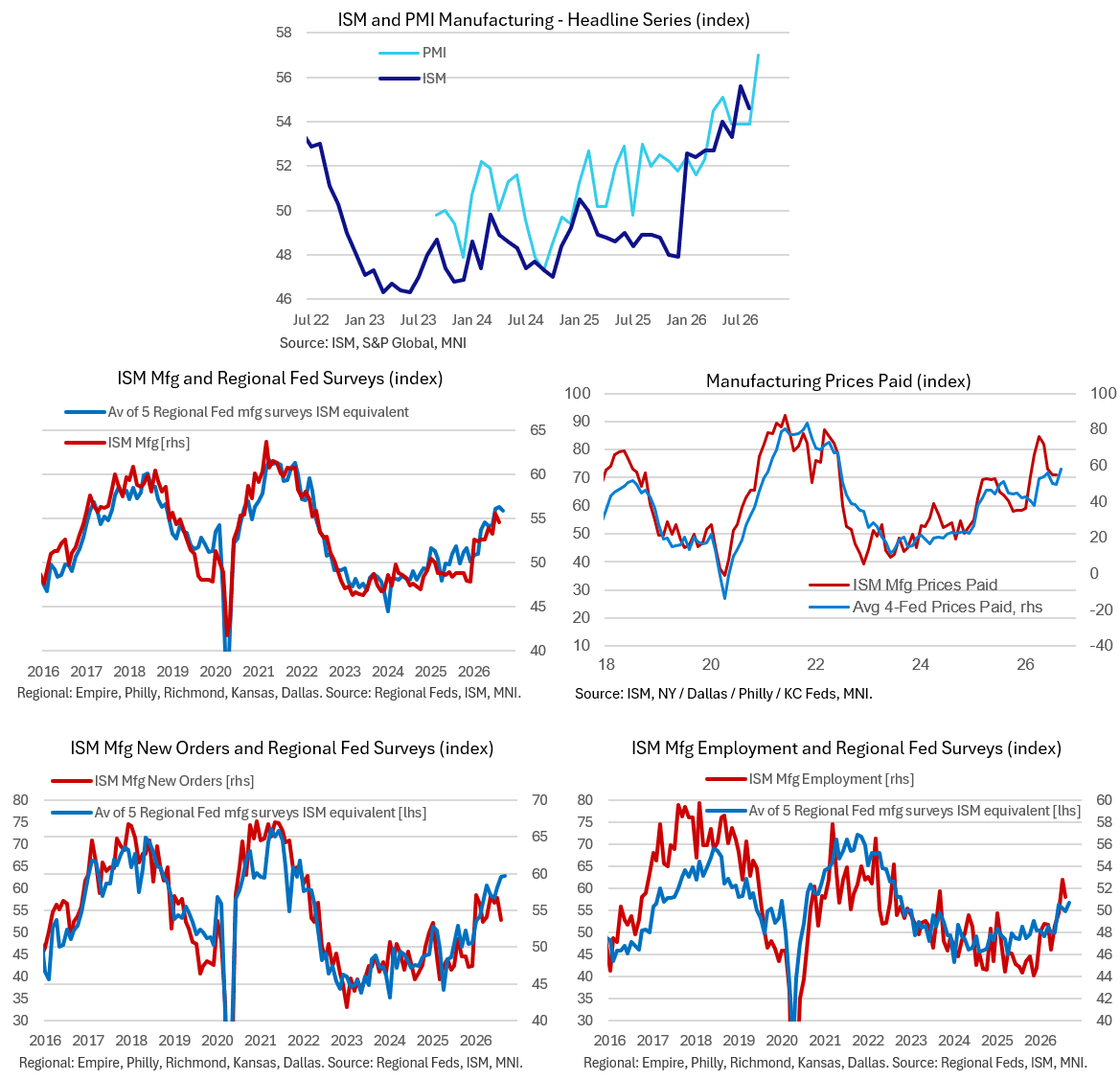
September's ISM Manufacturing report (10am ET Thursday) should show a 9th consecutive month in firmly expansionary territory, with median Bloomberg consensus for a rise to 54.9 from 54.6 prior. Employment is seen rising to 52.2 from 51.2, while consensus sees a more modest uptick in New Orders, to 54.2 from 53.7 (each of the expected figures would mark 2-month highs). We would expect the Prices Paid gauge - seen edging up to 72.5 from 71.1, which would be the highest since hitting the low 80s in April-May amid the initial energy spike - to be of particular importance this month given soaring input price readings in the month's regional Fed manufacturing surveys.
- The bar has been set very high by September's S&P Global flash PMI report which showed a 57.0 (53.7 expected, 53.9 prior) Manufacturing reading - a 59-month high.
- The report noted all 5 components boosted the PMI: "Production growth revived after having waned over the prior three months, reaching its fastest since April 2022, as new orders growth also accelerated to the fastest in nearly four-and-a-half years. Jobs growth hit the highest since February 2021, and inventories rose at an increased rate. Suppliers’ delivery times meanwhile lengthened to the greatest degree since July 2022." On prices, however, "input cost inflation ... nonetheless remained below the peaks seen earlier in the year".
- While regional Fed surveys largely corroborated the portrayal of September manufacturing activity, they were notably more hawkish on price pressures than the S&P PMI.
- The ISM Manufacturing PMI-equivalent indices averaged 55.9 across 5 regional Fed manufacturing surveys, a slight moderation from August's 56.3 with accelerations in 3 of 5 (Philadelphia, Kansas City, Dallas) weighed down by a large pullback in Richmond and a downtick in New York.
- We should note that the improvement was largely driven by soaring readings in Dallas and Kansas City, so may not be translated nationally (the regional Feds for example don't include a West Coast barometer).
- The activity details looked somewhat better than the headline though with Employment averaging 56.7 (47-month high) and New Orders 62.8 (57-month high). The ADP private payrolls report appeared to corroborate the Employment story, with manufacturing payrolls rising by a 48-month best 17k. Given the combination of the above, there's a decent chance ISM Employment rises more than is currently expected.
- Regional Feds' Prices Paid indices soared to a 51-month high in August, and we also note that Prices Received accelerated across the board (based on 4 Fed surveys).
- The Chicago Business Barometer, produced with MNI, rose 11.7 points to 58.8 in September for the highest since May with New Orders jumping, but Employment and Prices Paid (while still extremely elevated) softened vs August in contrast with other indicators mentioned above. Based on the national ISM weights it rose 6.7 points to 55.1.
FOREX: GBPAUD Surges Following Diverging Domestic Data
- Initial price action on Wednesday saw the USD pullback from its most recent extremes as market participants awaited both US PCE data and month/quarter end. This coincided with a number of major pairs approaching or reaching the 2026 extremes, providing a good spot for the dollar rally to pause for breath.
- Sure enough, the US PCE data were softer-than-expected and this appeared to play into the softer dollar narrative in the immediate aftermath of the release. However, sharp moves higher for long end US yields and other cross asset reversals such as gold moving significantly south provided some broader support for the USD index, which has actually edged back into positive territory as we approach the APAC crossover. This leaves the DXY within 40 pips off the 2026 high at 101.80.
- Across the G10, the focus has been on domestic data, with AUD underperforming following soft August CPI figures and stronger-than-expected UK Q2 GDP revisions relatively boosting the pound.
- For AUDUSD, most recent weakness has seen spot test below 0.6953, the 76.4% retracement point of the Jun 30 - Sep 9 bull leg. Clearance of this level would suggest potential for an extension towards 0.6865, the Jun 30 low and an important medium-term support. The diverging data has prompted a notable 0.77% boost for GBPAUD, rising to a one-month high on the approach to 1.91.
- Ongoing volatility for USDJPY continues to play out. New weekly lows of 156.38 were put in overnight with some analysts citing pressure into the Japanese fix. Subsequent yield dynamics have supported a strong recovery to 157.30 approaching the close.
- Japan Tankan survey data, Swiss CPI and US ISM Manufacturing PMI are data highlights on Thursday, with attention turning swiftly to Friday’s US employment data.
SWITZERLAND DATA: CPI Preview- Focus On Any Broadening Of Inflationary Pressures
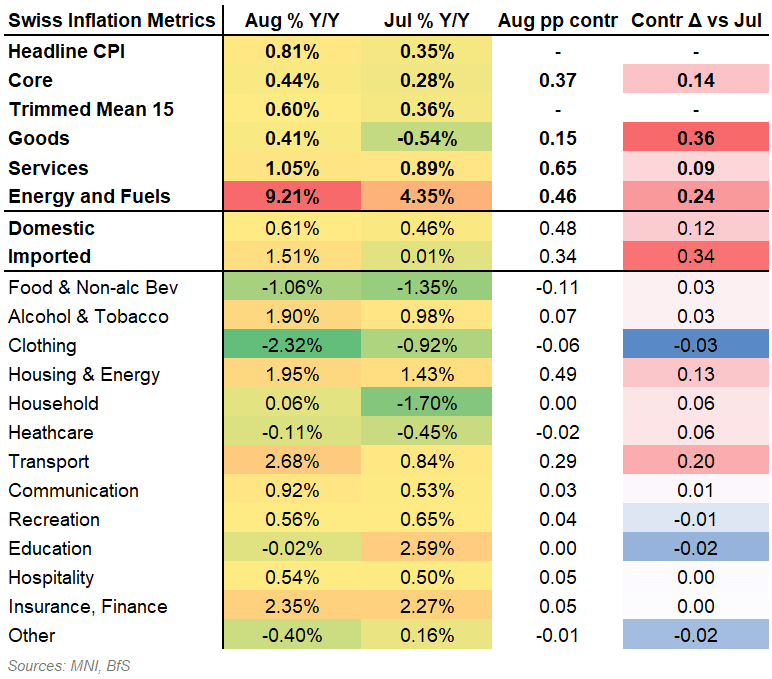
Swiss September CPI, scheduled for release tomorrow 07:30 BST / 08:30 CEST, is expected to accelerate to 1.0% Y/Y from 0.81% in August. This would represent its highest rate since August 2024.
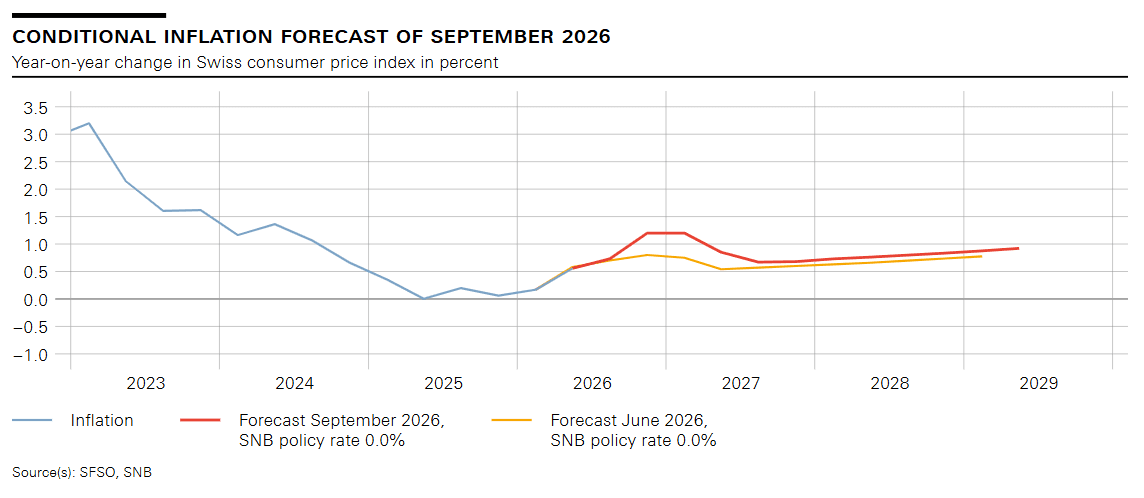
- A consensus print would bring average Q3 inflation in line with last week's SNB forecast for the quarter at roughly 0.7% (which had notably been unrevised since June).
- Recall that last week's SNB meeting saw Schlegel highlighting the inflation forecast sitting comfortably within the range of price stability throughout the entire projection horizon. This points away from near-term tightening, though Schlegel kept his options open for future meetings and does acknowledge inflation has been running higher recently.
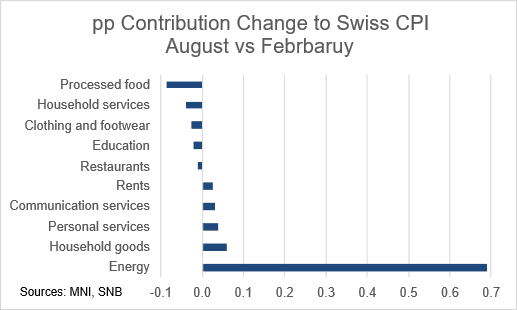
- The key focus for tomorrow's print will lie on if inflationary pressures spread through the wider economy. This comes as headline Y/Y upside since February (pre US-Iran war) has been driven entirely by energy prices, as also highlighted in SNB commentary (see chart below).
- Bloomberg consensus for tomorrow's print is slightly skewed to the upside, with a 1.04% average estimate (3 analysts looking for a 0.9% print, 7 for 1.0%, 4 for 1.1% and 1 analyst each for 1.2% and 1.3%).
- Goldman Sachs are looking for a consensus 1.0% Y/Y print, "as core inflation should move broadly sideways, while oil products should contribute almost 0.7pp to year-over-year headline inflation vs. 0.5pp in August".